
By Nauman Zafar | Party Wall Consultant | Survey of Party Wall · Last Updated: May 2026
Content reviewed against Pyramus and Thisbe Club professional standards and Pyramus & Thisbe Club best practice guidelines.
TL;DR — Hip to Gable Party Wall in 60 Seconds
A hip-to-gable loft conversion on a semi-detached property in London always triggers the Party Wall etc. Act 1996. The new gable wall is built on or at the party wall line — Section 1. The conversion raises the party wall height — Section 2. Steel beams bearing into the party wall for the new floor structure — Section 2 again. Serve a Party Structure Notice two months before your builder’s start date. Your neighbour has 14 days to respond. Silence is deemed dissent. An award governs the works before the first tile comes off.
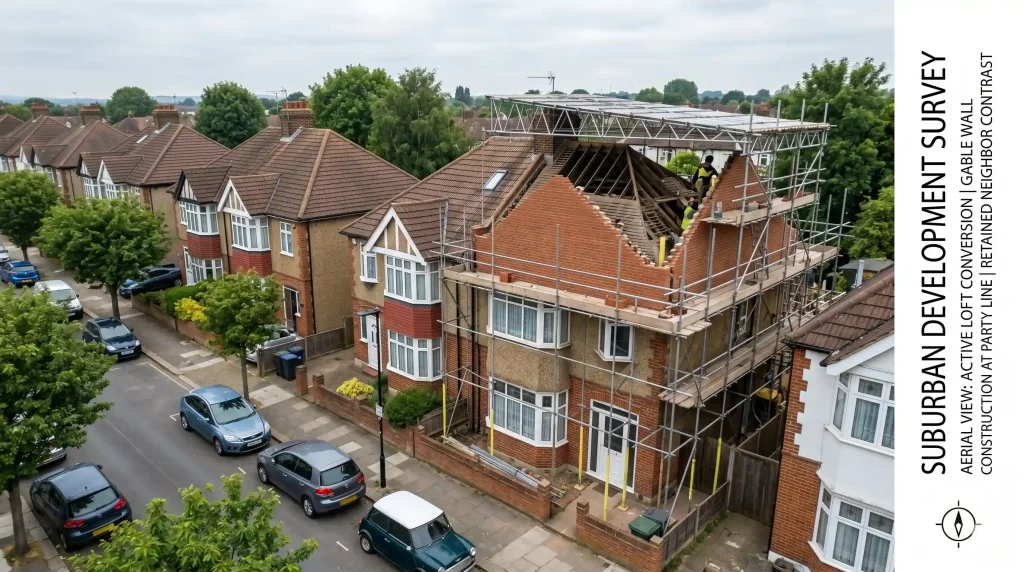 Hip to Gable Party Wall Guide: Why This Conversion Always Triggers the Act and How to Handle It Without Derailing Your Project
Planning a hip-to-gable conversion? Tell us your postcode and your builder’s start date. We will confirm exactly which notices apply and whether your timeline is achievable. Free, one business day.
A hip-to-gable conversion is the most popular loft conversion type for semi-detached properties in London. It replaces the sloping hip end of the roof with a vertical gable wall, creating a full-height end wall that dramatically increases usable loft space. Properties built between 1900 and 1960 — the interwar semis that dominate Outer London from Wembley to Wimbledon — are ideal candidates because their generous roof spaces and relatively simple roof structures make the conversion straightforward from a structural perspective.
What is not straightforward is the party wall position. A hip-to-gable conversion on a semi-detached house is one of the few residential projects that triggers the Party Wall Act on every single instruction. Not most. Every one. Here is why, and here is how to handle it.
Why Hip to Gable Always Triggers the Party Wall Act
Three simultaneous triggers fire on every semi-detached hip-to-gable conversion. Each requires a separate notice. All three run in parallel under Section 2’s two-month notice period, which governs the earliest start date.
| Trigger | Section | Why it fires | Notice period |
|---|---|---|---|
| New gable end wall built at party wall line | Section 1 | New wall at or on the boundary where previously only a hip slope existed | 1 month |
| Raising the party wall height | Section 2 | Party wall is extended vertically to support the new gable structure | 2 months |
| Steel beams into party wall for new floor | Section 2 | Loft floor structure requires steel beams bearing into or onto the party wall | 2 months |
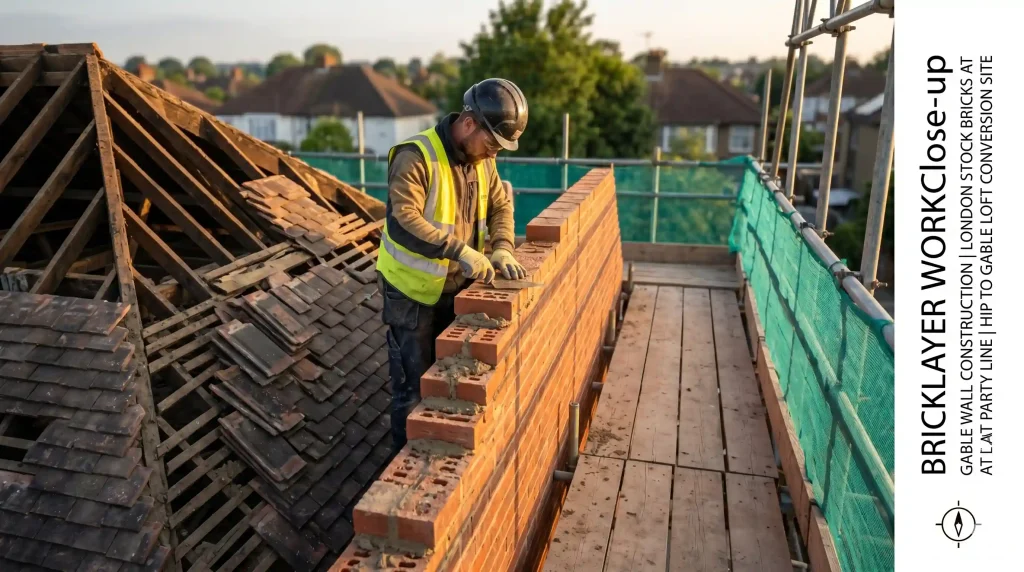
The 1930s Semi — Why London’s Most Common Property Type Is the Most Common Party Wall Instruction
London’s interwar semi-detached properties — built primarily between 1920 and 1939 across the suburbs that grew around the newly extended Underground lines — share a distinctive roof structure. The main roof ridge runs front to back. The hip end faces the shared boundary with the neighbour, sloping down at roughly 40 to 45 degrees toward the top of the party wall. The party wall itself typically ends at or just above ceiling level.
When a hip-to-gable conversion removes that sloping hip and replaces it with a vertical gable, two things happen simultaneously at the party wall. The party wall must be extended upward to carry the new gable structure — that is a Section 2 raising. The new gable wall is built right up to the party wall line on one side — that is a Section 1 junction wall. Both notices fire from the moment the conversion is designed. There is no version of a hip-to-gable on a semi-detached London property that avoids both.
What the Party Wall Award Covers for a Hip to Gable
The award for a hip-to-gable is typically more detailed than a standard rear extension because the works affect the party wall at height — a location that is harder to monitor, more exposed to weather, and more technically sensitive to get right. Expect the award to cover these elements.
Temporary weatherproofing obligations — stripping the hip slope and raising the party wall creates a period where the adjoining owner’s property is exposed to weather through the shared roof junction. The award sets out the sequence and the temporary protection required. Party wall raising method — the award specifies how the party wall is extended: block by block, with what materials, to what standard, and how the new wall ties into the existing structure. Steel installation sequence — beam pockets cut into the party wall and padstones must be installed in a specified sequence with adequate curing time between adjacent bays. Schedule of condition — particularly important for the neighbour’s top floor ceiling and any decorative plasterwork below the party wall that may be sensitive to vibration.
Case Law Relevant to Hip to Gable Conversions
Jones v Ruth [2011] EWHC (TCC)
Established that ownership of a raised party wall section sits with the owner who raised it, unless the award provides otherwise. For a hip-to-gable where the party wall is raised by the building owner, the new upper section belongs to the building owner. The adjoining owner cannot later attach their own structure to it without consent. This matters for future conversions by the neighbour — they cannot assume the raised wall is shared unless the award explicitly grants shared ownership.
Nutt v Podger and Veda Road Ltd [2021]
Verbal agreements between neighbours to proceed without formal notices are unenforceable. A friendly conversation with the semi-detached neighbour agreeing to “let you get on with it” has no legal effect. If the works trigger the Act and no valid notice is served, Power and Kyson v Shah strips both sides of the Act’s protection.
Power and Kyson v Shah [2023] EWCA Civ 239
No notice means no Act. For a hip-to-gable, where the works raise the shared party wall and affect the shared roof structure, proceeding without notice leaves the adjoining owner exposed and gives them a common law claim for any damage to their top floor or roof junction.
Costs for a Hip to Gable Party Wall Process
| Cost component | London 2026 range |
|---|---|
| Notice drafting (Section 1 + Section 2) | £300 to £550 |
| Schedule of condition (top floor and loft) | £400 to £750 |
| Award — agreed surveyor | £900 to £1,600 |
| Award — two surveyors | £1,800 to £3,200 |
| Total — neighbour consents | £700 to £1,300 |
| Total — neighbour dissents | £2,100 to £4,000 |

Key Takeaways
- Hip-to-gable conversions on semi-detached London properties always trigger the Party Wall Act under Section 1 (new gable at boundary) and Section 2 (raising party wall, installing steels). Every single instruction.
- Serve the Party Structure Notice two months before the builder’s start date. Do not book the builder until the notice period has run and an award is in hand.
- Jones v Ruth confirms that the raised party wall section belongs to the building owner. The neighbour cannot later attach their own structure to it without consent.
- Verbal agreements with neighbours have no legal effect — Nutt v Podger makes this clear. Written notice and written consent or a formal award are the only valid routes.
Hip-to-gable project anywhere in London? Send us your postcode and the architect’s drawings. We draft both notices, manage the 14-day response window, and produce the award before your roof comes off. Same-day visits across all 33 boroughs.
By Nauman Zafar | Party Wall Consultant | Survey of Party Wall · Last Updated: May 2026
Content reviewed against Pyramus and Thisbe Club professional standards and Pyramus & Thisbe Club best practice guidelines.
TL;DR — Semi-Detached Party Wall in 60 Seconds
Semi-detached properties in London share one central party wall with one neighbour. Any structural work affecting that shared wall — cutting in steel beams, raising the wall height, underpinning, removing the chimney breast — triggers Section 2 of the Party Wall etc. Act 1996. Any excavation within 3 metres of the shared boundary and deeper than the neighbour’s foundations triggers Section 6. Hip-to-gable conversions trigger both Section 1 and Section 2 simultaneously. Unlike terraced houses with two party wall neighbours, semi-detached owners have one notice relationship to manage — but that one relationship is structurally more sensitive because there is only one shared wall carrying both houses’ structural loads.
Party Wall Requirements for Semi-Detached Properties: The One Wall That Matters and What Happens When You Work on It
Planning a loft conversion, extension, or structural work on a semi-detached property? Tell us your postcode and project type. We will confirm which sections apply and what your notice timeline looks like. Free, one business day.
Semi-detached properties are structurally different from terraced houses in one critical way. A terrace has neighbours on both sides, which means the structural loads are balanced and each party wall carries only the loads from its own pair of houses. A semi-detached property has one shared wall — and that wall is the sole structural interface between two houses that are otherwise freestanding. Every load change on one side of that wall is felt on the other side.
That structural sensitivity is why the Party Wall Act matters more, not less, for semi-detached properties. The single shared wall is load-bearing in ways that are not always obvious from the plans. And the one neighbour affected by your project has no buffer — everything you do to the shared wall affects their home directly.
The Key Structural Difference Between Semi-Detached and Terraced
| Factor | Terraced house | Semi-detached |
|---|---|---|
| Number of party walls | Two (left and right neighbour) | One (shared side only) |
| Party wall load distribution | Shared across multiple properties — balanced | Carried entirely between two houses — concentrated |
| Roof structure | Usually separate roofs meeting at party wall | Often shared roof structure, especially 1930s builds |
| Chimney stack | Shared chimney stacks — clearly party wall | Chimney stack may be entirely on one side or shared |
| Side flank wall | Not applicable — no exposed flank | Free-standing flank wall — not a party wall but relevant to extension notices |
The Most Common Party Wall Projects on Semi-Detached Properties
Hip-to-gable loft conversion
The single most common party wall instruction for semi-detached properties. Section 1 fires for the new gable wall at the party wall line. Section 2 fires for raising the party wall and installing the new floor steels. Both notices must be served. The Section 2 two-month notice period governs the earliest build start. For the full hip-to-gable guide, see the dedicated article on this site.
Rear extension
Section 6 applies if foundations are within 3 metres and deeper than the neighbour’s footings. Section 2 applies if the extension ties into or attaches to the existing party wall at any point. Most rear extensions on semi-detached London properties trigger Section 6 because interwar foundation depths of 750 to 1,000 millimetres are shallower than modern Building Regulations requirements.
Side extension or wrap-around
A side extension on a semi-detached property on the non-party-wall side is unlikely to trigger the Act unless the foundations are within 3 metres of the rear neighbour’s building. On the party wall side, a side extension almost always triggers Section 1 (new wall at boundary) and Section 6 (foundation excavation close to neighbour’s footings). The wrap-around extension — rear plus side — combines all three sections.
Removing a chimney breast
If the chimney breast is attached to or bonded into the party wall — which it almost always is in 1930s semi-detached properties — removal triggers Section 2. The structural dependency of the chimney stack on the party wall must be assessed before any demolition begins. A chimney breast removed without notice that causes the shared stack to become unstable creates immediate Section 7(2) liability for the building owner.
Interwar Semi-Detached London — The Foundation Depth Problem
London’s interwar semi-detached stock — the 1920s and 1930s suburbs from Wembley to Wimbledon, from Ilford to Isleworth — was built on strip foundations typically between 750 and 1,000 millimetres deep. Modern Building Regulations require new foundations for extensions of at least 1,000 millimetres, and frequently 1,200 to 1,500 millimetres on London Clay sites with mature trees nearby.
The arithmetic is the same as for terraced properties. Your new extension foundation will almost always go deeper than your neighbour’s interwar footing. If you are within 3 metres of their building, Section 6(1) fires. And interwar semis in London sit close to their boundaries, so the 3-metre zone is almost always engaged by a standard rear or side extension.
Case Law Relevant to Semi-Detached Party Wall Matters
Jones v Ruth [2011] EWHC (TCC)
For hip-to-gable conversions, the ownership of the raised party wall section sits with the building owner who raised it. The neighbour cannot attach their future hip-to-gable conversion to your raised wall without consent. This is frequently relevant in semi-detached streets where one conversion triggers a neighbouring conversion five years later.
Ormiston-Kilsby v Fattahi [2019]
Extension built without party wall notices — mandatory injunction for partial demolition. For semi-detached properties where the shared wall is the primary structural interface, building without notice and causing damage creates the same demolition risk as for terraced houses. The single party wall relationship amplifies the consequence of getting it wrong.
Onigbanjo v Pearson [2008] BLR 507
Consent given by the adjoining owner at the start of the process does not waive their right to invoke surveyor jurisdiction if a specific dispute arises during works. For a semi-detached neighbour who watches their top floor ceiling crack during the loft conversion steelwork, consent given at the notice stage does not prevent them from seeking a supplemental award on the damage.
Costs for Semi-Detached Party Wall Process — London 2026
| Project | Sections triggered | Total cost range — one neighbour |
|---|---|---|
| Hip-to-gable loft (consent) | 1 + 2 | £700 to £1,300 |
| Hip-to-gable loft (dissent) | 1 + 2 | £2,100 to £4,000 |
| Rear extension (consent) | 6 (and possibly 2) | £800 to £1,400 |
| Rear extension (dissent) | 6 (and possibly 2) | £2,200 to £3,800 |
| Wrap-around extension (dissent) | 1 + 2 + 6 | £3,000 to £5,500 |
Key Takeaways
- Semi-detached properties have one shared party wall — structurally more sensitive than a terrace because there is no load distribution across multiple properties.
- Hip-to-gable conversions always trigger Section 1 and Section 2. Rear extensions almost always trigger Section 6. Side extensions trigger Section 1 and Section 6.
- Interwar semi-detached foundations sit at 750 to 1,000 millimetres. Modern Building Regulations require 1,000 to 1,500 millimetres. Section 6 fires on almost every extension project.
- Jones v Ruth confirms ownership of the raised party wall section. The neighbour cannot attach their future conversion to your raised wall without consent.
- Verbal consent has no legal effect — Nutt v Podger is clear. Written notice and written consent or a formal award are the only valid routes.
Semi-detached project anywhere in London? Send us your postcode and what you are building. We draft the correct notices, manage the timeline, and produce the award. Same-day visits across all 33 boroughs.
Survey of Party Wall : party wall consultancy covering all London boroughs. Semi-detached specialist. Section 1, 2 and 6 notices served same week. Same-day visits. Zero paperwork risk.