🧮 Free Tool · Party Wall etc. Act 1996

Party Wall Cost Calculator:
Estimate Your London Fees

Your builder told you to sort the party wall before work starts, and the quotes are all over the place. Use this free calculator to predict your surveyor cost in seconds, based on your project, borough, and neighbours. No email. No sign-up. Just the numbers.

✓ Free, no sign-up ✓ 2026 London pricing ✓ All 33 boroughs ✓ Full cost breakdown

Here is the thing. Party wall surveyor costs in London are not random. They follow a pattern set by four factors: the type of work you are doing, the borough you are in, how many neighbours you affect, and whether your neighbour agrees or dissents.

Get those four right and you can predict your cost before you call anyone. The calculator below does exactly that, then shows you a full breakdown of where every pound goes and how the consent route compares to the dispute route.

Cost Calculator

Estimate your party wall cost

Pick your project, borough, neighbours, and property type for a real 2026 London cost range.

Estimated total cost
The building owner pays the surveyor fees in most cases
Where your money goes
Consent route vs dispute route
✓ Consent route
Neighbour agrees in writing. No award needed. Schedule of condition still recommended.
⚠ Dispute route
Neighbour dissents or stays silent. Surveyors appointed, award drafted.
Want an exact quote for your project?
This is an estimate. Send us your postcode and project details and we will confirm an exact fixed fee within one business day, free, no obligation.
All 33 London boroughs covered · Fixed-fee quotes · Response within 1 business day

This calculator gives indicative 2026 London pricing for guidance only. It is not a quote. Final fees depend on project complexity, neighbour response, and site specifics.

How Party Wall Costs Are Calculated in London

A party wall surveyor fee is not a single flat charge. It is the sum of the work needed to take your project from a served notice through to a signed party wall award. Under the Party Wall etc. Act 1996, the building owner, meaning the person doing the works, pays the surveyor fees in most cases, including the adjoining owner's surveyor where one is appointed.

The four levers that move your cost are simple. Project type sets the baseline: a chimney breast removal sits at the bottom, a basement excavation sits at the top because it triggers Section 6 of the Act and almost always needs a detailed schedule of condition plus monitoring. Borough sets the multiplier: rates in prime central London run materially higher than outer boroughs like Havering or Bexley. Number of neighbours multiplies the work, because each adjoining owner is served separately and can appoint their own surveyor. Consent or dispute decides the route, and that is the biggest swing of all.

What You Are Actually Paying For

When you see a party wall fee, it covers five distinct phases of work. The calculator above splits your estimate across these so you can see where every pound goes.

Notice preparation and serving covers drafting the correct notice for your project, whether a Section 2 party wall notice, a Section 1 line of junction notice, or a Section 6 excavation notice, and serving it correctly on every adjoining owner. The schedule of condition is a full photographic and written record of the neighbour's property before works begin, and it is your protection if any damage claim arises. Party wall award drafting produces the legally binding document setting out how works will run, permitted hours, access rights, and how damage will be assessed, and it is the heaviest single phase. Works monitoring covers site visits during construction where the job warrants it. Final inspection and sign-off closes the process.

Consent Route vs Dispute Route: The Cost That Surprises People

This is the single biggest swing in your bill, and most cost guides skip it.

If your neighbour consents in writing to your notice, a party wall award is often not required. You still want a schedule of condition to protect yourself, but you avoid the heaviest phase. That is the cheaper path. If your neighbour dissents, or simply does not respond within 14 days, a dispute is deemed to have arisen under the Act. Surveyors are then appointed, an award is drafted, and your cost moves to the upper end of the range, often including the adjoining owner's surveyor fee.

The lesson is practical. A friendly conversation with your neighbour before the notice lands can move you from the dispute route to the consent route and save you a meaningful sum. That is the cheapest cost-control move available to any building owner.

Agreed Surveyor vs Two Surveyors

There are two ways the surveyor side can be structured, and they cost differently. An agreed surveyor is a single impartial surveyor who acts for both you and your neighbour: one professional, one fee, one award. This is the lower-cost structure and it works well where the relationship is cooperative.

Two surveyors means you appoint yours and your neighbour appoints theirs. The two agree the award between them and appoint a third surveyor to settle any disagreement under Section 10 of the Act. This is the higher-cost structure because you typically pay for both. It exists to protect the adjoining owner where trust is low. Neither is better in the abstract; the right structure depends on the relationship and the complexity of the works.

Why London Costs More Than the Rest of the UK

The Party Wall etc. Act 1996 applies identically across England and Wales, and the Act does not set fees. What drives London's premium is the market around it: higher property values raising the stakes on every job, denser terraced and semi-detached housing meaning more shared walls, and concentrated demand in a city where extensions and loft conversions run year-round. Outer London boroughs sit below prime central rates, which is exactly why the calculator bands your borough rather than quoting one flat London figure.

When You Might Not Need a Surveyor at All

Honesty builds trust, so here it is plainly. If your neighbour consents in writing to your works, you are not legally required to appoint a surveyor to draft an award before you proceed. Many straightforward jobs with cooperative neighbours run on consent alone.

Even then, a schedule of condition is worth having. It is the cheap insurance that settles the "your works cracked my wall" argument before it starts. For basement and excavation work under Section 6, that record is not optional in practice. It is the difference between a quick resolution and a long dispute. Not sure which notice your project needs? Use our party wall notice checker first.

Party Wall Cost: Frequently Asked Questions

For a straightforward residential project affecting one neighbour, expect roughly £850 to £1,600 in outer London, rising in inner and prime central boroughs. Basement projects and jobs affecting multiple neighbours run higher. The calculator above gives you a banded estimate based on your specific project, borough, and number of neighbours.
The building owner, meaning the person carrying out the works, pays the surveyor fees in most cases. This usually includes the adjoining owner's surveyor fee where your neighbour appoints their own under the two-surveyor route.
Yes. A party wall agreement and a party wall award are the same legally binding document. The cost you see quoted for an agreement is the cost of preparing and serving notices, producing a schedule of condition, and drafting the award.
Three moves work. Speak to your neighbour informally before the notice lands to push toward the consent route. Use an agreed surveyor where the relationship is cooperative. And get your plans finalised before serving notice, because changing the design mid-process means redoing work and rebilling.
Each adjoining owner must be served a separate notice, and each can appoint their own surveyor, require their own schedule of condition, and be covered by their own award. A two-neighbour basement job carries far more work than a single-neighbour chimney removal.
No. It gives an indicative 2026 London range for budgeting. Your exact fixed fee depends on site specifics and your neighbour's response. Send your postcode and project details through the WhatsApp button on your result for an exact quote within one business day.
🗺️ Free Notice Roadmap

Get your exact party wall quote for your project.

Tell us your postcode and what you are building. We will send you a fixed-fee quote within one business day, free, no obligation.

Get My Exact Quote on WhatsApp

All 33 London boroughs · Fixed-fee quotes · Response within 1 business day

By Nauman Zafar | Party Wall Consultant | Survey of Party Wall · Last Updated: May 2026
Content reviewed against Pyramus & Thisbe Club best practice guidelines. This page is for general guidance only and does not constitute legal or surveying advice.

Basement Extension Party Wall Requirements London | Notice + Award
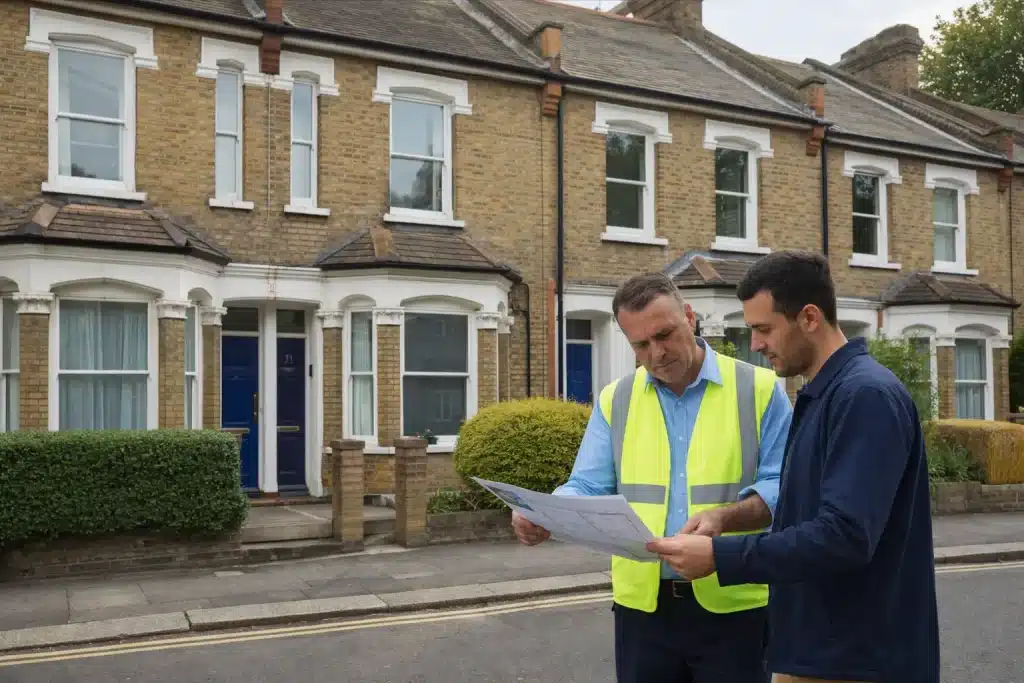
Party wall requirements in London for shared walls, boundary works and excavations

Basement Extension Party Wall Requirements London Quick answers (London):• You need a notice if you: cut into a shared wall, build at the boundary, or dig near a neighbour’s foundations.• Notice periods are usually 1–2 months, depending on the type of work.• If your neighbour dissents, surveyors agree a party wall award before work starts. […]

Party Wall Process Step-by-Step: From Notice to Award
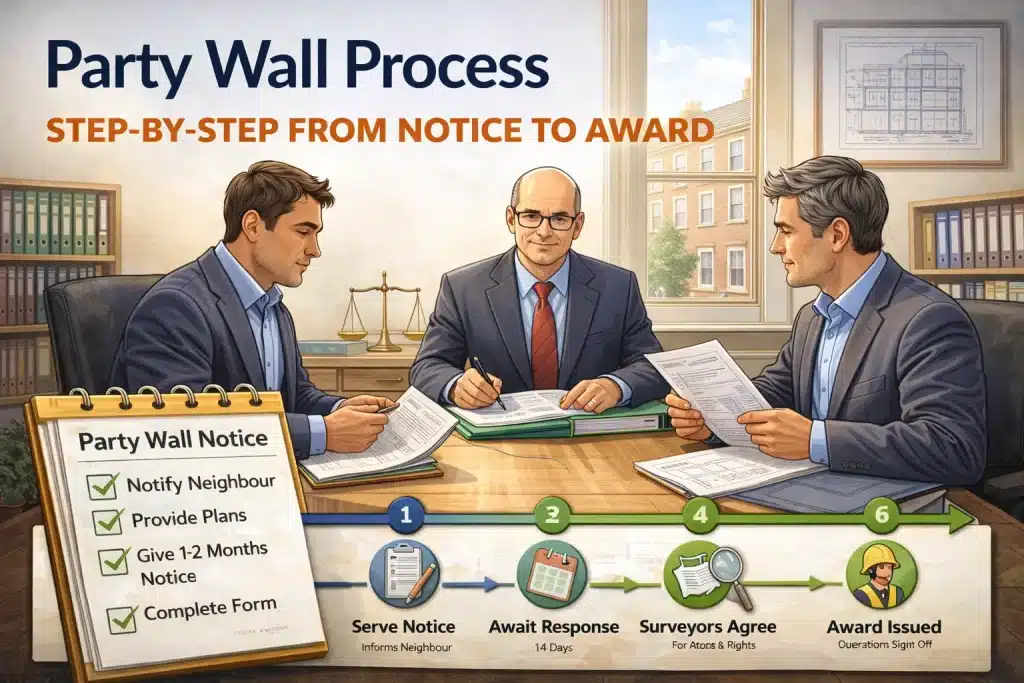
Party wall process guide in action

  Quick Answer: The Party Wall Process Timeline The complete party wall process takes 10-16 weeks (2.5-4 months) from serving notice to starting work: When navigating this process, it is essential to seek expert party wall advice in South East London to ensure compliance with legal requirements. This guidance can help prevent disputes with neighbors […]

Party Wall Cost London Guide

Introduction Party Wall Cost London—these four words are the silent budget killer of capital-based renovations. Whether you are excavating a basement in Kensington or adding a loft in Hackney, the Party Wall etc. Act 1996 creates a mandatory financial checkpoint that, if mismanaged, can spiral from a minor administrative fee into a £5,000+ liability. The […]

Party Wall Act 1996 Guide for London Property Owners

What is the Party Wall Act 1996? The Party Wall Act 1996 is UK legislation that provides a framework for preventing and resolving disputes between property owners when building work affects shared walls, boundaries, or nearby structures. If you’re planning a loft conversion, extension, or basement in London, you’ll likely need to follow this Act […]

Power v Shah [2023]: What “No Notice, No Act” Means for London Homeowners
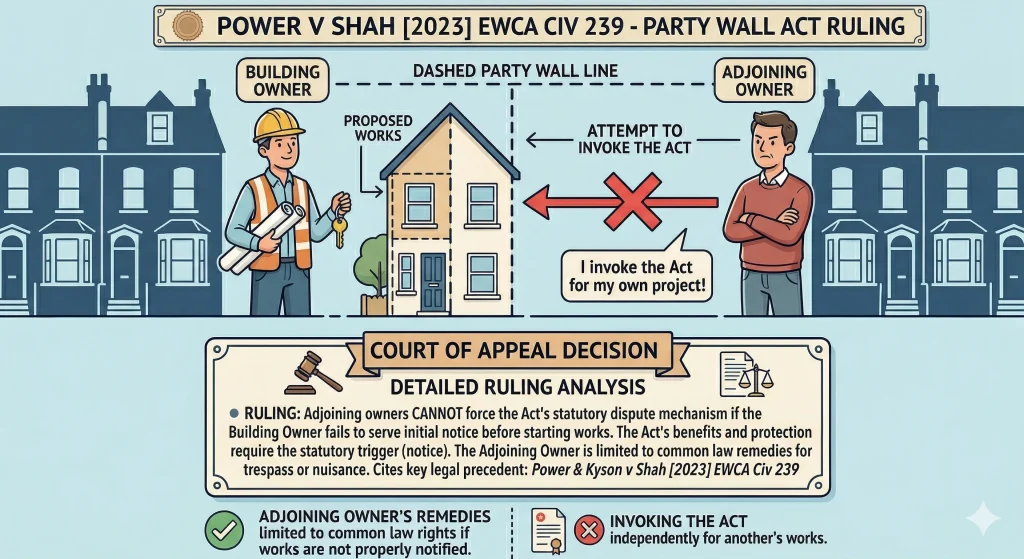
Diagram showing the Power v Shah 2023 Court of Appeal ruling on the Party Wall Act building owner started work without serving notice and the adjoining owner could not force the Act to apply illustrated with London terraced houses in the background

No Notice, No Act: What the 2023 Court of Appeal Ruling Means for London Homeowners By Site Admin,  | Survey of Party Wall No Notice, No Act: What the 2023 Court of Appeal Ruling Means for London Homeowners Quick Answer  If a building owner carries out notifiable works without first serving a party wall notice, […]

Party Wall Act Sections 1, 2 and 6 Explained
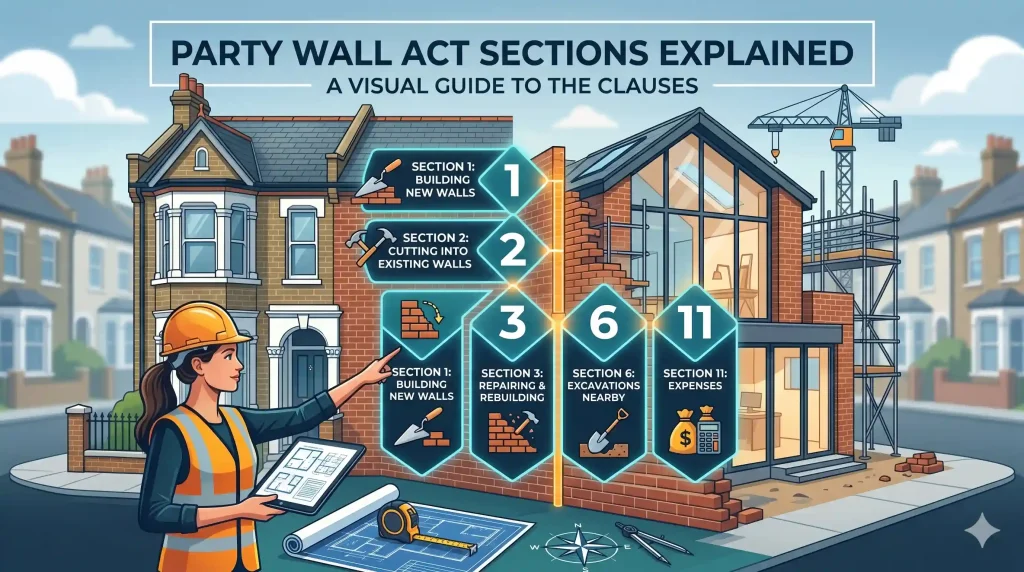
A comprehensive visual guide and infographic explaining key sections of the UK Party Wall Act. A female party wall surveyor points to illustrated panels defining Section 1 (Building New Walls), Section 2 (Cutting Into Existing Walls), Section 3 (Repairing & Rebuilding), Section 6 (Excavations Nearby), and Section 11 (Expenses). The image includes visuals of a traditional Victorian terrace house and a modern building under construction with scaffolding, plus blueprints and tools.

By Nauman Zafar | Party Wall Consultant | Survey of Party Wall · Last Updated: May 2026 Content reviewed against RICS professional standards and Pyramus & Thisbe Club best practice guidelines. TL;DR — Party Wall Notice in 60 Seconds A party wall notice is a written legal document you must serve on every affected neighbouring […]

Party Wall Act 1996 Explained 2026: Essential London Homeowner Guide
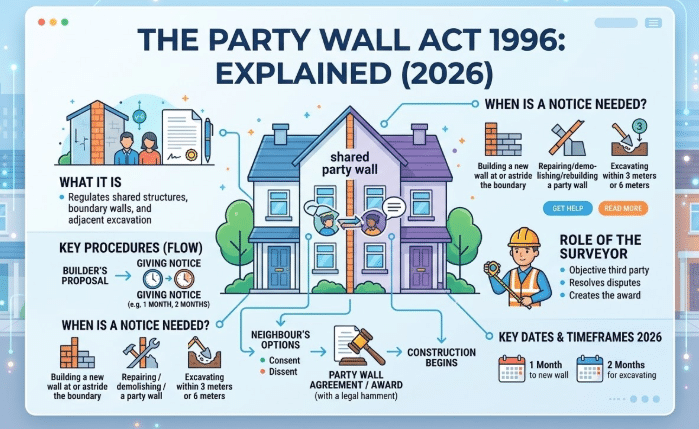
Infographic explaining the Party Wall Act 1996 showing a shared wall between two houses, when a party wall notice is needed, excavation 3 metre and 6 metre rules, key procedures, neighbour consent or dissent options, role of the party wall surveyor, and notice timeframes.

Party Wall Act 1996 Explained: Complete London Guide (2026) What Is the Party Wall Act 1996? The Party Wall etc. Act 1996 is a UK law that protects neighbouring properties when building work affects shared walls, boundaries or nearby foundations. It requires property owners to serve notices, appoint surveyors if disputes arise and follow agreed […]