
The Truth About Retrospective Party Wall Awards: Can You Produce an Award After Works are Complete?
The Retrospective Award Dilemma: When Building Owners Discover the Problem Too Late
The phone call every party wall surveyor receives regularly goes something like this:
“We completed our loft conversion six months ago. Our builder said we didn’t need party wall procedures because our neighbours agreed verbally. Now we’re trying to sell the property and the buyer’s solicitor is asking for the party wall award. Can we get one created now? Will anyone know it wasn’t done properly at the time?”
This scenario—building work completed without proper party wall procedures, followed by desperate attempts to create documentation retroactively—represents one of the most common complications in London property transactions. Building owners who either didn’t understand their obligations or deliberately bypassed statutory requirements now face a critical question: Can you produce a valid party wall award after works are complete?
The short answer is nuanced: Yes, technically you can create a retrospective party wall award, but with significant limitations, questionable legal validity, and practical complications that often make retrospective awards inadequate solutions to the original procedural breach.
According to conveyancing data, approximately 15-20% of London property transactions encounter party wall documentation issues, with retrospective award requests representing a substantial portion of these complications. The financial stakes are considerable—properties can lose £10,000-£50,000+ in value when party wall breaches are discovered, and sales frequently fall through entirely when retrospective solutions prove inadequate.
This comprehensive guide addresses the urgent questions building owners and adjoining owners face when building work completed without proper party wall procedures:
- Can party wall awards be created after works finish?
- Are retrospective awards legally valid and enforceable?
- What limitations do retrospective awards have?
- Will conveyancing solicitors accept retrospective awards?
- What happens if adjoining owners refuse to cooperate?
- What alternative remedies exist when retrospective awards aren’t feasible?
Understanding retrospective party wall awards from both legal and practical perspectives helps building owners assess realistic options when facing party wall documentation deficiencies—and helps adjoining owners understand their rights when approached about creating retrospective awards.
<a name=”what-is-retrospective-award”></a>
What Exactly Is a Retrospective Party Wall Award?
A retrospective party wall award is a formal party wall agreement created by surveyors after notifiable building work has already been completed, rather than before work commenced as the Party Wall Act 1996 requires.
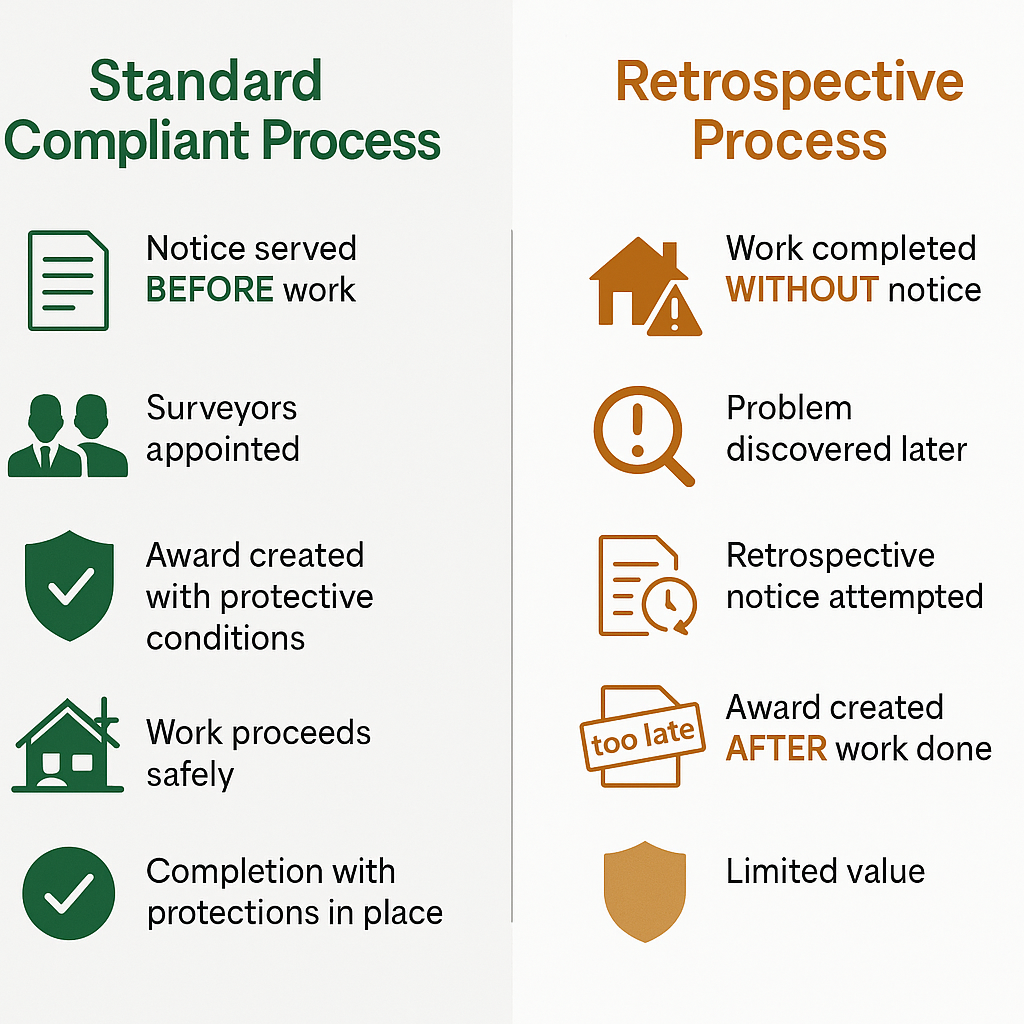
The Standard Timeline vs. Retrospective Timeline
Standard compliant process:
- Planning stage: Building owner plans notifiable work
- Notice service (2+ months before starting): Proper written notice served on adjoining owners
- Response period (14 days): Adjoining owners consent or dissent
- Surveyor appointment (if dissent): Both parties appoint surveyors
- Award creation (before work starts): Surveyors create party wall award specifying conditions
- Work proceeds: Building work conducted under award terms
- Completion: Work finishes; final account settled
Retrospective process:
- Work completed: Building work finishes (often months/years prior)
- Problem discovered: Property sale, damage dispute, or legal advice reveals no proper procedures followed
- Retrospective notice served: Building owner serves party wall notice describing work already completed
- Surveyor appointment: Parties appoint surveyors
- Retrospective award creation: Surveyors create award documenting work already done
- Recording purposes only: Award serves primarily as documentation, not work control
What Retrospective Awards Attempt to Document
Retrospective party wall awards typically include:
Work description:
- Detailed account of building work completed
- Structural interventions that occurred
- Depths excavated
- Beams inserted
- Party structures affected
Schedule of Condition (post-completion):
- Current condition of adjoining owner’s property
- Any damage that occurred during works
- Comparison to pre-work condition (if available)
Compensation provisions:
- Agreements about damage compensation already paid
- Ongoing obligations if damage appeared later
- Dispute resolution mechanisms
Acknowledgments:
- Both parties acknowledging work is complete
- Agreement that no further disputes exist (ideally)
- Confirmation of compliance with Building Regulations
Key Difference: Prospective vs. Retrospective Control
Prospective party wall awards (standard):
- Control HOW work will be executed
- Impose preventive safeguards
- Establish monitoring during construction
- Create protection mechanisms before damage occurs
- Allow surveyors to stop work if problems develop
Retrospective party wall awards:
- Document WHAT work occurred
- Record damage that already happened
- Attempt to settle past disputes
- Provide documentation for property transactions
- Cannot prevent damage that already occurred
This fundamental distinction explains why retrospective awards are controversial—they lack the primary protective function that party wall procedures exist to provide.
The Legal Validity Question: Are Retrospective Awards Enforceable?
The legal status of retrospective party wall awards exists in uncertain territory—they’re not explicitly prohibited by the Party Wall Act 1996, but their enforceability and validity face significant questions.
What the Party Wall Act Actually Says
The Party Wall Act 1996 does not explicitly prohibit retrospective awards. The Act focuses on prospective procedures—requiring notice before work begins and creating awards to control how work will be executed. However, the Act doesn’t specifically state “awards cannot be created after work completes.”
This legislative silence creates theoretical space for retrospective awards. However, silence doesn’t equal endorsement—the Act’s clear focus on prospective control suggests Parliament intended awards to prevent damage, not merely document it after the fact.
Legal Opinions on Retrospective Award Validity
Party wall legal experts hold varying opinions on retrospective award enforceability:
The permissive interpretation:
Some practitioners argue retrospective awards serve valid purposes:
- The Act doesn’t prohibit them explicitly
- Both parties can consent to creating documentation retroactively
- Practical need exists for resolving completed work situations
- Awards provide better documentation than no award at all
The skeptical interpretation:
Other experts question retrospective award validity:
- Awards exist to control future work, not document past work
- The Act’s notice periods become meaningless if retrospective awards are valid
- Retrospective awards may constitute agreements to overlook statutory breaches
- Courts may not enforce retrospective awards’ terms
The pragmatic reality:
In practice, retrospective awards function more as negotiated settlement agreements than true party wall awards. Their value depends heavily on:
- Whether both parties cooperate willingly
- The specific circumstances of the breach
- How courts might view them if disputes arise later
- Whether conveyancing solicitors accept them
The Enforceability Problem
Even if retrospective awards are created, enforcing their terms presents challenges:
Prospective awards contain enforceable obligations:
- Building owners must follow specified methodologies
- Access must be provided for inspections
- Work must stop if damage occurs
- Surveyors can impose additional conditions mid-project
Retrospective awards lack these enforcement mechanisms because:
- Work is already complete—no methodologies to enforce going forward
- No ongoing construction to monitor or control
- Damage already occurred—prevention is impossible
- The building owner’s main obligation (following award terms during work) is moot
Retrospective awards primarily create:
- Documentation of what occurred
- Agreements about past damage compensation
- Possibly ongoing obligations for latent damage
But the core enforcement issue remains: courts may question whether retrospective awards constitute valid party wall awards at all, or merely settlement agreements dressed in party wall terminology.
The Statutory Breach Reality
Creating a retrospective award doesn’t erase the original statutory breach. The building owner still:
- Breached the Party Wall Act by commencing work without notice
- Failed to provide the adjoining owner with timely opportunity for surveyor protection
- Potentially committed trespass if work affected party structures
- Violated statutory duties that retrospective documentation cannot undo
Retrospective awards may settle disputes arising from these breaches, but they don’t retroactively create compliance. This distinction matters for:
- Insurance claims
- Future legal disputes
- Damage claims from subsequent owners
- Regulatory compliance questions
The Party Wall Act’s Timeline Requirements: Why Retrospective Awards Are Problematic
Understanding the Party Wall Act’s mandated timeline clarifies why retrospective awards struggle to fulfill the Act’s protective purposes.
The Statutory Notice Periods Serve Critical Functions
Two-month notice period (party structure work):
This extended period allows adjoining owners time to:
- Seek professional advice about the proposed work
- Commission pre-work condition surveys
- Appoint qualified party wall surveyors
- Negotiate protective conditions before work begins
- Understand risks and ensure adequate safeguards
One-month notice period (excavation work):
Even this shorter period provides:
- Opportunity to assess foundation risks
- Time to arrange monitoring equipment installation
- Ability to commission structural engineer assessments
- Chance to negotiate methodology restrictions
These timeline requirements aren’t bureaucratic formalities—they’re essential protections ensuring adjoining owners can prevent damage rather than merely seeking compensation after damage occurs.
What Retrospective Awards Cannot Restore
When building owners create retrospective awards after work completes, adjoining owners lose:
1. Preventive protection: The opportunity to impose conditions preventing damage is gone. Damage either occurred or didn’t—retrospective awards can only document and compensate, not prevent.
2. Real-time monitoring: Surveyors should monitor work as it progresses, identifying problems early when corrections are possible. Retrospective awards eliminate this critical oversight.
3. Stop-work authority: Party wall awards give surveyors authority to halt work if dangerous practices emerge. This protection has no meaning after completion.
4. Method control: Awards specify excavation methods, shoring requirements, vibration limits, and other protective measures. Retrospective awards document methods used but couldn’t control them prospectively.
5. Informed decision-making: Notice periods allow adjoining owners to understand what’s proposed and make informed decisions about consent versus dissent. Retrospective notice presents accomplished facts, not proposals for consideration.
The “Closing the Stable Door” Problem
Retrospective party wall awards attempt to impose order after chaos—like creating traffic rules after an accident occurred. While post-accident analysis has value, it doesn’t prevent the accident that already happened.
For adjoining owners, this means:
- Damage may have occurred without protective measures
- No professional surveyor protected their interests during critical phases
- Structural interventions happened without oversight
- Evidence of damage causation may be impossible to establish now
For building owners, this means:
- They cannot demonstrate compliance with protective measures
- Their work methods cannot be validated as adequate
- Future damage claims face uncertainty about liability
- Documentation quality is inherently inferior to prospective awards
When Retrospective Awards Actually Make Practical Sense
Despite their limitations, retrospective party wall awards serve useful purposes in specific circumstances where they represent the best available solution to completed work situations.
Scenario 1: Minor Work, No Damage, Cooperative Neighbours
When retrospective awards work well:
- Building owner completed relatively minor party wall work (e.g., small beam insertion, limited excavation)
- No damage occurred to adjoining property
- Both parties maintain cooperative relationship
- Both parties want documentation for future property transactions
- Both parties acknowledge no disputes exist
Example: A homeowner cut into a party wall to insert a small steel beam for an internal alteration. They realized afterward that party wall notice was required. No damage occurred to the neighbour’s property. Both parties agree to create a retrospective award documenting the work for future conveyancing purposes.
Why it works: Both parties benefit from documentation. The adjoining owner isn’t seeking compensation for damage (none occurred). The building owner needs documentation for future sale. The retrospective award efficiently achieves both goals.
Scenario 2: Damage Already Settled, Documentation Needed
When retrospective awards resolve completed disputes:
- Building work completed without proper notice
- Damage occurred and was identified
- Building owner already compensated adjoining owner informally
- Both parties want formal documentation of settlement
- Future property sales require party wall documentation
Example: Basement excavation proceeded without notice. Cracking appeared in the adjoining property. The building owner paid £8,000 to repair damage. Years later, when the building owner plans to sell, their solicitor requires party wall documentation. Both parties agree to create a retrospective award documenting the work and damage settlement.
Why it works: The substantive issues are resolved—damage was repaired and compensated. The retrospective award merely formalizes what already occurred, creating a paper trail for conveyancing purposes.
Scenario 3: Long-Completed Work, New Ownership
When retrospective awards address legacy issues:
- Work completed many years ago by previous owners
- Current owners discover lack of party wall documentation
- No ongoing disputes exist
- Current neighbours are willing to cooperate
- Documentation benefits both properties’ values
Example: A homeowner purchased a property where the previous owner had underpinned the party wall ten years earlier without proper procedures. The current owner discovers this during refinancing. They approach the neighbour (who also purchased after the work occurred) about creating retrospective documentation. Both parties cooperate, recognizing mutual benefit.
Why it works: Neither current owner was responsible for the original breach. Both benefit from resolving the documentation deficiency. The retrospective award draws a line under historic issues.
Scenario 4: Preparing for Property Sale
When retrospective awards facilitate transactions:
- Building owner plans to sell property
- Conveyancing searches reveal party wall work without documentation
- Sale is contingent on resolving the documentation issue
- Time pressure exists
- Adjoining owner is willing to cooperate for reasonable compensation
Example: A seller discovers their loft conversion from five years ago lacks party wall documentation. The buyer is willing to proceed if proper documentation is obtained. The seller negotiates with the neighbour, offering £3,000 to create a retrospective award confirming no ongoing disputes. The neighbour agrees, enabling the sale to complete.
Why it works: Financial incentive exists for both parties. The seller needs documentation to complete sale. The neighbour receives compensation for cooperation. The retrospective award serves its documentary purpose.
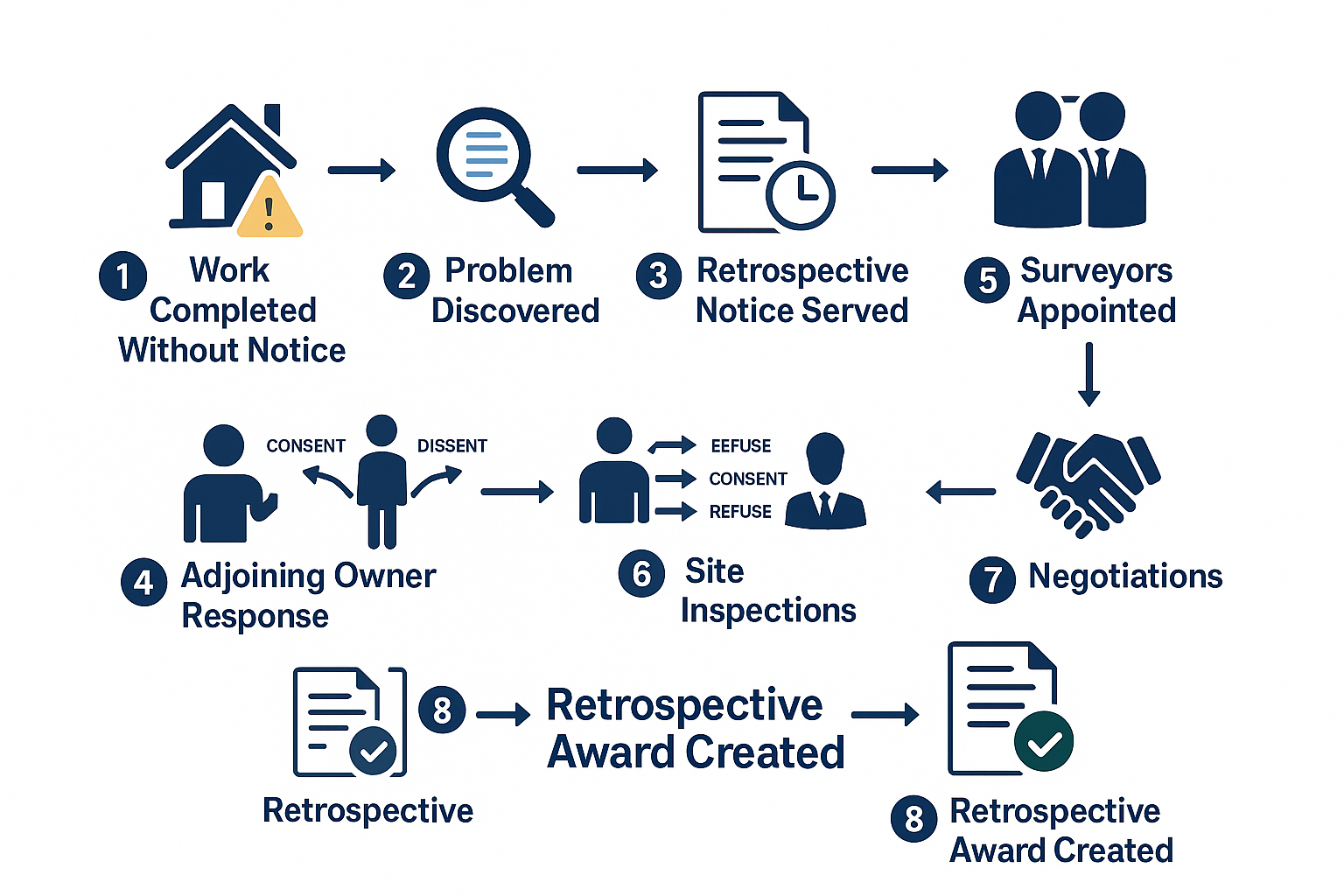
The Process: How Retrospective Party Wall Awards Are Created
Creating retrospective party wall awards follows similar procedures to standard awards but with important adaptations acknowledging that work is complete.
Step 1: Retrospective Notice Service
The building owner serves retrospective party wall notice describing work already completed:
Critical notice elements:
- Reference to Party Wall Act 1996 sections
- Clear statement that work is already complete
- Detailed description of all work undertaken
- Dates when work occurred
- Acknowledgment that proper notice wasn’t served initially
- Request for retrospective documentation
Example notice language:
“This notice is served retrospectively under the Party Wall Act 1996 [Section 2/Section 6]. Building work was completed at [address] between [dates] without proper party wall notice being served at the time. The work comprised: [detailed description]. I am now serving this retrospective notice and propose that surveyors be appointed to create a retrospective party wall award documenting the completed work and addressing any matters arising from it.
Step 2: Adjoining Owner Response
Upon receiving retrospective notice, adjoining owners have choices:
Option 1: Consent Provide written consent acknowledging the work is complete and agreeing to retrospective documentation. This fast-tracks the process.
Option 2: Dissent Dissent and appoint a surveyor to protect their interests during retrospective award creation. This is typical and appropriate.
Option 3: Refuse cooperation Decline to participate in retrospective procedures. This creates significant complications for the building owner.
Step 3: Surveyor Appointment
If the adjoining owner dissents (standard approach):
- Adjoining owner appoints their surveyor
- Building owner appoints their surveyor (or uses the same surveyor if both parties agree)
- Surveyors inspect both properties to document current conditions
Surveyor fees in retrospective situations:
- Building owner pays all surveyor fees (as with standard procedures)
- Fees may be higher than standard awards due to investigative work required
- Typical total: £3,000-£8,000 depending on complexity
Step 4: Site Inspections and Evidence Gathering
Surveyors conduct thorough inspections focusing on:
Building owner’s property:
- Documenting completed work
- Assessing Building Regulation compliance
- Understanding methodologies used (if ascertainable)
- Identifying structural interventions
Adjoining owner’s property:
- Current condition assessment
- Identifying any damage
- Attempting to establish whether damage relates to the building work
- Comparing to pre-work condition if photos/surveys exist
Evidence challenges: Without real-time monitoring, establishing causation between building work and damage becomes difficult. Surveyors must make retrospective assessments based on damage patterns, timing, and professional judgment.
Step 5: Negotiation and Settlement
Surveyors negotiate retrospective award terms addressing:
Work description: Detailed documentation of what occurred
Damage assessment:
- If damage exists, determining causation and quantum
- Negotiating compensation if not already paid
- Establishing liability for future latent damage
Building Regulation compliance:
- Confirming work complies with Building Regulations
- Addressing any regulatory issues discovered
Future protections:
- Agreeing that no further claims exist (if appropriate)
- Establishing dispute resolution mechanisms for future issues
- Addressing warranties or guarantees
Step 6: Award Creation and Service
Once negotiations conclude, surveyors create the retrospective party wall award containing:
- Comprehensive work description
- Schedule of Condition (current state)
- Damage determinations and compensation agreed
- Acknowledgments from both parties
- Surveyor fees allocation
- Dispute resolution provisions
The award is served on both parties, typically within 1-2 months of surveyor appointment.
Critical Limitations of Retrospective Awards
Understanding what retrospective party wall awards cannot achieve is as important as knowing what they can accomplish.
Limitation 1: Cannot Erase the Original Breach
Creating a retrospective award does not mean the building owner complied with the Party Wall Act. The original statutory breach occurred and remains a fact. The retrospective award documents a settlement of that breach but doesn’t retroactively create compliance.
Implications:
- Insurance claims related to the breach may still be affected
- Future legal disputes may reference the original non-compliance
- Regulatory authorities may still have concerns
- The building owner cannot claim “full compliance” even with a retrospective award
Limitation 2: Adjoining Owners Can Refuse to Cooperate
Unlike standard party wall procedures (which are mandatory once notice is served), adjoining owners can simply refuse to participate in retrospective award creation.
If the adjoining owner refuses:
- No retrospective award can be created without their cooperation
- The building owner cannot force the process
- The documentation deficiency remains unresolved
- Property sale complications persist
Why adjoining owners might refuse:
- They’re angry about the original breach
- They’re seeking leverage for other disputes
- They have no incentive to cooperate
- They’re advised by solicitors not to assist
Building owner’s recourse: Limited. They can offer financial inducements (essentially compensating for cooperation) but cannot compel participation.
Limitation 3: Cannot Establish Prospective Control
Retrospective awards document what happened—they cannot establish prospective control over work methods, monitoring, or damage prevention. This means:
- No surveyors monitored the work in real-time
- No protective conditions were imposed during critical phases
- Damage that occurred could not be prevented
- Evidence of proper methodology may be lacking
Limitation 4: Damage Causation Becomes Disputed
Without real-time monitoring and Schedule of Condition before work began, proving that building work caused damage becomes significantly harder:
With standard procedures:
- Pre-work Schedule of Condition documents baseline
- Monitoring identifies damage as it appears
- Cause-and-effect relationship is clear
- Immediate remediation is possible
With retrospective awards:
- Pre-work condition is often undocumented
- Damage discovered after work completes
- Multiple potential causes exist (age, weather, other factors)
- Building owners can argue damage is pre-existing or unrelated
This evidential difficulty often results in:
- Disputes about damage quantum
- Reduced compensation settlements
- Adjoining owners accepting less than full compensation
- Unresolved disagreements about liability
Limitation 5: Conveyancing Solicitors May Reject Them
Even when retrospective awards are created, some conveyancing solicitors question their validity:
Buyer’s solicitors may:
- Request indemnity insurance rather than accepting the retrospective award
- Reduce purchase offers to account for perceived risk
- Require additional warranties from sellers
- Advise buyers to renegotiate or withdraw
Lender’s solicitors may:
- Question whether retrospective awards satisfy their requirements
- Impose additional lending conditions
- Require higher deposits to offset perceived risk
- Decline mortgage offers entirely
Market perception: Retrospective awards carry a stigma—they explicitly demonstrate non-compliance occurred. Even with documentation, some market participants view properties with retrospective awards as higher risk.
Limitation 6: Future Latent Damage Risk Remains
Damage from building work can appear months or years after completion. Retrospective awards struggle to address latent damage:
Standard awards include:
- Ongoing inspection rights
- Defined periods for identifying damage
- Clear compensation mechanisms
- Surveyor involvement in damage assessment
Retrospective awards may attempt to include these, but:
- Time has already passed—some latent damage periods may have expired
- Evidence connecting late-appearing damage to the work is weaker
- Building owners may resist ongoing liability years after completion
- Enforcement of retrospective award terms is uncertain
<a name=”alternative-solutions”></a>
Alternative Solutions When Proper Procedures Were Ignored
Retrospective party wall awards represent one approach to resolving completed work without proper procedures—but several alternatives exist, each with different advantages and limitations.
Alternative 1: Formal Settlement Agreements (Not Party Wall Awards)
Rather than creating a retrospective “party wall award,” parties can execute a formal settlement agreement acknowledging:
- Building work occurred without proper procedures
- Both parties agree to resolve all disputes arising from the work
- Compensation (if any) has been paid or agreed
- No further claims will be made
- The agreement is binding on future property owners
Advantages over retrospective awards:
- More honest about what they are (settlements, not compliance)
- Potentially more enforceable as standard contracts
- Clearer scope and limitations
- May be more acceptable to conveyancing solicitors who understand their true nature
Alternative 2: Indemnity Insurance
Party wall indemnity insurance provides coverage for property owners against future claims or losses arising from party wall work conducted without proper procedures.
How it works:
- Building owner purchases policy (typically £150-£500 for standard cover)
- Policy covers legal costs defending claims plus damages awarded
- Coverage typically £250,000-£1,000,000
- Policy attaches to the property, protecting future owners
Advantages:
- Doesn’t require adjoining owner cooperation
- Provides financial protection against future claims
- Many conveyancing solicitors accept indemnity insurance
- Relatively inexpensive solution
Limitations:
- Doesn’t create party wall documentation
- May not cover damage that already manifested
- Some lenders don’t accept indemnity insurance
- Doesn’t address current damage disputes
Alternative 3: Negotiate Direct Compensation
Building owners can negotiate direct compensation agreements with adjoining owners:
Process:
- Acknowledge the procedural breach
- Commission structural engineer to assess any damage
- Agree compensation for damage plus goodwill payment
- Execute deed of release confirming all claims settled
- Adjoining owner provides letter for conveyancing confirming no disputes exist
Advantages:
- Often faster than creating retrospective awards
- Can be more cost-effective
- Provides clear settlement documentation
- May satisfy conveyancing requirements
Alternative 4: Accept Reduced Property Value
In some cases, building owners may accept that the procedural breach affects property value rather than attempting retrospective solutions:
Approach:
- Disclose the breach to buyers honestly
- Reduce asking price to account for risk
- Target buyers less concerned about party wall history
- Provide all available documentation (even if imperfect)
When this makes sense:
- Adjoining owner refuses all cooperation
- Cost of retrospective solutions exceeds value impact
- Building owner is not in urgent need to sell
- Damage was minimal and compensated informally
The Conveyancing Problem: Retrospective Awards and Property Sales
The primary driver for retrospective award requests is property sales—conveyancing searches reveal party wall work without documentation, creating transaction complications.
What Conveyancing Searches Reveal
Standard conveyancing enquiries include:
- “Has any building work been carried out affecting party walls?”
- “Were party wall procedures followed for all notifiable work?”
- “Please provide copies of party wall awards”
- “Please confirm no party wall disputes exist”
Building Control records show:
- Extensions requiring structural work
- Basement excavations
- Loft conversions
- Planning permissions involving party structures
These searches frequently reveal:
- Building work clearly requiring party wall procedures
- No corresponding party wall awards on file
- Procedural breaches that occurred years earlier
Buyer’s Solicitor Concerns
When party wall breaches are discovered, buyer’s solicitors raise legitimate concerns:
Risk concerns:
- Adjoining owners could seek legal action against current or future owners
- Damage from the work may not yet have manifested
- Insurance claims could be compromised
- Future property value could be affected
Due diligence questions:
- Why weren’t proper procedures followed?
- What other aspects of the work might be non-compliant?
- Has the work been inspected and approved by Building Control?
- What other hidden problems might exist?
Typical solicitor advice to buyers:
- Renegotiate purchase price downward (£5,000-£30,000 common reductions)
- Request indemnity insurance
- Require warranties from sellers
- Consider withdrawing from purchase entirely
When Retrospective Awards Satisfy Conveyancing
Retrospective awards may successfully resolve conveyancing concerns when:
The award demonstrates:
- Both parties cooperated in creating documentation
- Surveyors inspected and documented current conditions
- No ongoing disputes exist
- Damage (if any) has been settled
- The work complies with Building Regulations
The accompanying documentation includes:
- Building Control completion certificates
- Structural engineer reports confirming work quality
- Photos of completed work
- Pre-work photos (if available)
- Correspondence between parties showing cooperation
When Retrospective Awards Don’t Satisfy Conveyancing
Some conveyancing solicitors remain skeptical of retrospective awards because:
They explicitly evidence non-compliance:
- The award itself confirms procedures weren’t followed originally
- Risk of future claims may still exist
- Legal validity of retrospective awards is uncertain
They may lack critical elements:
- No pre-work Schedule of Condition
- No monitoring during critical phases
- Damage causation questions remain
- Methodology validation is missing
Conservative solicitors may advise:
- Requesting indemnity insurance IN ADDITION to retrospective award
- Substantial price reductions to account for risk
- Seller warranties about future claims
- Retention of funds pending resolution of any latent issues
Cost Implications: Why Retrospective Awards Often Cost More
Creating retrospective party wall awards typically costs more than following proper procedures originally would have—and may still require additional expenditure to resolve conveyancing concerns.
Direct Costs of Retrospective Award Creation
Surveyor fees:
- Building owner’s surveyor: £1,500-£4,000
- Adjoining owner’s surveyor: £1,500-£4,000 (building owner pays)
- Additional investigative work: £500-£2,000
- Total surveyor costs: £3,500-£10,000
Increased costs compared to standard awards because:
- Surveyors must investigate rather than control prospectively
- More complex evidence gathering required
- Damage assessment without baseline documentation
- Potential disputes about causation require more surveyor time
Additional professional fees:
- Structural engineer assessment: £1,500-£3,000
- Legal advice on retrospective award validity: £1,000-£2,500
- Conveyancing advice: £500-£1,500
- Additional fees: £3,000-£7,000
Indirect Costs and Value Impact
Property value reduction:
Even with retrospective awards, properties may suffer value impacts:
- Stigma of non-compliance: £5,000-£20,000
- Buyer caution/negotiation leverage: £10,000-£30,000
- Lender reluctance creating smaller buyer pool: Variable impact
Transaction delay costs:
- Extended conveyancing timeline: 4-12 weeks typical delay
- Continued mortgage/rent payments during delay
- Removal company date changes
- Onward purchase complications if in chain
Negotiation leverage loss:
- Buyers demand price reductions
- Sellers negotiate from weakened position
- Cash offers may be withdrawn
- Mortgage offers may fall through
Incentive Payments to Adjoining Owners
Adjoining owners have little obligation to cooperate with retrospective award creation. Building owners often must offer financial inducements:
Typical incentive payments:
- Goodwill payment for cooperation: £1,000-£5,000
- Compensation for time and inconvenience: £500-£2,000
- Additional payment if damage exists: £2,000-£20,000+
Total cost including incentives: £2,500-£27,000 additional
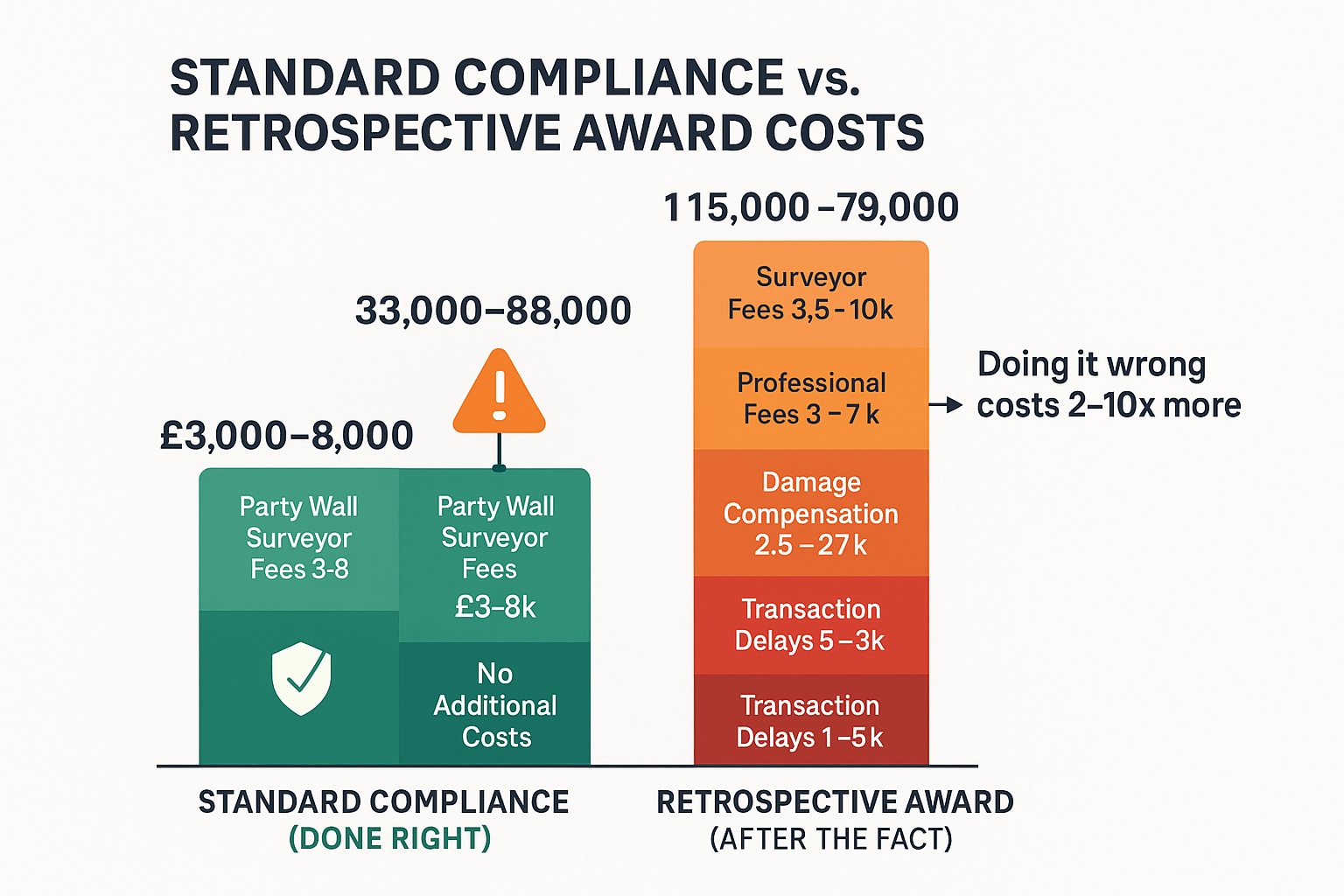
Total Cost Comparison
Following proper procedures initially:
- Standard party wall costs: £3,000-£8,000
- No value impact
- No transaction delays
- Clean documentation
- Total cost: £3,000-£8,000
Retrospective award approach:
- Surveyor fees: £3,500-£10,000
- Professional fees: £3,000-£7,000
- Incentive payments: £2,500-£27,000
- Value impact: £5,000-£30,000
- Transaction delays: £1,000-£5,000
- Total cost: £15,000-£79,000
The “savings” from skipping procedures initially prove illusory—retrospective compliance costs 2-10 times more than doing it right originally.
Case Studies: Retrospective Awards in Practice
Real scenarios illustrate when retrospective party wall awards succeed or fail to resolve completed work complications.
Case Study 1: The Successful Retrospective Award
Situation: Semi-detached house in Wandsworth. Owner completed rear single-storey extension five years earlier. Original builder said party wall procedures weren’t needed. No damage occurred. Owner now selling property; buyer’s solicitor requires party wall documentation.
Resolution approach: Owner approached neighbour, explained situation, offered £2,500 for cooperation. Both appointed surveyors. Retrospective award created within six weeks documenting the extension and confirming no damage or disputes.
Outcome:
- Total cost: £7,200 (surveyors + incentive payment)
- Property sale completed successfully
- Buyer satisfied with retrospective documentation
- No price reduction required
Success factors:
- No damage present
- Cooperative neighbour
- Recent work (within litigation period)
- Simple extension work
- Both parties motivated to resolve
Case Study 2: The Refused Retrospective Award
Situation: Terraced house in Islington. Owner underpinned party wall three years earlier without notice. Significant cracking appeared in neighbour’s property during the work. Building owner paid £5,000 informally for repairs. Now selling property and needs documentation.
Attempted resolution: Building owner approached neighbour about creating retrospective award. Neighbour refused, stating:
- Original breach damaged trust
- Informal payment was inadequate
- No interest in helping building owner sell
- Advised by solicitor not to cooperate
Outcome:
- No retrospective award possible
- Building owner purchased indemnity insurance (£800)
- Property value reduced by £18,000 during negotiation
- Sale nearly fell through multiple times
- Total loss: Approximately £25,000 below market value
Failure factors:
- Damaged relationship from original breach
- Neighbour had no incentive to cooperate
- Existing damage disputes
- Legal advice against cooperation
Case Study 3: The Partial Success
Situation: Loft conversion in Clapham completed two years earlier. Minor beam insertion into party wall. No formal notice served. Some hairline cracking appeared during work but stabilized.
Resolution approach: Building owner offered £4,000 for neighbour cooperation (£2,000 goodwill + £2,000 crack repair). Retrospective award created documenting work and minor damage settlement.
Outcome:
- Retrospective award created successfully
- Total cost: £9,500 (surveyors + payments)
- Buyer’s solicitor initially skeptical
- Required additional indemnity insurance (£650)
- Price reduction: £8,000
Mixed results:
- Award provided some documentation value
- But didn’t eliminate all buyer concerns
- Still suffered financial impact
- Better than no award but not ideal solution
<a name=”best-practices”></a>
Best Practices: What to Do When Work Completed Without Notice
For building owners discovering party wall breaches after work completion, following best practices maximizes chances of successful resolution.
Immediate Steps Upon Discovery
1. Assess the situation honestly:
- What work was completed?
- When did it occur?
- Was any damage caused?
- What’s your relationship with your neighbour?
- Why do you need documentation now? (Selling, refinancing, etc.)
2. Seek expert advice immediately:
- Party wall surveyor consultation
- Property solicitor advice
- Realistic assessment of options
3. Don’t compound the breach:
- Don’t start additional work without proper notice
- Don’t ignore the problem hoping it disappears
- Don’t misrepresent the situation to potential buyers
Approaching Your Neighbour
Best practices for initial contact:
Be honest and apologetic: “I’ve discovered that proper party wall procedures weren’t followed when [work] was completed. I apologize for this oversight and would like to resolve the situation properly now.”
Explain the situation clearly: “I’m [selling/refinancing] and the [solicitor/lender] requires party wall documentation. I’d like to work with you to create retrospective documentation that protects both our interests.”
Offer fair compensation: “I recognize this requires your time and cooperation. I’m prepared to compensate you reasonably for your involvement in resolving this.”
Don’t be defensive or dismissive: Avoid: “It’s just a technicality” or “My builder said it was fine” or “I didn’t think it mattered”
Choosing Between Retrospective Award and Alternatives
Consider a retrospective award when:
- Your neighbour is cooperative
- No significant damage exists
- Work is relatively recent (within 3-5 years)
- You need comprehensive documentation
- You can afford £10,000-£20,000 total costs
Consider indemnity insurance when:
- Your neighbour won’t cooperate
- Work is older (5+ years ago)
- Damage was minor and already settled
- Cost-consciousness is priority
- Lender/solicitor will accept insurance
Consider direct settlement when:
- Damage exists but can be easily quantified
- Your neighbour wants compensation, not documentation
- Speed is important
- Relationship preservation matters
Working With Surveyors on Retrospective Awards
If pursuing retrospective award:
Appoint experienced surveyors:
- Choose surveyors with retrospective award experience
- Ensure they understand conveyancing requirements
- Discuss realistic outcomes upfront
Provide comprehensive information:
- Original plans and specifications
- Building Control documentation
- Photos of the work (during and after)
- Any correspondence with neighbour
- Evidence of Building Regulation compliance
Be realistic about outcomes:
- Understand limitations of retrospective awards
- Accept that you’re negotiating from weakness
- Be prepared to make reasonable concessions
- Budget adequately for all costs
Frequently Asked Questions
Can you legally create a party wall award after building work is complete?
Yes, technically. The Party Wall Act 1996 doesn’t explicitly prohibit retrospective awards. However, their legal validity and enforceability are questionable because the Act clearly intends awards to control work prospectively, not document it retrospectively. Retrospective awards function more as settlement agreements than true party wall awards.
Many building owners create retrospective awards when work completes without proper procedures, particularly when selling properties. Whether these awards fully satisfy legal requirements or conveyancing concerns varies depending on circumstances and professional opinions involved.
Will a retrospective party wall award satisfy my buyer’s solicitor?
Maybe, but not guaranteed. Some conveyancing solicitors accept well-documented retrospective awards, especially when:
- Both parties cooperated willingly
- Surveyors conducted thorough inspections
- No ongoing disputes exist
- The award includes comprehensive documentation
However, other solicitors remain skeptical because retrospective awards explicitly evidence original non-compliance. They may:
- Require indemnity insurance in addition to the award
- Advise price reductions to account for risk
- Request seller warranties about future claims
- In some cases, advise buyers to withdraw
Success depends on: The quality of the retrospective award, additional supporting documentation, buyer’s risk tolerance, and the specific solicitor’s approach.
What if my neighbour refuses to cooperate with creating a retrospective award?
Your neighbour has no legal obligation to cooperate with retrospective award creation. Unlike standard party wall procedures (which are mandatory once proper notice is served), retrospective processes require voluntary cooperation.
If your neighbour refuses, your options include:
- Offer financial inducement: Many neighbours cooperate for reasonable compensation (£2,000-£10,000 depending on circumstances)
- Purchase indemnity insurance: Doesn’t require neighbour cooperation but provides financial protection
- Negotiate direct settlement: Execute a settlement agreement rather than a formal party wall award
- Accept property value impact: Disclose the breach to buyers and accept reduced offers
You cannot force retrospective award creation. If the relationship is damaged or your neighbour has no incentive to help, retrospective awards may not be achievable.
How long after work completes can retrospective awards be created?
There’s no absolute time limit, but practical considerations apply:
Optimal timing: Within 1-3 years of completion
- Evidence is still relatively fresh
- Damage causation is easier to establish
- Relationships may still allow cooperation
- Market impact is minimized
Challenging timing: 3-6 years
- Evidence degrades over time
- Causation becomes disputed
- Some damage limitation periods may expire
- Neighbours less motivated to cooperate
Very difficult: 6+ years
- Very hard to establish what work occurred
- Damage causation nearly impossible to prove
- May exceed limitation periods for some claims
- Conveyancing professionals more skeptical
Legal limitation periods: Claims under the Party Wall Act must generally be brought within six years, but this doesn’t prevent creating retrospective documentation—it just limits future legal claims.
Are retrospective awards more expensive than following proper procedures initially?
Yes, significantly. Retrospective compliance typically costs 2-10 times more than following proper procedures originally:
Standard compliance costs: £3,000-£8,000
- Surveyor fees
- Schedule of Condition
- Award creation
- Clean documentation
Retrospective approach costs: £15,000-£79,000
- Higher surveyor fees (investigative work)
- Additional professional fees (engineers, solicitors)
- Neighbour incentive payments (£1,000-£10,000+)
- Damage compensation if applicable (£2,000-£20,000+)
- Property value reduction (£5,000-£30,000)
- Transaction delays and complications
The “savings” from skipping procedures initially prove illusory. Nearly every building owner who attempts retrospective solutions wishes they’d followed proper procedures originally.
Can retrospective awards address damage that appeared after work finished?
This is one of the primary challenges with retrospective awards. Standard party wall awards include mechanisms for identifying and compensating damage during and after work. Retrospective awards struggle with this because:
Without pre-work documentation:
- No baseline exists for comparison
- Proving the work caused damage becomes difficult
- Building owners can argue damage is pre-existing
Damage appearing months/years later:
- Causation becomes increasingly disputed
- Multiple potential causes exist
- Evidence connecting damage to work weakens
Retrospective awards can attempt to address future damage by:
- Including ongoing inspection rights
- Establishing dispute resolution procedures
- Agreeing damage assessment methodologies
However, enforcement of these provisions is uncertain because retrospective awards’ legal status is questionable. Standard awards created prospectively provide much stronger protection for latent damage.
If I purchase a property where work was done without proper procedures, am I liable?
Potentially yes, though liability scenarios are complex:
You may face:
- Claims from adjoining owners for damage that hasn’t yet been resolved
- Inability to sell your property without addressing the documentation deficiency
- Difficulty obtaining insurance or mortgages
- Reduced property value
Your legal position:
- You didn’t commit the original breach
- Previous owner may have contractual liability to you
- Indemnities in sale contracts may protect you
- But practical problems persist regardless of technical liability
This is why thorough conveyancing is critical. Good conveyancing solicitors identify party wall documentation issues before you purchase, allowing you to:
- Renegotiate price downward
- Require sellers to obtain retrospective awards before completion
- Request indemnity insurance
- Walk away if risks are too great
Does indemnity insurance work as well as a retrospective award?
Different solutions for different purposes:
Indemnity insurance advantages:
- Doesn’t require neighbour cooperation
- Relatively inexpensive (£150-£500 typically)
- Provides financial protection against claims
- Many conveyancing solicitors accept it
- Covers future owners
Indemnity insurance limitations:
- Doesn’t create party wall documentation
- May not cover damage already manifested
- Some lenders won’t accept it
- Doesn’t address current disputes
Retrospective awards advantages:
- Creates formal documentation
- Involves professional surveyors
- Can address existing damage
- May be viewed as more comprehensive
Retrospective awards limitations:
- Expensive (£7,000-£20,000+)
- Requires neighbour cooperation
- Legal validity uncertain
- Not always accepted by solicitors
Best approach often combines both: Retrospective award where possible, supplemented with indemnity insurance for additional security.
Conclusion: Prevention Remains Better Than Retrospective Cure
The uncomfortable truth about retrospective party wall awards is that while they’re sometimes achievable and occasionally resolve conveyancing complications, they’re always inferior to following proper procedures originally—and often inadequate solutions to the problems they attempt to address.
Retrospective awards can:
- Provide some documentation for property transactions
- Settle disputes between cooperative parties
- Demonstrate good faith efforts to comply belatedly
- Potentially satisfy some conveyancing requirements
But retrospective awards cannot:
- Erase the original statutory breach
- Restore protective conditions that should have existed
- Guarantee acceptance by solicitors or lenders
- Eliminate all risks from the procedural failure
- Reduce costs compared to original compliance
The Economic Reality
Every building owner who spends £15,000-£40,000 creating retrospective awards and addressing resulting complications wishes they’d spent £5,000-£8,000 following proper procedures initially. The “savings” from skipping party wall requirements prove illusory—retrospective compliance costs exponentially more.
The Legal Uncertainty
Unlike standard party wall awards (which have clear statutory foundation and established enforcement mechanisms), retrospective awards exist in legal grey areas. Courts have not definitively ruled on their validity, conveyancing professionals disagree about their adequacy, and their enforceability remains uncertain.
This legal uncertainty means: Building owners who rely on retrospective awards as complete solutions may discover years later that these awards don’t provide the protection assumed—creating ongoing liability and value impacts.
Survey of Party Wall: Preventing Retrospective Problems
At Survey of Party Wall, we help building owners avoid retrospective complications by:
Prospective services (preventing problems):
- Proper party wall notice drafting and service
- Schedule of Condition surveys before work begins
- Professional surveyor representation
- Party wall award creation with comprehensive protections
- Real-time monitoring during construction
Retrospective services (resolving problems):
- Honest assessment of retrospective award feasibility
- Negotiation with adjoining owners
- Retrospective award creation when appropriate
- Alternative solution advice (indemnity insurance, settlements)
- Conveyancing support documentation
We offer free initial consultations to assess whether retrospective awards are achievable and appropriate for your situation—or whether alternative approaches better serve your needs.
The Bottom Line
If you’re planning building work: Follow proper party wall procedures from the outset. The modest investment prevents expensive retrospective complications.
If work already completed without notice: Seek expert advice immediately about realistic options. Retrospective awards may help, but understand their limitations and costs before proceeding.
If you’re buying property with party wall complications: Insist on proper resolution before completing or receive appropriate compensation for the risk you’re assuming.
Don’t let the retrospective award fallacy—the belief that documentation created after-the-fact fully resolves procedural breaches—lead you into expensive complications. Proper party wall procedures work. Retrospective fixes are always compromises.
Related Resources:
- The Consent Without Notice Fallacy: Why Verbal Agreements Are Invalid
- Stop Work Now: The Ultimate Guide to Party Wall Injunctions
- Party Wall Act 1996: Complete Compliance Guide
- Conveyancing Party Wall Issues: Buyer’s Protection Guide