
By Nauman Zafar | Party Wall Consultant | Survey of Party Wall · Last Updated: May 2026
Content reviewed against Pyramus and Thisbe Club professional standards and Pyramus & Thisbe Club best practice guidelines.
TL;DR — Party Wall Agreement Cost in 60 Seconds
Party wall agreement costs in London between £800 and £5,500 depending on the project type, the number of neighbouring properties involved, and whether neighbours consent or dissent. A simple rear extension with one consenting neighbour typically lands at £800 to £1,400. A basement with two dissenting neighbours and monitoring requirements can reach £8,000 to £15,000. The building owner always pays — including the adjoining owner’s surveyor fees. VAT at 20% applies to all surveyor fees and is almost always excluded from headline quotes.
Party Wall Agreement Cost London 2026: Real Fees, What Drives Them Up, and What You Can Do to Keep Them Down
Want a fixed-fee quote for your specific project? Tell us your postcode, your project type, and how many neighbours share your walls or boundaries. We will give you a transparent quote within one business day. No obligation.
The most common complaint about party wall costs is not the amount — it is the surprise. Homeowners budget for a surveyor’s quote, get a second invoice from the adjoining owner’s surveyor they have never met, and then face a third invoice for monitoring visits nobody mentioned. This guide removes every one of those surprises. Here is every cost component, what drives each one up or down, and what the total looks like across five real London project types in 2026.
What You Are Actually Paying For
A party wall agreement — properly called a party wall award — is not a single service. It is a sequence of professional outputs produced over several months. Each stage has its own fee. The building owner pays for all of them, including the stages produced by the adjoining owner’s surveyor.
| Cost component | London 2026 range | Who produces it | Often excluded from headline quote? |
|---|---|---|---|
| Notice drafting and service | £200 to £450 | Building owner’s surveyor | Sometimes — check |
| Schedule of condition | £400 to £900 per property | Building owner’s surveyor | Frequently — confirm upfront |
| Party wall award drafting | £600 to £1,200 | Building owner’s surveyor | No — core service |
| Adjoining owner’s surveyor fee | £750 to £1,800 | Adjoining owner’s surveyor — you pay | Always excluded from your surveyor’s quote |
| Monitoring visits during works | £200 to £500 per visit | Either surveyor | Usually excluded — confirm number included |
| Post-completion inspection | £250 to £600 | Either surveyor | Sometimes excluded |
| Third surveyor (only if invoked) | £1,500 to £4,000 | Third surveyor | Not in any quote — contingency only |
| VAT at 20% | On all surveyor fees | All surveyors | Almost always excluded from headline quotes |
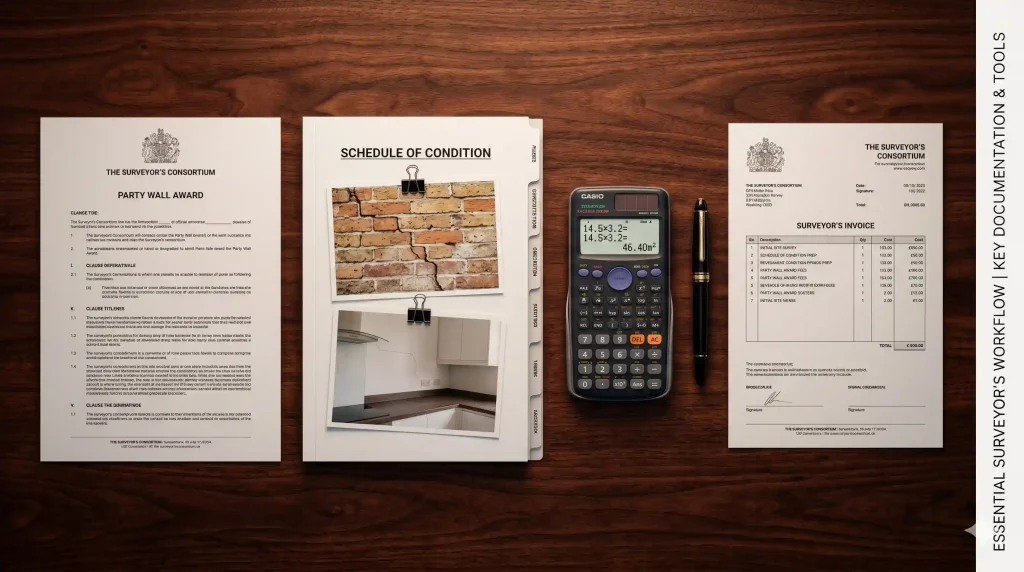
Total Cost by Project Type — London 2026
| Project | Neighbours affected | Consent scenario | Total range (ex VAT) |
|---|---|---|---|
| Rear extension | 1 | Consent | £800 to £1,400 |
| Rear extension | 1 | Dissent — two surveyors | £2,200 to £3,800 |
| Mid-terrace loft conversion | 2 | Both consent | £1,400 to £2,400 |
| Mid-terrace loft conversion | 2 | Both dissent — two surveyors each | £4,500 to £7,500 |
| Side return extension | 1 | Dissent — two surveyors | £2,500 to £4,500 |
| Hip-to-gable semi-detached | 1 | Dissent — two surveyors | £2,100 to £4,000 |
| Basement excavation | 2 to 4 | All dissent — two surveyors each + monitoring | £8,000 to £15,000+ |
What Drives Costs Up — The Six Key Variables
Number of adjoining owners
Every adjoining owner is a separate relationship, a separate notice, a separate schedule of condition, and a separate award. A mid-terrace with two party wall neighbours costs roughly double a semi-detached with one. A converted house next door with three long leaseholders and a freeholder can mean four separate award processes for one project.
Consent vs dissent
The single biggest cost variable. A consenting neighbour who also agrees to a schedule of condition costs the building owner around £600 to £900 in professional fees plus the surveyor’s notice preparation. A dissenting neighbour who appoints their own surveyor typically adds £750 to £1,800 to the total — the cost of their surveyor’s time to review the drawings, attend site, and agree the award.
Project complexity
A basement with piled foundations, underpinning, monitoring equipment, and a vibration assessment takes a surveyor four to five times longer than a single-storey rear extension. Hourly-rate surveyors pass this directly to the building owner. Fixed-fee surveyors scope it into their initial quote — or should. Always confirm what the fixed fee includes.
The adjoining owner’s surveyor appointment
The biggest budget surprise in party wall projects. The building owner selects and budgets for their own surveyor. The adjoining owner independently appoints theirs — often from a panel firm, sometimes on an hourly basis. The building owner pays that invoice. Always ask your surveyor to estimate what a reasonable adjoining owner’s surveyor fee looks like for your project type and add it to your budget.
VAT
Every professional surveyor who is VAT registered adds 20% on top. Most headline quotes exclude VAT. On a £3,000 total fee, that is £600 you were not expecting. Confirm VAT status before signing any engagement letter.
Plan changes mid-process
If your architect revises the structural drawings after the notice has been served and the award is being drafted, the surveyor must reassess and often re-serve. That additional work is charged. Lock the structural design before serving notices.
How to Keep Party Wall Costs Down — Five Practical Steps
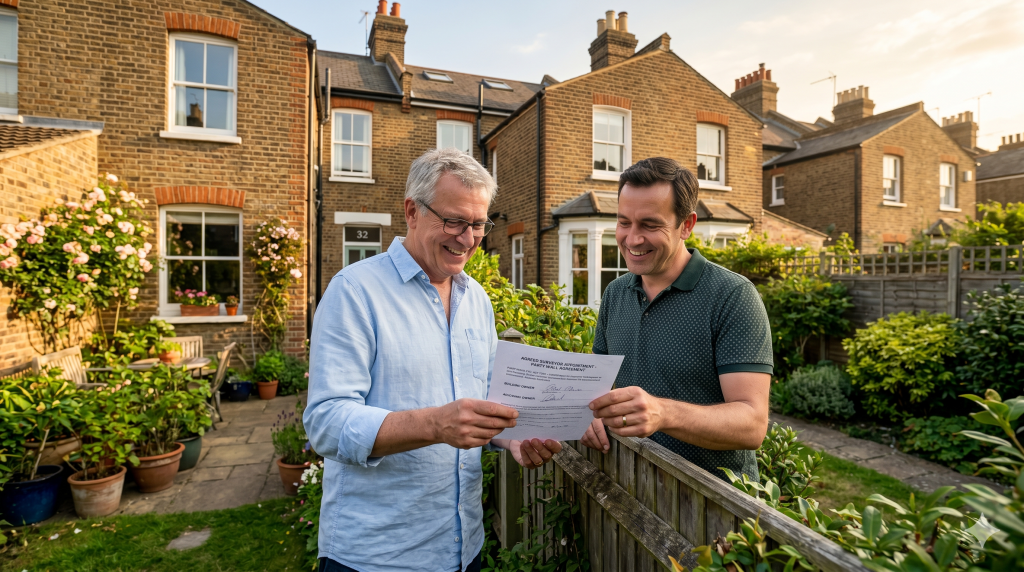
Suggest an agreed surveyor to your neighbour before serving a formal notice. A single impartial surveyor acting for both parties typically costs 40 to 60 percent less than two separate appointment fees. Explain that the agreed surveyor has a legal duty to protect both sides; it is not a concession, it is a genuine cost saving for the process.
Serve notices early and correctly the first time. Invalid notices that must be re-served restart the clock and create additional professional time. Get the drawings locked and the notices drafted correctly once.
Fix the structural design before notices go out. Every plan change after service costs more than getting the design right before the first notice is drafted.
Ask for a fully inclusive fixed-fee quote. Confirm in writing that the quote includes notice drafting, schedule of condition, award, and all standard correspondence. Confirm what monitoring visit allowance is included. Confirm VAT position.
Instruct early in the project — at planning stage, not when the builder is booked. Early instruction gives time for the notice periods to run without delay and reduces the risk of rushed, disputed awards.
Get a transparent fixed-fee quote for your London project. Tell us your postcode, project type, and number of affected neighbours. We will send you a fully inclusive quote within one business day — no hidden extras, VAT clearly stated.
Survey of Party Wall : party wall consultancy covering all London boroughs. Fixed fees, VAT-inclusive quotes on request. No hidden charges. Same-day visits. Zero paperwork risk.
Frequently Asked Questions: Party Wall Costs
Who pays for the party wall surveyor?
The building owner — the person carrying out the works — pays all reasonable party wall costs under Section 10(13) and Section 11(1) of the Act. This includes their own surveyor’s fees and the adjoining owner’s surveyor’s fees where two surveyors are appointed. There is no circumstance where the adjoining owner pays for the standard award process unless a third surveyor rules in the building owner’s favour on a specific dispute.
Do I pay the neighbour’s surveyor even if I did not choose them?
Yes. The adjoining owner has an absolute right to appoint their own surveyor and you pay their reasonable fees. You do not choose who they appoint. Your surveyor can challenge fees that are unreasonable — the award sets the final apportionment — but the principle of you paying is non-negotiable.
Is VAT charged on party wall surveyor fees?
Yes if the surveyor is VAT registered, which most London professionals are. VAT at 20% is charged on all professional fees. Most headline quotes exclude VAT. Always confirm whether the quoted figure is plus VAT or VAT-inclusive before accepting.
Can I get a fixed-fee party wall agreement?
Yes — many surveyors offer fixed fees for standard projects. Ask specifically for a fixed fee covering notice drafting, schedule of condition, award preparation, and one set of monitoring visits. Confirm in writing what is and is not included. Open-ended hourly rate agreements can escalate significantly on complex or contentious projects.
What happens to party wall costs if the project is cancelled?
If the notice has been served and a surveyor appointed but works do not proceed, the building owner still owes the surveyor’s fees for work done to date. Some surveyors charge a cancellation or abortive fee. Confirm the position on cancellation before instructing.
Are party wall costs tax deductible?
For a private homeowner carrying out works on their own residence, party wall costs are not generally deductible against income tax. For landlords and property investors, party wall fees related to a rental property may be deductible as a revenue expense or treated as part of the improvement capital cost. Confirm with a tax adviser for your specific position.
Key Takeaways
- Party wall costs in London in 2026 range from £800 to £1,400 for a simple rear extension with one consenting neighbour to £8,000 to £15,000 for a complex basement with multiple dissenting neighbours.
- The building owner pays all costs — including the adjoining owner’s surveyor fees and VAT. Always budget both.
- The four biggest surprises: the adjoining owner’s surveyor invoice, VAT, monitoring visit charges, and costs from plan changes mid-process. All four are preventable with a fixed-fee, fully-inclusive engagement letter.
- An agreed surveyor (one for both parties) saves 40 to 60 percent compared to two separate appointments. Suggest this to your neighbour before formal notice goes out.
Related Guides
- Complete Guide to the Party Wall Act 1996
- What Does a Party Wall Surveyor Do
- Party Wall Notice Explained
- Section 6 Excavation: The 3m and 6m Rules
By Nauman Zafar | Party Wall Consultant | Survey of Party Wall · Last Updated: May 2026
Content reviewed against Pyramus and Thisbe Club professional standards and Pyramus & Thisbe Club best practice guidelines.
TL;DR — How to Respond to a Party Wall Notice
You have 14 days to respond to a party wall notice from the date of service. Three options: consent in writing, which allows the works to proceed under the Act; dissent in writing and appoint your own surveyor; or do nothing, which triggers deemed dissent automatically after 14 days and requires surveyor appointment. You cannot stop lawful building works by ignoring the notice or refusing to engage — the Act does not give you a veto. What it gives you is the right to proper protection while the works happen.
Received a Party Wall Notice? Here Is Exactly What to Do in the Next 14 Days
Received a party wall notice and not sure what to do? Tell us your postcode and what the notice says. We will confirm your options and what the next step is for your specific situation. Free, same-day response.
A party wall notice through your letterbox is not a threat. It is a legal document from your neighbour telling you they are planning building work that may affect the structure you share. The Party Wall etc. Act 1996 gives you rights in this situation — not to stop the works, but to ensure you are properly protected while they happen.
The 14-day clock starts from the date on the notice, not the date you open it. Here is exactly what to do, in order, to protect yourself without creating an unnecessary dispute or delaying your neighbour’s project.
Step 1 — Check the Notice Is Valid
Before you respond, check that the notice is legally valid. A deficient notice does not engage the Act and does not start your 14-day clock. A valid notice must include the name and address of the building owner, your name and address, the address of the property where works are proposed, a description of the proposed works, the proposed start date (at minimum one month or two months after the notice date, depending on the section), and for a Section 6 excavation notice, plans and sections showing the depth and position of the proposed dig.
If the notice is addressed to you as a tenant rather than to the freeholder or long leaseholder, it may be deficient — party wall notices must be served on the legal owner, not the occupier. If you are renting, forward the notice to your landlord immediately.
Step 2 — Understand What Work Is Proposed
Read the notice and the attached drawings carefully. Three types of notice are possible.
| Notice type | What it covers | Your response window |
|---|---|---|
| Line of Junction Notice (Section 1) | New wall at or on the boundary | 14 days from service |
| Party Structure Notice (Section 2) | Work to the shared party wall — steels, raising, underpinning, chimney removal | 14 days from service |
| Notice of Adjacent Excavation (Section 6) | Digging within 3 or 6 metres of your building | 14 days from service |
Step 3 — Decide: Consent or Dissent
You have three options. Each has different consequences for you and for your neighbour’s programme.
Option A — Consent in writing
If you are satisfied that the proposed works are reasonable and the drawings show no significant risk to your property, you can consent in writing within 14 days. Consent means the works can proceed under the Act’s framework without a formal award. You retain the right to request a schedule of condition — a photographic record of your property before works begin — even if you have consented. This is your baseline evidence if any damage occurs. Ask for it explicitly in your consent letter.
Consent is not the same as waiving all rights. Following Onigbanjo v Pearson [2008], you retain the right to invoke surveyor jurisdiction if a specific dispute arises during the works even after giving initial consent.
Option B — Dissent and appoint a surveyor
If you have concerns about the structural impact of the works, if the excavation is close to your foundations, if the drawings show significant intervention in the shared wall, or if you simply want independent representation, dissent in writing and appoint your own surveyor. Your surveyor’s fees are paid by the building owner — this costs you nothing. The building owner’s surveyor and your surveyor then produce a party wall award that governs how the works proceed.
Dissenting is not hostile. It is the mechanism the Act provides for ensuring the works are properly managed. Most London projects with dissent proceed smoothly because the award resolves every potential dispute before the first tool touches the wall.
Option C — Do nothing
If you do not respond within 14 days, the Act treats your silence as deemed dissent under Section 5 or Section 6(7). A dispute is automatically created. The building owner will contact you and ask you to appoint a surveyor within 10 days. If you still do not respond, Section 10(4) allows them to appoint a surveyor on your behalf. The process continues without your active participation — but you lose the opportunity to shape how the works are managed through your own appointed surveyor.
Doing nothing is not a strategy. It delays the project for both of you, it means a surveyor is appointed on your behalf without your input, and it does not stop the works.
What You Cannot Do
You cannot stop lawful building works by refusing to engage with the party wall process. The Act gives the building owner the right to carry out notifiable works. What the Act gives you is the right to be protected while those works happen. If you attempt to physically obstruct lawful works covered by a valid party wall award, the building owner can apply to the County Court for an injunction.
You cannot appoint a surveyor who advocates purely for your position. Under Gyle-Thompson v Wall Street (Properties) Ltd [1974], party wall surveyors act in a quasi-judicial capacity and owe a duty of impartiality to both owners. Your surveyor protects your property — they do not fight your corner in the way a solicitor would.
What Happens After Dissent
Once you have dissented and appointed your surveyor, the building owner’s surveyor contacts yours to begin the award process. Your surveyor will visit your property to carry out the schedule of condition — the photographic baseline that protects you against spurious damage claims. The two surveyors then negotiate and produce the party wall award. The award is served on both owners. Either owner can appeal to the County Court within 14 days under Section 10(17).
From dissent to award typically takes four to six weeks on a standard residential project. On a complex basement with multiple adjoining owners, it can take eight to twelve weeks. The building owner cannot start notifiable work until the award is in place.
The Schedule of Condition — Why It Matters for You
Whether you consent or dissent, the schedule of condition is the document that protects you financially. It is a room-by-room photographic and written record of the condition of your property before the works start — every crack, every damp mark, every hairline fracture in the plasterwork. Any damage that appears during or after the works is compared to the schedule. If it was there before, the building owner is not liable for it. If it is new, they are.
Without a schedule of condition, proving that new damage was caused by the neighbour’s works is much harder. With one, the evidence is clear and claims are resolved quickly. Always insist on a thorough schedule — not a cursory ten-photograph walkthrough.
Case Law on Adjoining Owner Rights
Onigbanjo v Pearson [2008] BLR 507
An adjoining owner who consents to the proposed works does not waive their right to invoke surveyor jurisdiction if a specific dispute arises later during the build. Consent at the notice stage does not mean you have no recourse if a crack appears in your ceiling three months into the project.
Kaye v Lawrence [2010] EWHC 2678 (TCC)
You have the right to request security for expenses under Section 12(1) of the Act if the proposed works carry a real risk of significant damage to your property. For deep excavations or basement projects close to your foundations, this is a legitimate request that your surveyor can include in the award. The building owner must ringfence funds in escrow before works start.
Gyle-Thompson v Wall Street (Properties) Ltd [1974]
Party wall awards are binding on both owners as if made by a court. Once an award is served, the building owner can carry out the works as specified. You cannot obstruct those works without risking a court injunction against you.
Frequently Asked Questions: Responding to a Party Wall Notice
Can I stop my neighbour’s building works by refusing to respond?
No. If you do not respond within 14 days, deemed dissent is created automatically. The process continues without your active engagement. Refusing to respond does not stop the works — it just means a surveyor is appointed on your behalf by the building owner.
Do I have to pay for the party wall surveyor?
No. As the adjoining owner, your surveyor’s reasonable fees are paid by the building owner. You appoint your own surveyor independently. You pay nothing in the standard residential scenario.
What if the notice looks wrong or is missing information?
Write to the building owner pointing out the deficiency. A deficient notice is legally invalid and does not start your 14-day clock. The building owner must re-serve a corrected notice. Keep a record of your written objection.
Do I have to let the surveyor into my home?
Section 8 of the Act gives the building owner a right of access to your property for specific purposes — to carry out the works and to carry out inspections. Access for the schedule of condition is an important pre-works visit. Refusing access can lead to complications in the award process and, ultimately, court intervention. Give reasonable access with reasonable notice.
What if I am happy with the works but want protection from damage?
Consent to the works in writing and ask explicitly for a schedule of condition in your consent letter. The schedule is carried out by the building owner’s surveyor at no cost to you. You get the photographic baseline that protects you without triggering the full award process.
Can I negotiate changes to the proposed works?
Dissent triggers the award process, which gives your surveyor the opportunity to negotiate the working method, working hours, temporary protection measures, and monitoring requirements. You cannot change the scope of the works themselves — the building owner retains the right to carry out lawful works — but you can shape how they are carried out through the award.
Key Takeaways
- You have 14 days from service to respond: consent, dissent, or do nothing. Silence creates deemed dissent — the process continues without you.
- Consent allows works to proceed. Always ask for a schedule of condition in your consent letter even if you consent.
- Dissent triggers the award process. Your surveyor’s fees are paid by the building owner. Dissenting costs you nothing.
- You cannot stop lawful building works. The Act gives you protection rights, not veto rights.
- Following Onigbanjo v Pearson, consent does not waive all future rights. You can still invoke surveyor jurisdiction if specific damage occurs during the works.
Received a notice and not sure whether to consent or dissent? Send us the notice details and your postcode. We will tell you exactly what the works involve and what the best response is for your specific situation. Free, same-day, no obligation.
Survey of Party Wall : adjoining owner specialist covering all London boroughs. Free initial advice on any notice received. Same-day response. Zero obligation.