
By Nauman Zafar | Party Wall Consultant | Survey of Party Wall · Last Updated: May 2026
Content reviewed against Pyramus and Thisbe Club professional standards and Pyramus & Thisbe Club best practice guidelines.
TL;DR — Special Foundations in 60 Seconds
Special foundations are foundations that use an assemblage of beams or rods to distribute load — reinforced concrete, piles, or reinforced underpinning. Under Section 7(4) of the Party Wall etc. Act 1996, a building owner cannot place special foundations under a neighbour’s land without that neighbour’s express written consent. Unlike all other party wall matters where a neighbour cannot unreasonably refuse, special foundations consent can be withheld for any reason whatsoever. No consent means redesign. There is no appeal.
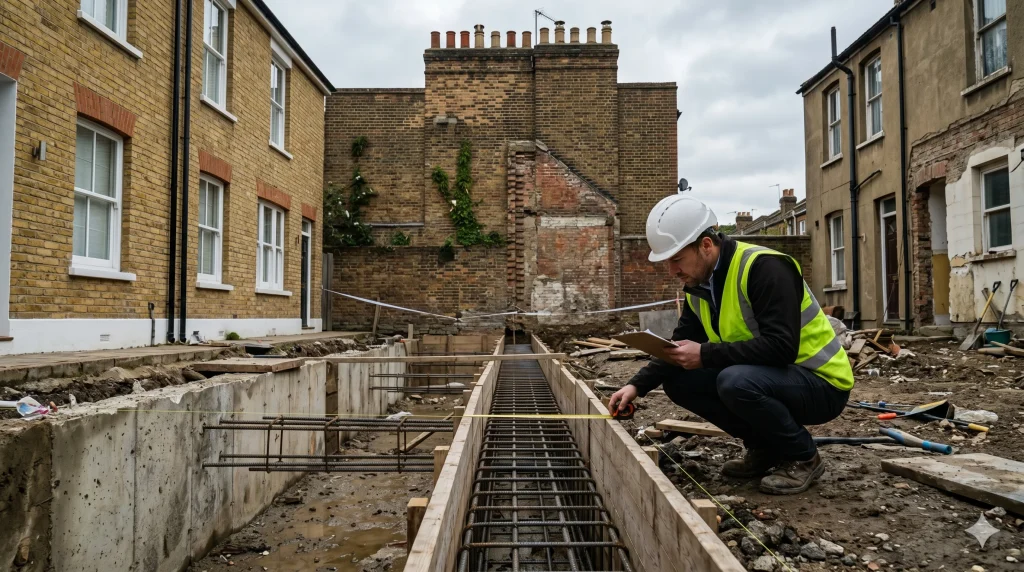
Special Foundations Under the Party Wall Act: Why Your Neighbour Can Say No and You Cannot Appeal
Structural engineer proposing reinforced or piled foundations near your boundary? Tell us your postcode and foundation design. We will check whether Section 7(4) applies before you commit to a design that needs consent you may not get. Free, one business day.
Most homeowners planning a side return extension or boundary wall discover special foundations at the worst possible time. The structural engineer’s drawings are finalised. The planning application is in. And then the party wall surveyor points to Section 7(4) of the Act and explains that the reinforced pad foundations projecting 400 millimetres under the neighbour’s garden need explicit written consent — and the neighbour can say no for any reason at all, including plans they have not yet started.
Here is what this guide covers: the precise statutory definition, when the rule fires, why it is categorically different from every other party wall matter, what happens if consent is refused, how to approach the neighbour conversation, and what compensation is reasonable where consent is given.
What Are Special Foundations Under the Party Wall Act
Section 20 of the Party Wall etc. Act 1996 defines special foundations as foundations in which an assemblage of beams or rods is employed for the purpose of distributing any load. The definition captures four types of foundation used regularly in London construction.
| Foundation type | Special foundation? | Why |
|---|---|---|
| Reinforced concrete pad with rebar | Yes | Assemblage of rods (rebar) employed to distribute load |
| Contiguous bored piles | Yes | Reinforced concrete columns distributing load to deeper strata |
| Reinforced concrete raft | Yes | Rebar mesh throughout distributing load across the slab |
| Reinforced concrete underpinning | Yes — confirmed in Chaturachinda v Fairholme [2015] | Mass concrete block with reinforcement beneath RC underpin |
| Plain mass concrete strip foundation | No | No assemblage of beams or rods — unreinforced |
| Traditional brick on concrete strip | No | No reinforcement distributing load |
When Section 7(4) Fires — The Two Conditions
Section 7(4) applies when two conditions are both met. First, the building owner proposes to place special foundations. Second, those special foundations will be placed on or under the land of the adjoining owner — meaning they will project across the boundary line beneath the neighbour’s property. Both conditions must apply simultaneously. Special foundations placed entirely on your own land do not require consent under Section 7(4), though they still require a party wall notice under Section 1 or Section 6 if they are close to the boundary or the neighbour’s building.
Why this fires so often on London boundary projects
A side return extension with an external wall built exactly on the boundary needs foundations wide enough to carry the wall load. A standard foundation for a brick wall is typically 600 to 900 millimetres wide. If the wall sits precisely on the boundary, half the foundation projects onto the neighbour’s land. If that foundation is reinforced — as most modern London construction foundations are — Section 7(4) fires. The neighbour’s consent is required before that design can proceed.
The Critical Difference — Why Special Foundations Consent Cannot Be Refused Unreasonably… Except It Can
Every other party wall matter operates under a framework of reasonableness. Neighbours can dissent, but their surveyor works to produce a fair award. They cannot block works altogether. They can require protection measures, monitoring, and schedule of condition — but the building owner retains the right to proceed.
Special foundations under Section 7(4) are the single exception in the entire Act. The adjoining owner can refuse consent for any reason — including reasons that appear commercially self-interested, speculative, or simply inconvenient to them. The Act provides no reasonableness test. There is no appeal to the third surveyor. There is no appeal to the County Court on the refusal itself. If the neighbour says no, the foundation design must change.
Legitimate reasons neighbours give for refusing
Future development plans for their own property — foundations under their land could conflict with their own future foundations. Uncertainty about what is under their land — they do not want anything permanent placed there without knowing the full picture. General principle — they simply do not want another owner’s structure under their property. All three are legally valid grounds. None can be challenged.
What to Do Before Serving a Special Foundations Notice
The single most effective approach is a direct conversation before the formal notice goes out. Explain what the foundation design requires, why the engineer chose it, and what it means for the neighbour’s land in practical terms. Offer to instruct the engineer to model an alternative if the neighbour is uncomfortable. Present compensation figures upfront rather than leaving it to negotiation after a formal notice creates anxiety.
Neighbours who feel respected and informed before the legal paperwork arrives are substantially more likely to engage constructively. Neighbours who receive a formal notice without any prior conversation often refuse on principle before reading the technical detail.
Compensation Where Consent Is Given
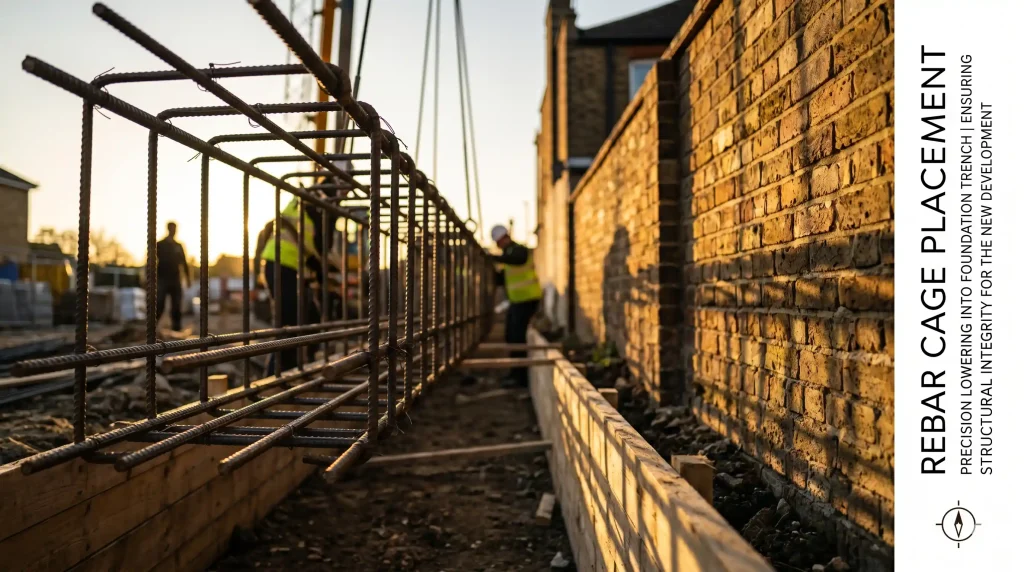
An adjoining owner who grants consent for special foundations under their land is entitled to compensation for the presence of those permanent structures. The Act does not prescribe a formula. Compensation is negotiated between the parties, often with the assistance of the party wall surveyors.
| Compensation basis | Typical London range 2026 |
|---|---|
| Pad foundations projecting 200-400mm under garden | £2,000 to £5,000 |
| Piled foundations under garden (moderate depth) | £4,000 to £8,000 |
| Deep piles affecting future development potential | £8,000 to £20,000+ |
| Right to tie into foundation for future extension | Negotiated — often £3,000 to £6,000 plus structural engineer sign-off |
What Happens If Consent Is Refused — Redesign Options
If the neighbour refuses, the foundation design must keep all reinforced elements within your own boundary. Three standard redesign routes exist in London construction.
Cantilever foundation — the foundation sits entirely on your land but is designed to cantilever the load rather than spread it symmetrically. More expensive, requires structural engineer input, but achievable in most London clay conditions. Typically adds £3,000 to £8,000 to foundation costs.
Unreinforced mass concrete strip — replace the reinforced pad with a plain mass concrete strip. This avoids the Section 7(4) definition entirely because there is no assemblage of beams or rods. Only viable at shallower depths where the unreinforced section can carry the load safely. Structural engineer must confirm this is appropriate for the soil conditions.
Boundary setback — move the wall off the boundary line by 200 to 300 millimetres so that the foundation sits entirely within your land with clearance. Loses marginally on floor space but eliminates the special foundations problem entirely.
Case Law on Special Foundations
Chaturachinda v Fairholme [2015]
The leading case on the Section 7(4) definition. The court confirmed that a mass concrete block placed beneath a reinforced concrete underpin counts as a special foundation because the rebar in the RC element constitutes the assemblage of rods distributing load. A party wall award alone is not sufficient authority to place special foundations under the neighbour’s land — written consent under Section 7(4) is a separate and additional requirement.
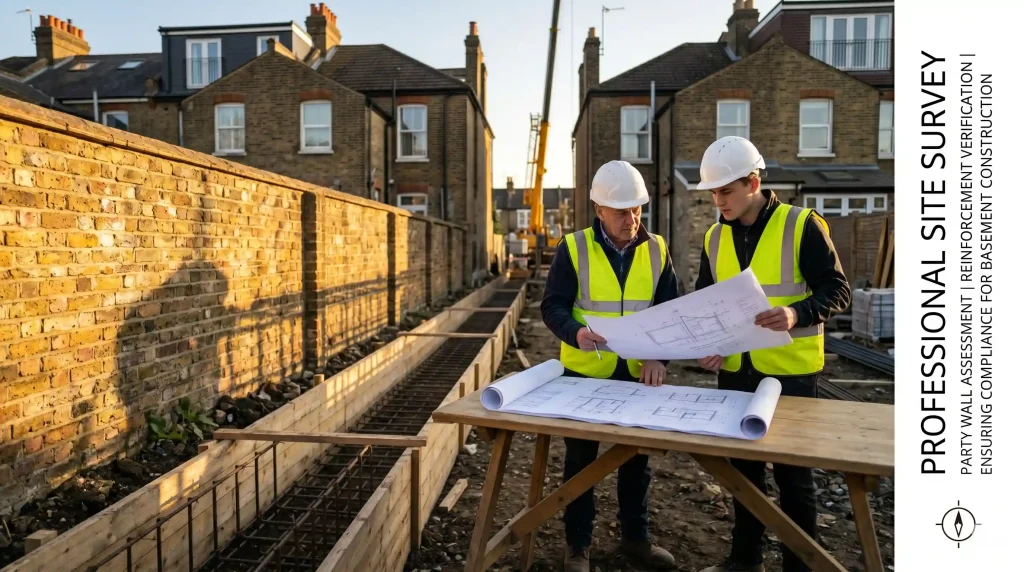
Power and Kyson v Shah [2023] EWCA Civ 239
While primarily concerned with the notice requirement, the judgment reinforces the importance of getting every statutory step right. A building owner who places special foundations without Section 7(4) consent has not just breached the Act — they have trespassed under the adjoining owner’s land. That gives the neighbour both an Act-based remedy and a common law trespass claim simultaneously.
Kaye v Lawrence [2010] EWHC 2678 (TCC)
Confirmed the surveyor’s power to require security for expenses on high-risk excavation projects. Where special foundations are proposed near a neighbour’s building, the risk level often justifies security being built into the award or the consent terms.
Neighbour has refused special foundations consent or you are not sure if your design requires it? Send us your postcode and your structural engineer’s foundation drawing. We will tell you exactly what applies and what the redesign options are. Free assessment, same-day response.
Survey of Party Wall : party wall consultancy covering all London boroughs. Special foundations specialist. Section 7(4) consent negotiation. Same-day visits. Zero paperwork risk.
Frequently Asked Questions: Special Foundations
Can my neighbour refuse special foundations consent?
Yes — for any reason. Section 7(4) of the Act gives the adjoining owner an absolute right to refuse. There is no reasonableness test and no appeal mechanism against the refusal. If consent is withheld, the building owner must redesign to keep all reinforced foundations within their own land.
Do I need special foundations consent if the piles are on my side of the boundary?
No. Section 7(4) only applies to special foundations placed on or under the adjoining owner’s land. Piles, reinforced pads, or rafts kept entirely within your own boundary do not require Section 7(4) consent — though they still need the relevant party wall notice if they are within 3 or 6 metres of the neighbour’s building.
Is a mass concrete strip foundation a special foundation?
No. Plain unreinforced mass concrete does not use an assemblage of beams or rods and does not meet the Section 20 definition of special foundations. You can place an unreinforced foundation under the neighbour’s land (with their written agreement as part of the party wall process) without the Section 7(4) absolute consent requirement — though a party wall award still governs how it is built.
How much compensation should I offer for special foundations consent?
There is no statutory figure. Compensation is negotiated. For pad foundations projecting 200 to 400 millimetres under a garden, £2,000 to £5,000 is a reasonable starting range in London in 2026. For deep piles that could affect future development potential, figures of £8,000 to £20,000 are not unusual. Offer a realistic figure upfront rather than starting low — neighbours who feel lowballed are more likely to refuse entirely.
What if the building owner places special foundations without consent?
The building owner has committed trespass under the neighbour’s land. The neighbour can seek a mandatory injunction requiring removal of the offending foundations, plus damages for trespass. Following Chaturachinda v Fairholme, the building owner also lacks the authority of a party wall award to proceed — the award alone is insufficient without Section 7(4) consent.
Key Takeaways
- Special foundations are foundations using an assemblage of beams or rods: reinforced concrete pads, piles, rafts, and reinforced underpinning all qualify.
- Section 7(4) requires explicit written consent before special foundations can be placed under the adjoining owner’s land. Consent can be refused for any reason with no appeal.
- Chaturachinda v Fairholme confirmed that a party wall award alone is not enough — Section 7(4) consent is a separate and additional requirement.
- If consent is refused, redesign options include cantilever foundations, unreinforced mass concrete strips, or boundary setback.
- Approach the neighbour directly before serving formal notice. Pre-notice conversations significantly improve consent rates.