
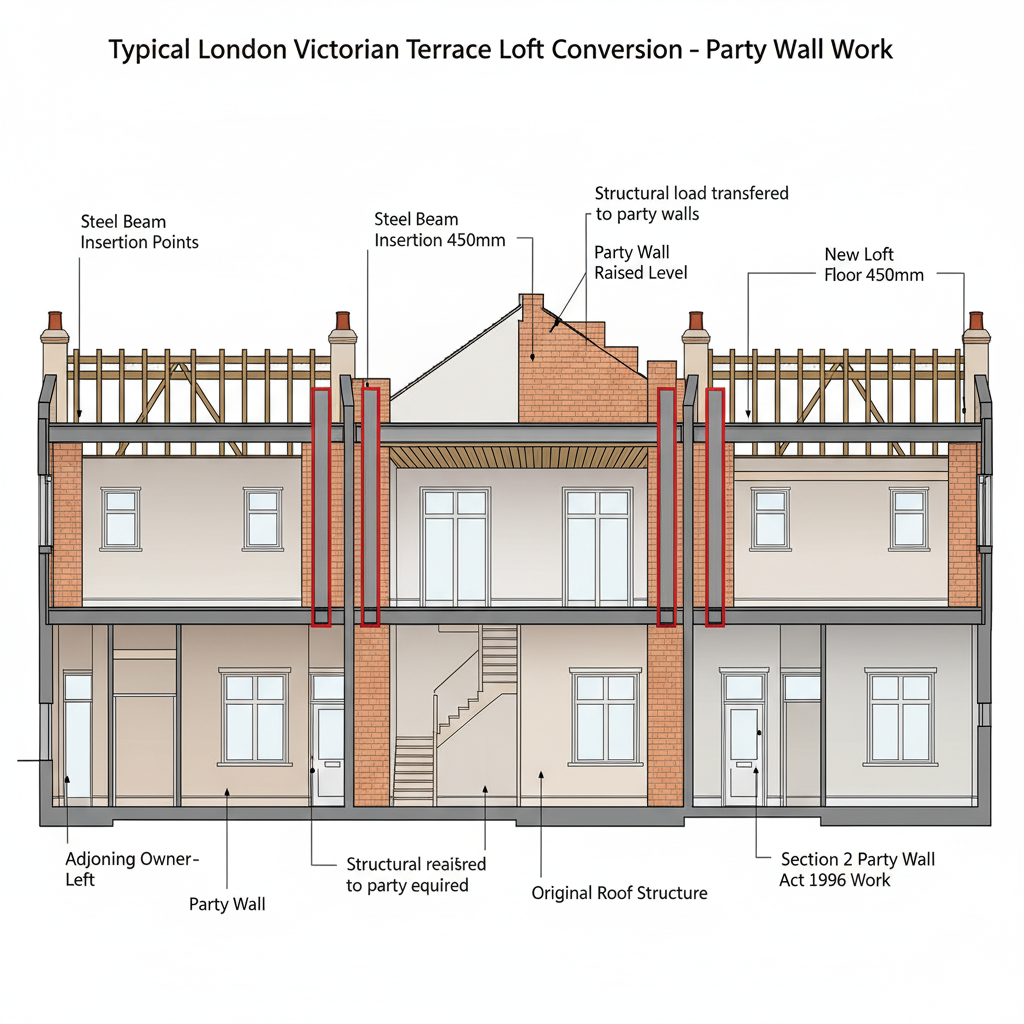
Loft Conversion Party Wall Notice: Complete London Guide
Table of Contents
- Introduction: Loft Conversions and Party Wall Requirements
- When Loft Conversions Require Party Wall Notices
- Steel Beam Insertion Scenarios
- Party Wall Raising Requirements
- Shared Chimney Stack Work
- When Notices Aren’t Required
- Understanding the Three Types of Party Wall Work
- The Complete Loft Conversion Party Wall Process
- Step 1: Initial Assessment
- Step 2: Notice Preparation and Service
- Step 3: Neighbor Response Period
- Step 4: Surveyor Appointments
- Step 5: Schedule of Condition Surveys
- Step 6: Party Wall Award Preparation
- Step 7: Construction and Monitoring
- Step 8: Completion and Final Survey
- Loft Conversion Party Wall Costs in London
- Common Loft Conversion Party Wall Issues
- London Borough Variations and Considerations
- Real London Loft Conversion Case Studies
- Legal Requirements and Compliance
- Expert Tips for Smooth Party Wall Processes
- Frequently Asked Questions
- Professional Party Wall Surveyor Services
Introduction: Loft Conversions and Party Wall Requirements
Loft conversions represent one of London’s most popular home improvements, adding valuable living space and typically increasing property value by 15-25%. However, 78% of London loft conversions require party wall procedures due to the capital’s predominant terraced and semi-detached housing stock.
Critical Statistics:
- 950,000+ London properties are suitable for loft conversion
- 78% require party wall notices due to structural work affecting shared walls
- Average party wall costs: £1,800-£3,200 for typical London loft conversion
- Timeline impact: Party wall procedures add 8-14 weeks before construction can commence
- Non-compliance risk: Projects halted by injunction, legal costs £10,000-£25,000+
Understanding when your loft conversion requires party wall notices, the complete process, realistic costs, and how to navigate potential complications ensures your project proceeds legally, smoothly, and without neighbor disputes.
This comprehensive guide draws from extensive London practice managing hundreds of loft conversion party wall matters across all 33 boroughs. Whether you’re converting a Victorian terrace in Islington, a 1930s semi in Barnet, or an Edwardian property in Wandsworth, you’ll find specific guidance for your situation.
What You’ll Learn:
- Exactly when loft conversions trigger party wall requirements
- Complete step-by-step process with realistic timelines
- Accurate cost expectations across London
- How to avoid common pitfalls and delays
- Legal compliance requirements and your rights
- Borough-specific considerations and variations
- Real case studies demonstrating successful outcomes
Who This Guide Is For:
- London homeowners planning loft conversions
- Architects and designers preparing planning applications
- Builders and contractors managing projects
- Property developers undertaking conversions
- Anyone needing to understand party wall requirements
Let’s explore everything you need to know about loft conversion party wall notices in London.
When Loft Conversions Require Party Wall Notices
Not every loft conversion requires party wall procedures, but the vast majority of London loft conversions do. Understanding exactly when notices are mandatory prevents costly mistakes and project delays.
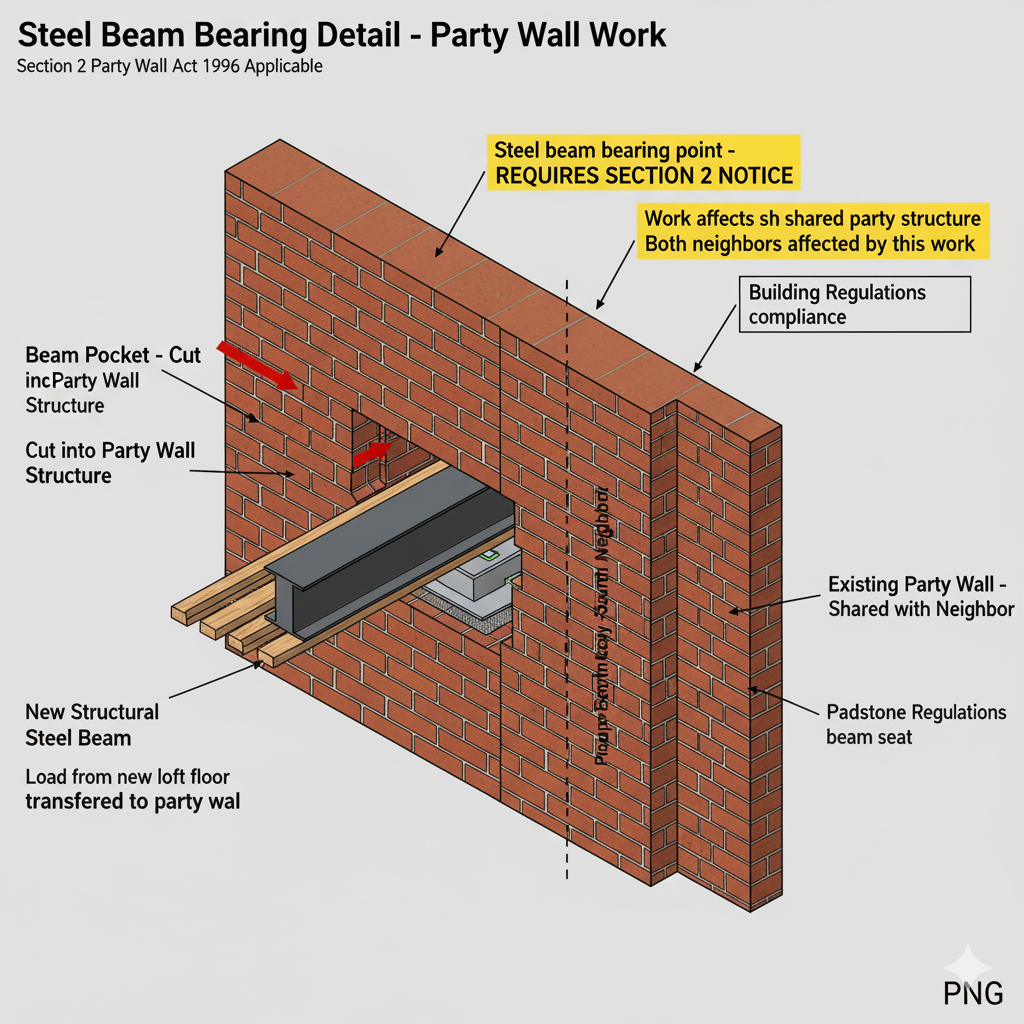
Steel Beam Insertion Scenarios
The Primary Trigger: The single most common reason loft conversions require party wall notices is structural steel beam insertion into party walls. This occurs in approximately 85% of London terrace and semi-detached property loft conversions.
Why Beams Bear Into Party Walls: Victorian, Edwardian, and inter-war properties typically have party walls extending through all floors into the roof space. When converting a loft, structural engineers specify steel beams to support new floor joists. These beams must bear onto load-bearing structures—usually the party walls on either side of the property.
What This Involves:
- Cutting pockets: Creating openings 200-250mm deep into the party wall to receive steel beam ends
- Masonry removal: Removing brick or blockwork from the shared structure
- Load transfer: New structural loads bearing onto the party wall
- Potential disturbance: Vibration, dust, and temporary structural changes
Legal Requirement: This work falls under Section 2 of the Party Wall Act 1996 (“work to an existing party wall”) and requires two months’ written notice before commencing.
Typical Scenarios:
Mid-Terrace Victorian Conversion: Party walls both sides extend into roof space. Converting the loft requires steel beams at front and rear of the property, each bearing into both party walls. This means steel work affects both neighboring properties—requiring notices to both neighbors.
End-Terrace or Semi-Detached: One party wall extends into roof space. Steel beams bear into this single party wall on one side and typically the external wall on the other. Requires notice to one neighboring property.
Hip-to-Gable Conversions: These often involve raising the party wall (see next section) in addition to steel beam insertion, creating multiple party wall implications requiring comprehensive notices.
Important Distinction: Even if beams only penetrate a few centimeters into the party wall, this constitutes “work to the party wall structure” requiring full party wall procedures. The depth of penetration doesn’t determine whether notices are needed—any structural modification to the shared wall triggers requirements.
Party Wall Raising Requirements
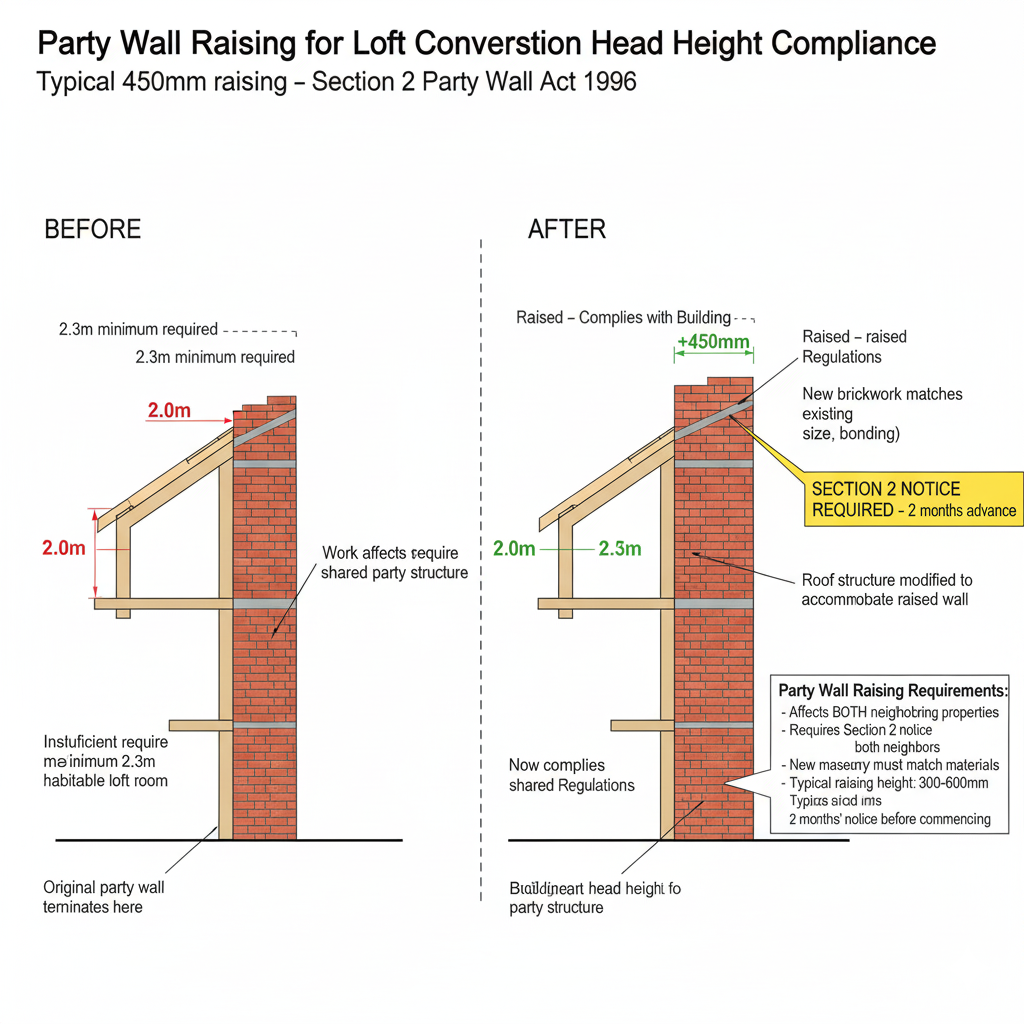
When Raising Becomes Necessary: Building Regulations require minimum ceiling heights in habitable rooms (2.3 meters in most areas, 2.15 meters at edges under sloping ceilings). Many London properties have party walls that don’t extend high enough to meet these requirements once loft floors are installed.
The Solution: Raising the party wall by typically 300-600mm creates sufficient head height. This involves building new masonry on top of the existing party wall, extending it higher into the roof space.
Party Wall Implications: Raising a party wall is explicitly covered by Section 2(2)(a) of the Party Wall Act 1996. You must serve two months’ notice before commencing this work.
Technical Considerations:
Structural Assessment: Can the existing party wall foundations support additional height and load? Victorian walls with shallow foundations may require assessment to ensure raising won’t cause settlement or stability issues.
Matching Materials: Party wall awards typically specify matching existing brickwork type, size, color, and bonding pattern. Lime mortar may be required for period properties rather than modern cement mortar.
Both Sides Affected: Raising a party wall creates a taller wall on both sides of the boundary. Both neighbors are affected even though the work is done from your side. Both must receive notices.
Roof Structure Implications: Raising party walls often requires modifications to roof structure where it meets the wall—rafters, purlins, or roof plates may need adjusting. This work must be specified in party wall notices and awards.
Common London Scenarios:
Victorian Terraces (1850-1910): Party walls often terminate at ceiling level or just above, requiring 400-600mm raising for loft conversion head height compliance. This is almost universal in terraced streets across Inner London boroughs.
Edwardian Properties (1900-1920): Similar construction to Victorian, typically requiring 300-500mm party wall raising.
1930s Suburban Properties: Party walls sometimes stop below roof space as roof structures are independent. These conversions may not require wall raising—a significant advantage in party wall process complexity.
Shared Chimney Stack Work
Chimney Stack Party Wall Status: Chimney stacks built astride party walls (straddling the boundary line) are party structures. Work affecting these stacks requires party wall notices even if the work appears to be entirely on your side.
Common Loft Conversion Chimney Scenarios:
1. Chimney Stack Removal: Many loft conversions involve removing chimney stacks that protrude through the new loft floor, creating obstructions or reducing usable space. If the stack is shared (built on the party wall line), removal requires Section 2 notices to neighbors.
Partial vs. Complete Removal:
- Removing only your side still affects party structure
- Complete removal obviously affects both properties
- Leaving stack but removing chimney breasts below requires assessment of stack stability
2. Chimney Stack Retention with Breast Removal: If you remove chimney breasts on lower floors but retain the stack in the loft space, structural support must be provided. This often involves gallows brackets or beams bearing into party walls—triggering party wall requirements.
3. Roof Level Chimney Work: Alterations to chimney stacks at roof level (repointing, capping, rebuilding) may require party wall procedures if the stack straddles the boundary and the work affects structural integrity.
Legal Position:
Ownership: Chimney stacks on party walls are jointly owned. Neither owner can remove or substantially alter them without serving party wall notices and obtaining appropriate awards.
Obligations: If removal creates instability requiring support work, the building owner undertaking removal is responsible for providing adequate support and protection to the neighbor’s property.
Insurance: Removing chimney stacks creates structural changes that must be declared to insurers. Party wall awards provide documentation demonstrating proper procedures were followed.
When Party Wall Notices Aren’t Required
Understanding Exceptions: Not every loft conversion triggers party wall requirements. Understanding exceptions prevents unnecessary procedures and costs.
Scenarios NOT Requiring Notices:
1. Steel Beams Don’t Touch Party Walls: If structural design allows beams to bear entirely on external walls or internal load-bearing walls without touching party structures, no party wall notices are needed. This is uncommon in terraced properties but occasionally feasible in semi-detached or detached properties.
2. Independent Roof Structures: Some 1930s-1950s properties have completely independent roof structures for each dwelling. Party walls stop at ceiling level with separate roof trusses. If loft conversion work doesn’t involve party walls at all (no raising, no beam insertion, no shared structures), notices aren’t required.
3. Detached Properties: Properties with no shared walls obviously don’t require party wall notices for internal work. However, if excavation for new staircase or structural work occurs within 3-6 meters of neighboring properties’ foundations, Section 6 (excavation) notices may be required.
4. Internal Non-Structural Work: Purely internal loft work not affecting party structures doesn’t require notices:
- Insulation installation (unless removing/rebuilding party wall sections)
- Plasterboard and internal finishes
- Electrics and plumbing (unless creating notches in party walls)
- Internal stud partition walls
- Velux windows in roof slopes (not affecting party walls)
Critical Distinction: Even one steel beam bearing into a party wall, or raising the party wall by even 300mm, triggers full party wall notice requirements. The threshold for “party wall work” is low—any structural modification to shared structures requires compliance.
Professional Assessment Required: Given the legal and financial consequences of non-compliance, obtain professional confirmation from your structural engineer, architect, or party wall surveyor about whether your specific loft conversion requires notices. Don’t assume—verify.
Understanding the Three Types of Party Wall Work
While loft conversions primarily involve Section 2 work (party structure modifications), understanding all three sections of the Party Wall Act 1996 helps you identify if multiple notice types apply to your project.
Section 1: Building New Walls at the Boundary
Application to Loft Conversions: Rarely applicable to loft conversions themselves, but may be relevant if you’re building new structures as part of a combined project (e.g., loft conversion plus garage construction at boundary).
Notice Period: One month before commencing work
Requirements:
- Building a new wall astride the boundary line
- Building a new wall entirely on your land up to the boundary
- Foundations for new walls at or near boundaries
Section 2: Work to Existing Party Walls
Primary Application for Loft Conversions: This is the critical section governing most loft conversion party wall work.
Notice Period: Two months before commencing work
Covered Work:
- Cutting into party walls (steel beam pockets, notches, chases)
- Raising party walls (increasing height for head room)
- Demolishing and rebuilding party walls or sections
- Underpinning party walls (rarely needed for loft conversions)
- Cutting away projecting footings if present
- Inserting damp-proof courses in party walls
- Reducing or thickening party walls (uncommon in loft work)
Multiple Elements: A single loft conversion often involves multiple Section 2 elements:
- Steel beam insertion (cutting into walls)
- Party wall raising (increasing height)
- Chimney stack work (removal or modification)
All can be covered in a single comprehensive Section 2 notice rather than multiple separate notices.
Section 6: Excavation Near Neighboring Buildings
Application to Loft Conversions: Usually not triggered by loft conversion work itself, but relevant if excavating for new staircases or foundation work.
Notice Period: One month before commencing (or longer if later start date specified)
Two Distance/Depth Triggers:
Within 3 Meters AND Going Deeper: If excavating within 3 meters of neighbor’s foundation and going deeper than their foundation base, Section 6 notice required.
Within 6 Meters AND Cutting 45-Degree Line: If excavating within 6 meters and a 45-degree line drawn downward from neighbor’s foundation base would be cut by your excavation, Section 6 notice required.
Loft Conversion Relevance: Internal staircases to new loft spaces sometimes require foundation work if structural support is needed. External staircases or dormer foundation work might trigger Section 6 if close to boundaries.
Combined Notices: Projects involving both Section 2 and Section 6 work can serve combined notices, though timing differs (Section 2 = 2 months, Section 6 = 1 month). Serve both simultaneously using the longer timeline (2 months) to cover all requirements.
The Complete Loft Conversion Party Wall Process
Understanding the step-by-step process with realistic timelines helps you plan your loft conversion project accurately and avoid delays.
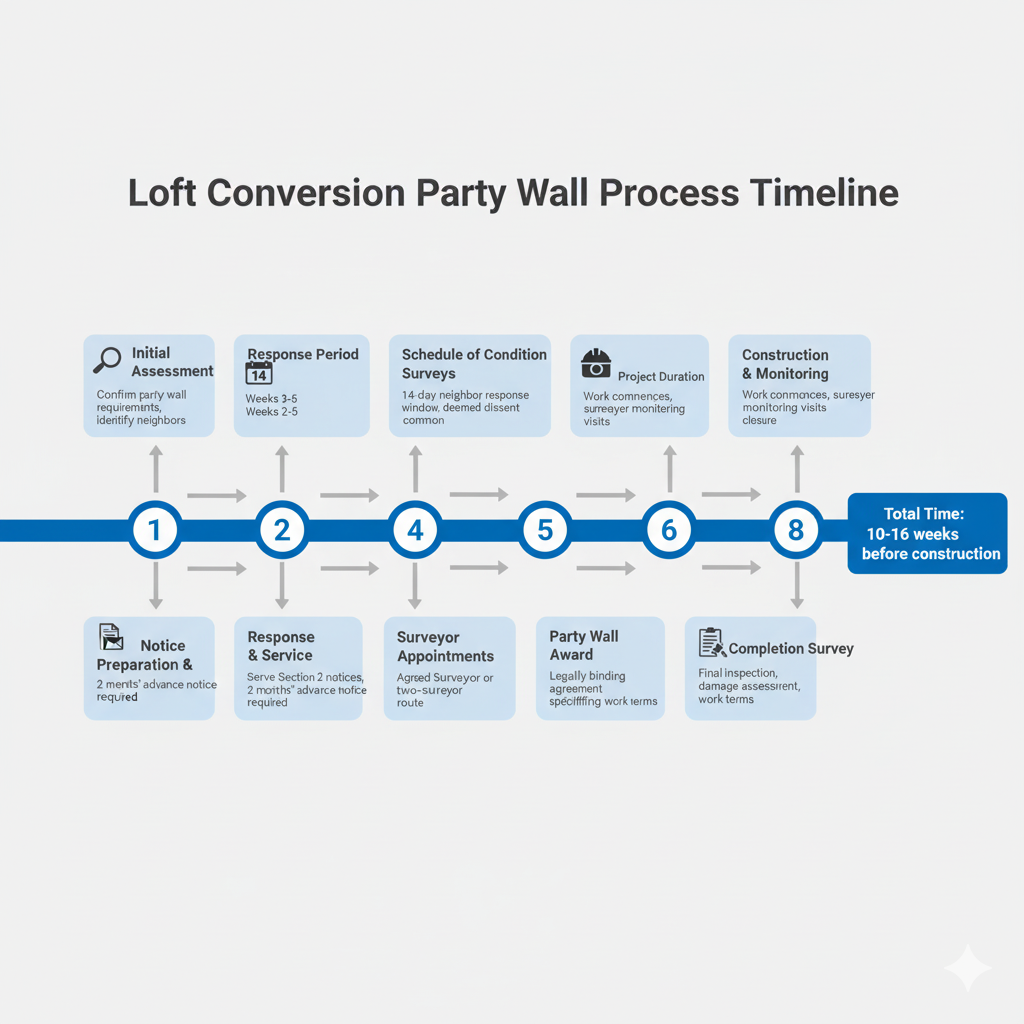
Step 1: Initial Assessment (Week 1)
Confirm Party Wall Requirements: Before serving any notices, definitively establish whether your loft conversion requires party wall procedures.
Key Actions:
1. Review Structural Plans: Your structural engineer’s drawings should show steel beam positions and bearings. If beams bear into party walls, party wall procedures are mandatory.
2. Identify All Affected Neighbors:
- Mid-terrace: Typically two neighbors (both sides)
- End-terrace or semi-detached: Usually one neighbor
- Corner properties: May affect multiple neighbors depending on configuration
- Converted buildings: May involve multiple flat owners plus freeholder
3. Property Boundary Verification: Obtain title deeds from Land Registry showing exact boundary positions. Victorian and Edwardian properties sometimes have unclear boundaries—verification prevents disputes about which wall is actually the party wall.
4. Preliminary Surveyor Consultation: Many party wall surveyors offer free initial consultations. Discuss your project, obtain timeline estimates, and get fee quotes before committing.
5. Neighbor Introduction: Consider informal conversations with neighbors before formal processes. Explain your plans, show drawings, and discuss timeline. This personal approach often smooths the entire process and increases chances of Agreed Surveyor appointments (more economical than separate surveyors).
Step 2: Notice Preparation and Service (Weeks 1-2)
Notice Preparation:
Party wall notices must be in writing and contain specific information:
Required Content:
- Your name and property address
- Neighbor’s name and address (serve to freeholder, not just tenants)
- Clear description of proposed work (attach structural drawings)
- Specific Party Wall Act sections being invoked (typically Section 2 for loft conversions)
- Proposed start date (must be at least 2 months ahead for Section 2 work)
- Statement of neighbor’s rights to consent or dissent
Supporting Documents:
- Architectural plans showing party wall positions
- Structural engineer drawings showing steel beam locations and bearings
- Cross-section drawings showing party wall raising
- Clear indication of which walls are party walls vs. external walls
Professional Preparation: Party wall surveyors typically prepare notices as part of their service, ensuring legal compliance and technical accuracy. Self-prepared notices often contain errors that delay processes or invalidate service.
Service Methods:
Legally Valid Service:
- Hand delivery to the neighbor personally
- Hand delivery to any person at the property
- Recorded delivery post (obtain proof of posting certificate)
- Leaving at property if unoccupied and affixing conspicuously
Best Practice for London Loft Conversions: Use recorded delivery post for clear proof of service date—critical for calculating the 2-month notice period. Keep all postal receipts and tracking information.
Important Timing Consideration: The two-month period begins from the date of service, not from when the neighbor receives or reads the notice. Serve notices with a proposed start date at least 2 months plus 1 week ahead to provide comfortable margin.
Step 3: Neighbor Response Period (Weeks 2-5)
14-Day Response Window: After receiving your notice, neighbors have 14 days to respond in one of three ways:
Option 1: Consent (Rare—Approximately 5% of London Cases) Neighbor formally agrees to your notice in writing. This is unusual because:
- Neighbors prefer independent verification of work scope
- Concern about potential property damage
- Desire for professional documentation protecting their interests
- May not understand party wall procedures
Important: Even with consent, conduct Schedule of Condition surveys to protect against future damage claims.
Option 2: Dissent (Approximately 15-20% of Cases) Neighbor formally objects in writing within 14 days. This isn’t necessarily hostile—many neighbors dissent simply to ensure proper professional oversight of the work. Dissent triggers the surveyor appointment process.
Option 3: No Response (Approximately 75-80% of Cases) This is the most common scenario in London. If neighbors don’t respond within 14 days, the Party Wall Act deems automatic dissent. This isn’t illegal or problematic—it’s an expected outcome built into the Act’s framework.
Why Non-Response Is Common:
- Neighbors don’t understand party wall procedures
- Away from property when notice served
- Uncertain how to respond
- Assume silence means no objection (incorrect assumption)
- Don’t prioritize responding
- Rental properties where tenants receive notices but can’t legally respond (must reach freeholder)
After 14 Days: Once deemed dissent occurs through non-response, you must proceed to Step 4 (surveyor appointments). Send a follow-up letter explaining deemed dissent status and the next steps in the process.
Step 4: Surveyor Appointments (Weeks 5-6)
When Dissent Occurs (Actual or Deemed): The Party Wall Act requires surveyor appointment to prepare a Party Wall Award—the legally binding agreement specifying work terms.
Two Appointment Routes:
Route A: Agreed Surveyor (60% of London Loft Conversions)
How It Works: Both you and your neighbor jointly appoint a single surveyor who acts impartially for both parties.
Advantages:
- Faster process (one surveyor, not coordinating multiple)
- More economical (single set of fees, typically £1,800-£2,800)
- Simpler communication
- Usually appropriate for straightforward loft conversions
Process:
- You suggest 2-3 qualified surveyors to your neighbor
- Neighbor selects one they’re comfortable with (or suggests alternatives)
- Both parties formally appoint in writing
- Surveyor confirms acceptance to both parties
Route B: Two Surveyors (40% of London Loft Conversions)
How It Works: You appoint your own surveyor, and your neighbor appoints their surveyor. The two surveyors then jointly select a Third Surveyor (who only gets involved if they disagree—rare, under 3% of cases).
Advantages:
- Each party has dedicated representation
- Appropriate for complex or high-value projects
- Better for multiple neighbors with different concerns
- Neighbor may prefer independent representation
Cost Impact: You pay both surveyors’ fees:
- Your surveyor: £2,000-£3,500
- Neighbor’s surveyor: £1,800-£3,200
- Total: £3,800-£6,700 per neighbor
If Neighbor Doesn’t Appoint: If your neighbor doesn’t appoint a surveyor within 10 days of dissent, you can appoint one on their behalf—choosing someone qualified and independent. That surveyor then represents your neighbor’s interests (though you still pay their fees).
London Loft Conversion Pattern: Agreed Surveyor appointments are more common in:
- Established residential neighborhoods
- Properties where neighbors know each other
- Straightforward loft conversions without complications
- Situations where preliminary communication was positive
Two-surveyor scenarios more common in:
- High-value properties (£1.5m+)
- Complex conversions affecting multiple neighbors
- Situations with existing neighbor tensions
- Commercial or mixed-use buildings
Step 5: Schedule of Condition Surveys (Weeks 6-8)
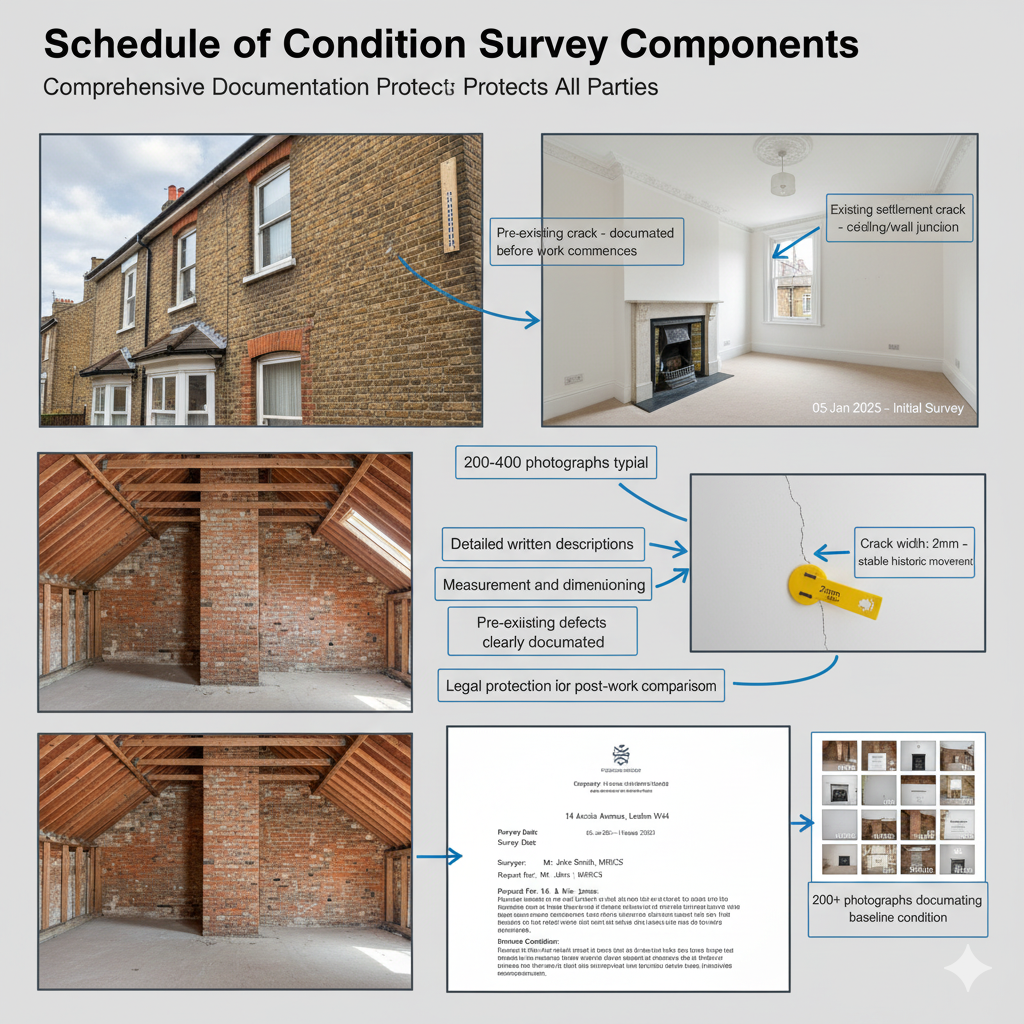
Critical Protection for All Parties: Schedule of Condition surveys document the existing state of all affected properties before work commences. This is arguably the most important element of party wall procedures.
Survey Scope for Loft Conversions:
Your Neighbor’s Property:
External Inspection:
- All elevations (front, rear, sides)
- Roof condition visible from ground
- Chimney stacks
- Gutters and downpipes
- External walls for cracks, movement, or defects
- Windows and doors
Internal Inspection (Rooms Adjacent to Party Walls):
- All rooms sharing party walls with your property
- Ceilings and floors in these rooms
- Internal walls and finishes
- Any existing cracks, stains, or damage
- Historic settlement or movement evidence
Loft Space Inspection: Critically important for loft conversions—surveyor inspects neighbor’s loft space to document:
- Party wall condition at roof level
- Chimney stack condition if present
- Roof structure condition
- Any existing damage or defects
- Relationship between your planned work and their property
Photographic Documentation: Comprehensive photography (typically 150-300 photos per property):
- Wide shots showing overall condition
- Close-ups of all defects, cracks, or damage
- Multiple angles of key areas
- Dated images providing time-stamped evidence
Written Descriptions: Detailed written report describing:
- General property condition
- Specific defects location, size, and nature
- Assessment of existing damage causes (age, settlement, previous work)
- Baseline condition for post-work comparison
Why This Matters:
For You (Building Owner): Proves any pre-existing damage wasn’t caused by your work. Victorian and Edwardian properties often have settlement cracks, historic movement, and previous damage. Without baseline documentation, you could be blamed and forced to pay for repairs of pre-existing issues.
For Your Neighbor: Provides evidence if new damage occurs during your loft conversion. Post-work surveys compare final condition to baseline, clearly identifying any damage your work caused.
Legal Protection: Schedule of Condition surveys form part of the Party Wall Award and carry legal weight if disputes arise about damage responsibility.
Access Requirements: Your neighbor must provide reasonable access for surveys. Typically 2-3 hours per property, scheduled at neighbor’s convenience. Surveyors are respectful and professional—this isn’t invasive.
Step 6: Party Wall Award Preparation (Weeks 8-11)
The Party Wall Award: A legally binding document specifying exactly how your loft conversion work affecting party walls will be executed and what protections exist for all parties.
Award Contents for Loft Conversions:
1. Detailed Work Description:
- Precise specification of steel beam insertion (locations, sizes, bearing depths)
- Party wall raising methodology (height, materials, techniques)
- Chimney stack work if applicable
- Structural engineer calculations and specifications
- Building methods and sequencing
2. Work Methodology:
- How cutting pockets for beams will be executed
- Protection measures during construction
- Vibration control for mechanical cutting
- Dust suppression requirements
- Load transfer procedures
3. Working Hours: Typically specified as:
- Monday-Friday: 8:00am-6:00pm
- Saturday: 8:00am-1:00pm
- No working Sundays or Bank Holidays
- (Variations negotiated based on circumstances)
4. Access Arrangements:
- Any required access through neighbor’s property
- Scaffolding or equipment placement needs
- Duration of access requirements
- Reasonable notice provisions
5. Protection Measures:
- How party walls will be protected during work
- Dust barriers and containment
- Structural support during construction
- Protection of neighbor’s property from debris or damage
6. Insurance and Liability:
- Confirmation of building owner’s insurance details
- Contractor insurance requirements
- Liability provisions
- Damage resolution procedures
7. Monitoring Provisions (If Required): For complex loft conversions or properties with pre-existing concerns:
- Crack monitoring gauge installation
- Vibration monitoring during work
- Periodic inspection requirements
- Reporting protocols
8. Rights and Obligations:
- Building owner’s obligations
- Adjoining owner’s rights
- Surveyor’s role during construction
- Dispute resolution procedures
9. Schedule of Condition: The baseline surveys are attached and incorporated into the Award, forming the comparison benchmark for post-work assessment.
10. Fees and Costs:
- Surveyor fee specifications
- Payment responsibility confirmation
- Disbursement provisions
Award Timeline:
Agreed Surveyor Route:
- Draft Award prepared: 7-10 days after surveys complete
- Review and finalization: 3-5 days
- Award service: 10-14 days after surveys typically
Two-Surveyor Route:
- Each surveyor prepares input: 7-10 days after surveys
- Negotiation and coordination: 5-10 days
- Consensus Award preparation: 5-7 days
- Award service: 14-21 days after surveys typically
London Complexity Factors Adding Time:
- Multiple neighbors requiring coordination: +5-7 days
- Complex technical specifications: +3-5 days
- Conservation area requirements: +5-10 days
- Unusual structural arrangements: +3-7 days
Step 7: Construction and Monitoring (Project Duration)
After Award Service: The Award is served to all parties. There’s a 14-day appeal period (appeals are very rare—under 2% of cases). After this period expires, construction can legally commence.
Compliance During Construction:
Your Obligations:
- Follow Award specifications precisely
- Employ competent contractors familiar with party wall requirements
- Provide Award copy to builders before work starts
- Adhere to specified working hours
- Minimize inconvenience to neighbors
- Maintain communication channels
Contractor Requirements: Your builder must:
- Understand party wall restrictions and requirements
- Execute work per Award methodology
- Take care not to damage neighboring property
- Allow surveyor site inspections
- Report any complications immediately
Surveyor Monitoring:
Periodic Inspections: Surveyors typically conduct 2-4 site inspections during loft conversion construction:
- Initial visit: Confirm work commencing per Award terms
- Mid-construction: Verify steel work installation, party wall raising execution
- Problem response: If issues arise or neighbors raise concerns
- Pre-completion: Final verification before finishing
Monitoring Triggers: More frequent inspections for:
- Complex projects
- Properties with pre-existing issues
- Neighbor concerns about vibration or damage
- Deviations from original specifications requiring assessment
If Issues Arise:
Damage Discovered: If your work causes damage to neighbor’s property:
- Stop work immediately
- Contact surveyor within 24 hours
- Surveyor assesses damage and cause
- Repair methodology determined
- Work to rectify damage undertaken
- Costs borne by building owner
Unforeseen Complications: If structural issues discovered during work:
- Stop relevant work
- Contact surveyor immediately
- Structural engineer assessment
- Award variation prepared if needed
- Additional approvals obtained before proceeding
Neighbor Communication: Maintain good relationships during construction:
- Provide advance notice of particularly noisy operations
- Keep shared areas clean
- Respond promptly to concerns
- Update on timeline changes
- Show consideration for neighbor’s daily routines
Step 8: Completion and Final Survey (Final Week)
Post-Completion Assessment: After loft conversion work is substantially complete, final Schedule of Condition surveys are conducted.
Final Survey Process:
1. Timing: Typically conducted 1-2 weeks after practical completion of party wall work (before final decorations, as damage may need access for repairs).
2. Comprehensive Comparison: Surveyor returns to neighbor’s property inspecting all areas covered in initial surveys:
- External elevations
- Internal rooms adjacent to party walls
- Loft spaces
- Roof and chimney condition
- Overall property state
3. Photographic Documentation: New photographs from identical positions as initial survey for direct comparison.
4. Damage Assessment: Surveyor determines:
- Any new damage or deterioration
- Whether changes are attributable to your work
- Severity and remediation requirements
- Cost estimates for repairs if needed
Possible Outcomes:
Outcome A: No Damage (Most Common—85% of London Loft Conversions) Final survey shows no actionable damage attributable to the work. Minor hairline cracks within acceptable tolerance. Surveyor issues completion certificate confirming compliance.
Outcome B: Minor Cosmetic Damage (12% of Cases) Small cracks in plaster, minor settling, cosmetic issues. Building owner responsible for repairs:
- Replastering affected areas
- Redecorating
- Matching finishes
- Costs typically £300-£1,500
Outcome C: Structural Damage (Rare—3% of Cases) Significant damage requiring structural repairs. Surveyor specifies:
- Cause determination (was it actually your work?)
- Required remedial works
- Structural engineer involvement if needed
- Timelines and costs
- Typically £2,000-£10,000+ depending on severity
Documentation:
Final Report: All parties receive:
- Final Schedule of Condition
- Photographic comparisons (before/after)
- Damage assessment if applicable
- Repair specifications if needed
- Compliance confirmation
- Award closure documentation
Retention Period: Keep all party wall documentation permanently:
- Original notices
- Surveyor correspondence
- Party Wall Awards
- Schedules of Condition (initial and final)
- Payment records
Why This Matters: Future property sales require party wall documentation. Solicitors request proof of compliance during conveyancing. Lack of documentation can delay or complicate sales, potentially reducing property value.
Loft Conversion Party Wall Costs in London
Understanding realistic costs helps you budget accurately for the complete loft conversion project including party wall procedures.
Surveyor Fee Breakdown
Agreed Surveyor Route (Single Surveyor for All Parties):
Mid-Terrace (Two Neighbors):
- Standard loft conversion: £2,200-£3,200
- Complex conversion (hip-to-gable, multiple dormers): £2,800-£4,000
- Large property (4+ bedrooms): £3,000-£4,500
End-Terrace or Semi-Detached (One Neighbor):
- Standard loft conversion: £1,800-£2,600
- Complex conversion: £2,200-£3,200
- Large property: £2,400-£3,500
Two-Surveyor Route (Separate Surveyors):
Per Neighbor Costs:
- Your surveyor: £2,000-£3,500
- Neighbor’s surveyor (you pay): £1,800-£3,200
- Total per neighbor: £3,800-£6,700
Mid-Terrace (Two Neighbors, Both Appoint Separate Surveyors):
- Total party wall costs: £7,600-£13,400
- Significantly higher than Agreed Surveyor route
What’s Included in Surveyor Fees:
Standard Services:
- Initial consultation and advice
- Notice preparation and service
- Surveyor appointment coordination
- Schedule of Condition surveys (initial and final)
- Photographic documentation (200-400 photos typical)
- Party Wall Award preparation and negotiation
- Construction monitoring visits (2-4 inspections)
- Dispute resolution if needed
- All correspondence and administration
- Final documentation and closure
Additional Costs to Budget:
Third Surveyor (If Required): If two surveyors disagree (rare, under 3%):
- Third Surveyor fees: £1,500-£3,000
- Usually shared between disputing parties
Specialist Reports: For complex situations:
- Structural engineer reports: £1,200-£2,500
- Building condition specialists: £800-£1,500
- Additional surveys for complications: £500-£1,200
Damage Repairs: If your work causes damage:
- Minor cosmetic repairs: £300-£1,500
- Significant replastering: £1,500-£4,000
- Structural repairs: £2,000-£10,000+
Cost Variations by London Area
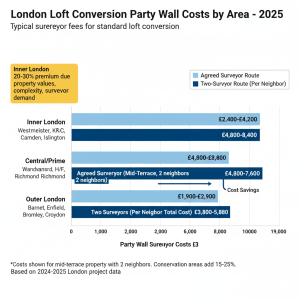
Inner London Boroughs (Westminster, Kensington & Chelsea, Camden, Islington):
- Premium pricing: 20-30% above average
- Typical range: £2,400-£4,200 (Agreed Surveyor, mid-terrace)
- Reflects property values, surveyor demand, complexity
Central/Prime Areas (Wandsworth, Hammersmith & Fulham, Richmond):
- Above average: 10-20% premium
- Typical range: £2,200-£3,800 (Agreed Surveyor, mid-terrace)
Outer London Boroughs (Barnet, Enfield, Bromley, Croydon):
- Competitive pricing: 10-15% below Inner London
- Typical range: £1,900-£2,900 (Agreed Surveyor, mid-terrace)
Conservation Areas: Add 15-25% to base fees due to:
- Enhanced methodology requirements
- Additional documentation
- Heritage consultant coordination
- Extended timelines
Cost-Saving Strategies
1. Agreed Surveyor Appointment: Single surveyor for all parties saves 40-50% compared to separate surveyors. Encourage this through good neighbor communication.
2. Early Engagement: Appoint surveyors 4-5 months before construction allows:
- Competitive quote comparison
- No rush fees
- Better surveyor availability
- Time for cost-effective approaches
3. Fixed-Fee Arrangements: Request fixed fees rather than hourly rates:
- Budget certainty
- No surprises
- Typically 15-20% more economical for standard loft conversions
4. Bundled Services: If using architect or structural engineer who offers party wall services, bundled packages sometimes offer savings.
5. Neighbor Communication: Five minutes of friendly pre-notice conversation can result in Agreed Surveyor appointments, saving £2,000-£5,000+ on typical mid-terrace conversions.
Comparison to Total Project Costs
Perspective: Typical London loft conversion costs: £35,000-£60,000 Party wall procedures: £2,000-£4,000 (Agreed Surveyor) Percentage: 5-8% of total project cost
This investment protects against legal problems costing £10,000-£25,000+ and maintains neighbor relationships worth far more than money.
Common Loft Conversion Party Wall Issues
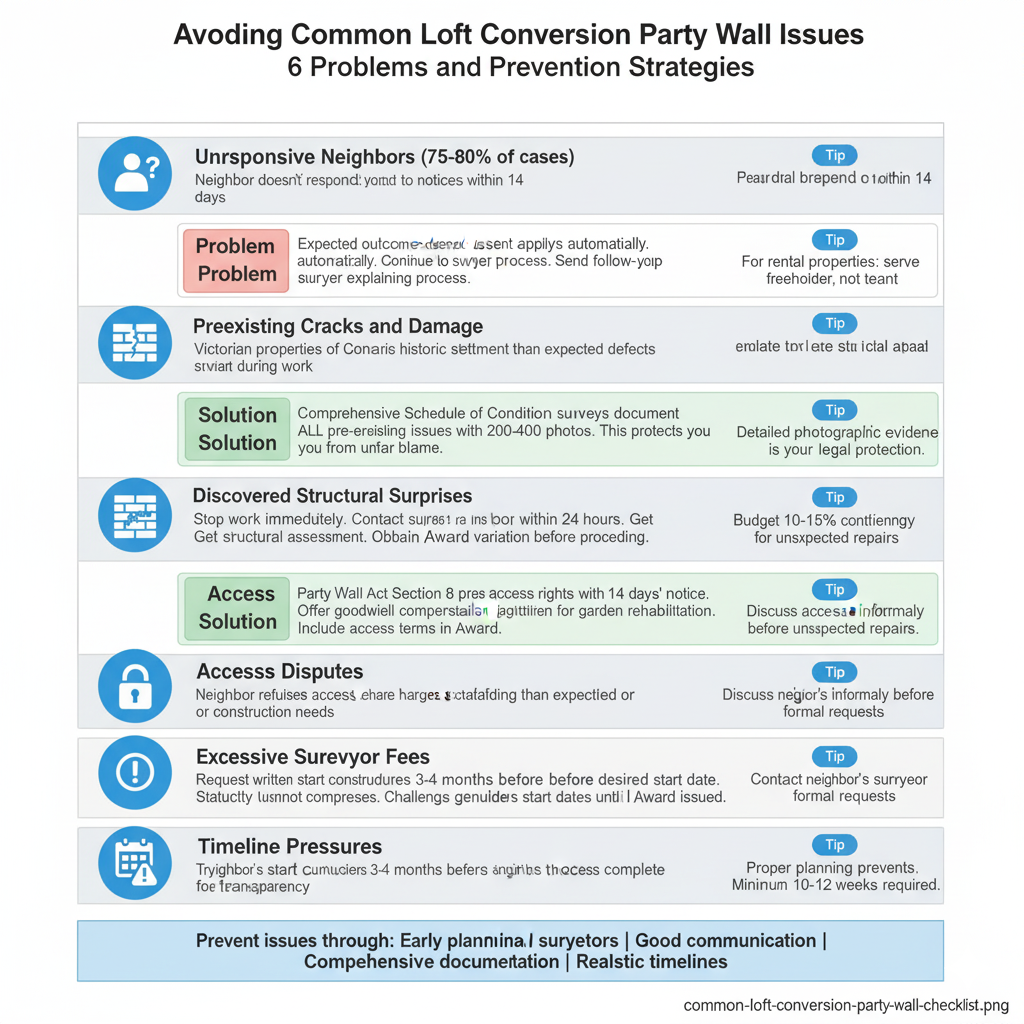
Understanding typical problems helps you anticipate and prevent them in your project.
Issue 1: Unresponsive Neighbors
Frequency: Very common (75-80% of cases)
Scenario: You serve party wall notices, but neighbors don’t respond within 14 days.
Why This Happens:
- Neighbors don’t understand procedures
- Away when notices served
- Uncertain how to respond
- Rental properties (tenant can’t respond legally)
- Assume silence means no objection
Solution: Deemed dissent occurs automatically after 14 days—this is normal and expected. Send follow-up letter explaining deemed dissent and next steps. Proceed to surveyor appointments as planned.
For Rental Properties: Always serve notices to freeholder (property owner), not tenants. Conduct Land Registry search (£3 online) to identify owner if unclear.
Issue 2: Pre-Existing Cracks and Damage
Frequency: Common (40% of Victorian/Edwardian properties)
Scenario: Schedule of Condition survey reveals your neighbor’s property has existing cracks, settlement, or structural issues. Neighbor worries your loft conversion will worsen these problems.
Why This Happens in London:
- Victorian/Edwardian properties naturally settle over 100+ years
- London Clay subsoil causes seasonal ground movement
- Previous undocumented alterations
- Historic subsidence or settlement
- Tree root activity
Solution: This is exactly why comprehensive Schedule of Condition surveys are essential:
- Detailed Documentation: Surveyor photographs and describes all pre-existing defects comprehensively
- Baseline Establishment: Creates clear evidence that damage existed before your work
- Monitoring Protocol: For significant concerns, install crack monitoring gauges
- Award Protection: Party Wall Award specifies building owner isn’t liable for pre-existing conditions
London Clay Consideration: Schedule surveys during similar seasonal conditions to final surveys (both in summer or both in winter) for fairest comparison, as clay movement is cyclical.
Issue 3: Discovered Structural Surprises
Frequency: Occasional (15% of projects)
Scenario: When cutting into party walls for steel beams, builders discover the Victorian masonry is in worse condition than expected—deteriorated mortar, void areas, spalling bricks, or hidden alterations.
Why This Happens:
- Historic repairs hidden behind plaster
- Moisture ingress over decades
- Original construction quality variations
- Concealed previous structural modifications
- Lime mortar deterioration
Solution:
- Stop Work Immediately: Don’t proceed until assessed
- Notify Surveyor: Contact within 24 hours
- Technical Assessment: Structural engineer inspects and specifies remedial work
- Award Variation: If work scope changes significantly, surveyor amends Award
- Cost Responsibility: Building owner typically bears costs of unexpected repairs needed to safely complete their work
Prevention: Include contingency clauses in builder contracts specifically for party wall condition uncertainties. Budget extra 10-15% for potential masonry repairs.
Issue 4: Access Disputes
Frequency: Occasional (12% of cases)
Scenario: Your builder needs temporary access through neighbor’s property for scaffolding, equipment delivery, or practical construction access. Neighbor refuses or demands excessive compensation.
Why This Happens:
- Privacy concerns
- Garden damage worries
- Previous bad experiences with building work
- Parking and disruption issues
- Lack of trust
Solution: The Party Wall Act includes access provisions (Section 8):
- Reasonable Access Rights: Building owners can access neighboring property where necessary
- Notice Requirements: Must give 14 days’ notice before accessing
- Minimize Impact: Access at reasonable times with minimal disruption
- Party Wall Award Terms: Surveyor specifies access arrangements in Award
- Compensation: If access causes loss (damaged plants, temporary inconvenience), reasonable compensation may be payable
- Legal Enforcement: If neighbor unreasonably refuses after proper notice, County Court can grant access orders
Best Approach: Discuss access needs with neighbors informally before formal requests. Offer goodwill gestures—pay for garden rehabilitation, provide temporary privacy screening, or compensate reasonably for inconvenience.
Issue 5: Excessive Surveyor Fees
Frequency: Occasional (10% of cases)
Scenario: Your neighbor appoints their own surveyor (two-surveyor route), and their surveyor’s fees are significantly higher than expected or seem disproportionate to work done.
Why This Happens:
- Neighbor doesn’t realize building owner pays their surveyor
- Some surveyors charge premium rates when someone else pays
- Scope creep as projects develop
- Lack of transparency in fee structures
Solution: You’re legally obligated to pay “reasonable” surveyor fees, but “reasonable” has limits:
- Request Fee Estimates: Before appointment confirmation, ask neighbor’s surveyor for written fee estimate
- Challenge Excessive Fees: If fees seem disproportionate, request itemized breakdowns
- Compare Market Rates: Use typical London fee ranges as benchmarks
- Pyramus and Thisbe Club Standards: Pyramus and Thisbe Club-regulated surveyors must charge reasonable, justifiable fees
- Dispute Resolution: If fees are genuinely excessive, raise with both surveyors—Third Surveyor can adjudicate
Prevention: When your neighbor appoints their surveyor, proactively contact them introducing your project and requesting fee quote. This creates transparency and allows cost discussions before work is done.
Issue 6: Timeline Pressures
Frequency: Common (30% of projects)
Scenario: You’ve scheduled builders to start your loft conversion in 8 weeks, but you haven’t served party wall notices yet. Can you accelerate the process?
Reality: No—statutory timelines cannot be compressed:
- Section 2 notice: Mandatory 2 months
- Response period: Fixed 14 days
- Surveyor processes: Typically 4-6 weeks minimum
Total Minimum: 10-12 weeks from notice service to construction commencement
Solution:
- Proper Planning: Begin party wall procedures 3-4 months before desired construction start
- Builder Coordination: Don’t promise start dates until Party Wall Award issued and appeal period expired
- Contingency Scheduling: Build 2-week buffer into construction scheduling for party wall contingencies
Attempting Acceleration: Rushing party wall procedures creates more delays than it saves. Errors in notices, inadequate surveys, or shortcuts often result in disputes requiring 4-8 weeks to resolve—eliminating any time “saved.”
London Borough Variations and Considerations
While the Party Wall Act 1996 applies uniformly across all London boroughs, local factors create area-specific considerations for loft conversions.
Conservation Areas
Boroughs with Extensive Conservation Areas:
- Westminster (75+ conservation areas)
- Camden (40+ conservation areas)
- Kensington & Chelsea (85% of borough)
- Richmond (60+ conservation areas)
- Islington (35+ conservation areas)
Party Wall Implications: Conservation area designation doesn’t change Party Wall Act requirements, but adds parallel considerations:
Additional Requirements:
- Heritage methodology statements for party wall work
- Material matching specifications (lime mortar, historic bricks)
- Conservation Officer consultation
- Enhanced Schedule of Condition detail for historic fabric
- Timeline extensions of 2-4 weeks typical
Both Processes Required: Planning permission (with conservation compliance) AND party wall procedures must both be satisfied independently.
Property Types by Borough
Victorian/Edwardian Terrace Dominance:
- Inner London: Islington, Camden, Hackney, Lambeth, Wandsworth
- Party Wall Impact: 85-90% of loft conversions require notices
- Typical costs: £2,200-£3,500 (Agreed Surveyor, mid-terrace)
1930s Suburban Semi-Detached:
- Outer London: Barnet, Enfield, Bromley, Croydon, Sutton
- Party Wall Impact: 60-70% require notices (some have independent roofs)
- Typical costs: £1,800-£2,600 (Agreed Surveyor, one neighbor)
Mixed Stock:
- Transitional areas: Ealing, Brent, Haringey, Waltham Forest
- Party Wall Impact: Varies by specific neighborhood
- Typical costs: £1,900-£3,000
Building Control Variations
Local Authority Building Control: Each borough operates its own Building Control department with slightly different:
- Interpretation approaches
- Processing times
- Inspector familiarity with party wall requirements
- Coordination with party wall procedures
Party Wall Impact: Building Control approval is separate from party wall compliance, but inspectors often ask for Party Wall Award documentation before signing off structural work.
Borough-Specific Notes:
Westminster:
- High-value properties = complex party wall scenarios
- Professional, experienced surveyors readily available
- Expect longer timelines in ultra-prime areas (3-4 months)
Camden:
- Many converted buildings (flats) = complex ownership structures
- Freeholder identification often time-consuming
- Conservation areas prevalent
Tower Hamlets:
- Extensive recent development = more modern party wall scenarios
- Mix of period and contemporary properties
- Growing surveyor capacity in area
Barnet:
- Predominantly suburban housing
- Many 1930s semis with simpler party wall scenarios
- Competitive surveyor market
Wandsworth:
- Mix of Victorian terraces and modern developments
- Active loft conversion market
- Well-established party wall surveyor presence
Transport and Access Considerations
Congestion Charge Zones: Central London boroughs (Westminster, Kensington & Chelsea, parts of Camden, Islington):
- Material delivery and contractor access more expensive
- Parking restrictions affect construction logistics
- Neighbor disruption from parking issues more sensitive
Parking Permits: Many boroughs require:
- Builder parking permits
- Skip licenses
- Scaffolding licenses
Party Wall Awards should address parking and access arrangements, particularly in dense urban areas where neighbor parking spaces may be affected.
Real London Loft Conversion Case Studies
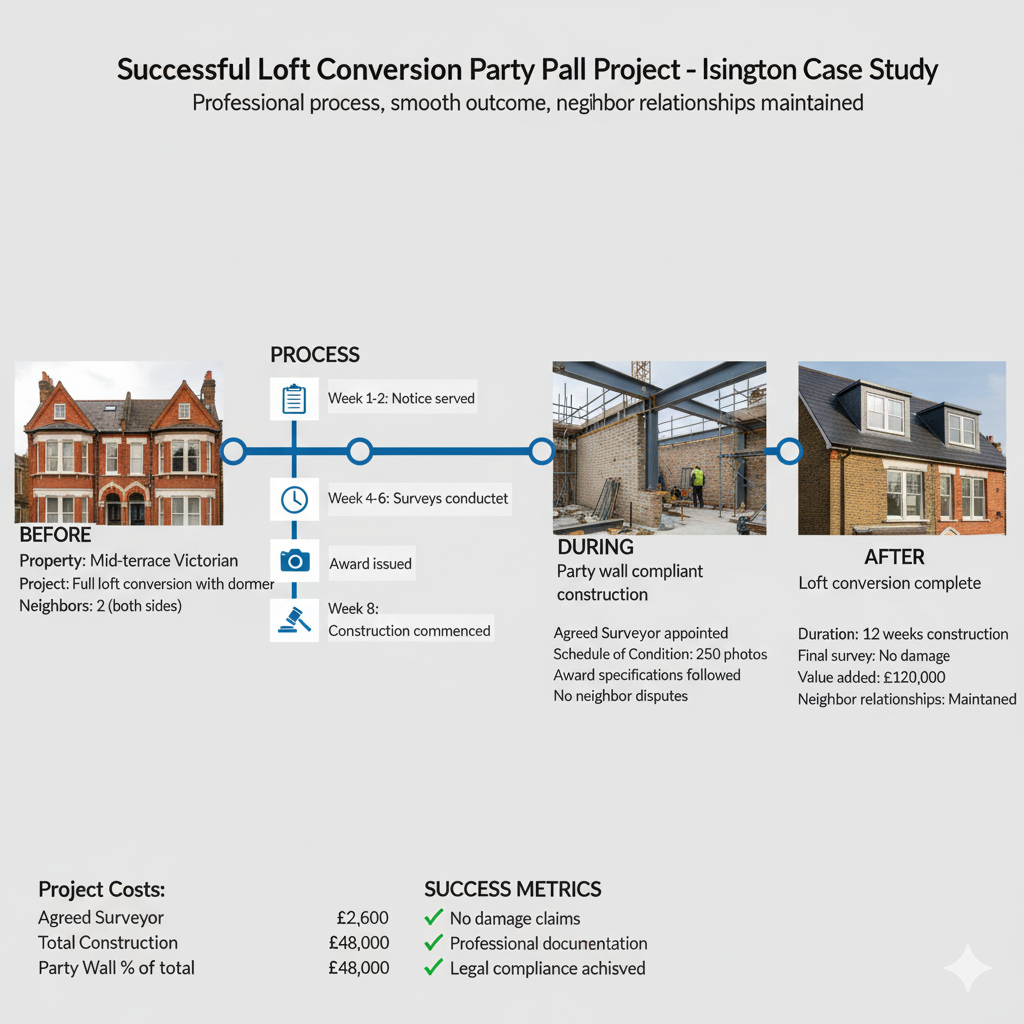
Case Study 1: Islington Victorian Terrace
Property: Mid-terrace Victorian house, Canonbury, N1 Project: Full loft conversion with dormer, creating 2 bedrooms and bathroom Party Wall Challenge: Two neighbors, conservation area requirements
Process: Served Section 2 notices 10 weeks before desired construction start. Both neighbors didn’t respond (deemed dissent). We acted as Agreed Surveyor for both parties.
Schedule of Condition surveys revealed left neighbor’s property had significant pre-existing cracks from historical settlement. Detailed photographic documentation crucial. Right neighbor’s property in excellent condition.
Party Wall Award specified:
- Steel beam insertion methodology (4 beams bearing into party walls)
- Party wall raising by 450mm for head height
- Working hours 8am-5pm Monday-Friday (no weekend work in residential area)
- Vibration monitoring for left neighbor due to pre-existing cracks
- Enhanced dust suppression due to conservation area
Timeline:
- Week 1-2: Notices served
- Week 3: Deemed dissent
- Week 4: Agreed Surveyor appointed
- Week 5-6: Schedule of Condition surveys
- Week 7-8: Award preparation
- Week 9: Award served
- Week 11: Construction commenced
Costs:
- Agreed Surveyor (both neighbors): £2,600
- Crack monitoring equipment: £180
- Total party wall costs: £2,780
Outcome: Loft conversion completed in 12 weeks. Final surveys showed left neighbor’s monitoring cracks had moved less than 1mm (within tolerance). No damage to right neighbor. Both neighbors satisfied with professional process. Client gained two bedrooms adding estimated £120,000 property value.
Key Lesson: Comprehensive documentation of pre-existing issues protected building owner from liability for historic damage. Conservation area requirements extended timeline by 2 weeks but ensured heritage compliance.
Case Study 2: Wandsworth Semi-Detached
Property: 1930s semi-detached house, Southfields, SW18 Project: Loft conversion creating master bedroom suite Party Wall Challenge: Independent roof structures, minimal party wall impact
Process: Structural engineer initially specified no party wall work required as roof trusses were independent. However, during design development, one steel beam was added bearing into party wall for Building Regulations compliance.
This single beam bearing triggered full Section 2 notice requirements. Served notice explaining minimal impact (one beam, 200mm bearing only).
Neighbor concerned despite minimal work. Appointed their own surveyor (two-surveyor scenario).
Negotiation: Two surveyors coordinated efficiently. Neighbor’s surveyor confirmed minimal impact after review of structural calculations. Schedule of Condition showed no pre-existing issues.
Award very straightforward given limited party wall work. Specified single beam installation methodology, working hours, and basic protections.
Timeline:
- Week 1-2: Notices served (after structural design change)
- Week 3-4: Neighbor appointed separate surveyor
- Week 5: Schedules of Condition
- Week 6-7: Award preparation and coordination
- Week 8: Award served
- Week 10: Construction commenced
Costs:
- Building owner’s surveyor: £1,600
- Neighbor’s surveyor (client paid): £1,400
- Total party wall costs: £3,000
Outcome: Despite limited party wall work, full procedures required. Two-surveyor route increased costs but provided neighbor reassurance. Loft conversion completed without issues. Final survey showed zero impact on neighbor’s property.
Key Lesson: Even minimal party wall work triggers full procedural requirements. Early structural design finalization prevents late-stage party wall discoveries that extend timelines.
Case Study 3: Camden Converted Building
Property: Flat in converted Victorian house, Kentish Town, NW5 Project: Loft conversion above top-floor flat Party Wall Challenge: Complex ownership (freeholder, leaseholder, other flat owners), management company involvement
Process: Client owned top-floor flat with loft space above. Freeholder owned the building freehold. Two other flats below.
Party wall notices required to:
- Freeholder (technically the “adjoining owner” under the Act)
- Other flat owners (as work affects building structure)
- Management company (for lease compliance, separate from Party Wall Act)
Served Section 2 notices to all parties explaining work scope. Freeholder appointed surveyor. Other flat owners didn’t respond (deemed dissent)—we appointed surveyor on their behalf.
Management company required separate architectural review and approval beyond party wall procedures.
Complications: Freeholder’s surveyor raised concerns about:
- Building insurance implications
- Structural changes to building
- Precedent for other flat owners
- Long-term building maintenance
Extended negotiations resulted in comprehensive Award addressing all concerns:
- Detailed structural specifications
- Building insurance coordination
- Acoustic performance between flats
- Future maintenance responsibilities
- Waterproofing guarantees
Timeline:
- Week 1-2: Notices served to multiple parties
- Week 3-5: Surveyor appointments and management company approval
- Week 6-8: Extended Schedule of Condition surveys (multiple properties)
- Week 9-13: Complex Award negotiations
- Week 14: Award finally served
- Week 16: Construction commenced
Costs:
- Building owner’s surveyor: £3,400
- Freeholder’s surveyor (client paid): £2,800
- Other flat owners’ surveyor (client paid): £2,200
- Management company fees: £450
- Total party wall and approval costs: £8,850
Outcome: Complex but successful. Loft conversion completed. All structural concerns addressed. Freeholder relationship maintained. Final surveys showed no impact on building or other flats.
Key Lesson: Converted buildings involve multiple stakeholders beyond typical party wall scenarios. Budget significantly more time (14-16 weeks) and costs for complex ownership structures. Management company processes run parallel to party wall procedures—both required.
Legal Requirements and Compliance
Statutory Framework
Party Wall etc. Act 1996: Governs all party wall matters in England and Wales. Key provisions for loft conversions:
Section 2 (Party Structure Work): Primary section covering loft conversion party wall work. Requires:
- Two months’ written notice before commencing
- Specific work description with drawings
- Proposed start date
- Statement of adjoining owner’s rights
Mandatory Compliance: Non-compliance isn’t optional. Proceeding without proper party wall procedures exposes you to:
Legal Consequences:
- Injunctions halting work immediately
- Legal costs £10,000-£25,000+
- Full liability for any neighbor property damage
- Potential criminal trespass (if accessing neighbor’s property without permission)
- Property sale complications (solicitors require party wall compliance documentation)
Building Control Requirements: Separate from party wall compliance. You need:
- Building Regulations approval (plans approved before work starts)
- Party Wall compliance (notices served, Award obtained)
- Planning permission (if required for external changes)
All three are independent—satisfying one doesn’t satisfy the others.
Rights and Obligations
Building Owner Rights:
- Undertake reasonable building work
- Serve party wall notices for necessary structural work
- Appoint surveyors to prepare Awards
- Access neighbor’s property for surveys (with reasonable notice)
- Proceed with work per Award terms even if neighbor objects
Building Owner Obligations:
- Serve proper notices with required content
- Pay all reasonable party wall surveyor fees (yours and neighbor’s)
- Follow Award specifications precisely
- Minimize inconvenience to neighbors
- Compensate for any damage caused by your work
- Complete work in reasonable timeframe
- Allow surveyor inspections
Adjoining Owner Rights:
- Receive proper advance notice of work
- Appoint own surveyor (at building owner’s expense)
- Independent professional advice and representation
- Schedule of Condition surveys protecting their interests
- Object to work methodology (surveyor arbitrates)
- Compensation for any damage
- Legal enforcement if building owner doesn’t comply
Adjoining Owner Obligations:
- Respond to notices within 14 days (or deemed dissent applies)
- Provide reasonable access for surveys
- Allow necessary access for work (if specified in Award)
- Not unreasonably obstruct building owner’s rights
- Respect Award terms once issued
Time Limits and Deadlines
Notice Periods:
- Section 2 (party structure): 2 months minimum
- Section 1 (new wall at boundary): 1 month minimum
- Section 6 (excavation): 1 month minimum (or longer if later start specified)
Response Deadline:
- Adjoining owner: 14 days from notice service to consent or dissent
- After 14 days: Deemed dissent automatically applies
Award Appeal:
- 14 days from Award service to appeal to County Court
- Appeals very rare (under 2% of cases)
Surveyor Appointment:
- If neighbor doesn’t appoint within 10 days of dissent, building owner can appoint on their behalf
Dispute Resolution
Informal Resolution (Preferred): Professional party wall surveyors resolve 97% of disputes through:
- Clear communication
- Technical expertise
- Fair negotiation
- Reasonable compromise
Third Surveyor (If Two Surveyors Disagree): Appointed jointly by the two surveyors. Makes binding determinations if they can’t agree. Rare—required in under 3% of cases.
County Court Appeals: Final recourse for unresolved disputes. Court can:
- Vary or overturn Awards
- Determine disputed issues
- Award costs
Practical Reality: Court appeals are extremely rare in well-managed party wall cases. Professional surveyors prevent disputes reaching this stage.
Expert Tips for Smooth Party Wall Processes
Before Serving Notices
1. Finalize Structural Design: Don’t serve notices until structural engineer’s drawings are final. Late design changes requiring different party wall work mean re-serving notices, restarting the 2-month countdown—delaying projects by 8-12 weeks.
2. Conduct Informal Neighbor Conversations: Five minutes explaining your project before formal notices transforms the process:
- Reduces resistance and formal dissent
- Increases Agreed Surveyor appointment likelihood (saving £2,000-£5,000)
- Maintains good relationships
- Prevents misunderstandings
3. Verify Ownership: For rental properties, identify freeholders through Land Registry searches (£3 online). Serving notices to tenants wastes time—you must reach property owners.
4. Choose Surveyor Before Notices: Having your surveyor prepared means faster response when deemed dissent occurs after 14 days.
During the Process
5. Maintain Communication: Regular updates to neighbors about process progress prevents them feeling excluded or worried about what’s happening.
6. Respond Promptly: When surveyors request information, access, or clarification, respond within 24-48 hours. Delays in your responses extend overall timeline.
7. Provide Clear Documentation: Give surveyors comprehensive, accurate structural drawings. Poor documentation causes delays while engineers revise plans.
8. Schedule Flexibility: Allow flexible scheduling for Schedule of Condition surveys. Accommodating neighbor availability speeds the process.
During Construction
9. Brief Builders Thoroughly: Ensure contractors understand:
- Party Wall Award requirements
- Working hour restrictions
- Party wall protection requirements
- Surveyor inspection expectations
- Neighbor consideration expectations
10. Monitor Compliance: Regularly verify your builders are following Award terms. Non-compliance creates problems requiring surveyor intervention and delays.
11. Maintain Site Standards: Keep shared access clean, control dust, minimize noise, respect working hours. Professional site management maintains neighbor goodwill.
12. Communication Protocols: Provide neighbors with site manager contact number for any concerns. Responsive communication prevents minor issues escalating.
Avoiding Common Mistakes
❌ Don’t: Start work before Award issued and 14-day appeal period expired ✓ Do: Wait for legal clearance even if timeline is tight
❌ Don’t: Assume neighbor silence means approval ✓ Do: Understand deemed dissent is normal and proceed with surveyor appointments
❌ Don’t: Choose surveyors based solely on lowest price ✓ Do: Select qualified, experienced London loft conversion specialists
❌ Don’t: Skip Schedule of Condition surveys even with neighbor consent ✓ Do: Always document baseline property condition for protection
❌ Don’t: Proceed if structural complications discovered during work ✓ Do: Stop immediately, contact surveyor, obtain technical assessment and Award variation
❌ Don’t: Ignore neighbor concerns or complaints during construction ✓ Do: Address issues promptly through surveyor if needed
Frequently Asked Questions
Q: Do all London loft conversions require party wall notices? A: No, but approximately 78% do. Loft conversions require notices if steel beams bear into party walls, party walls are raised for head height, or shared chimney stacks are affected. Only loft conversions with completely independent structures avoiding party walls don’t require notices—this is uncommon in terraced and semi-detached properties.
Q: How long does the loft conversion party wall process take? A: Minimum 10-12 weeks from serving notices to construction commencement for straightforward cases with Agreed Surveyor. Allow 12-16 weeks for:
- Two-surveyor scenarios
- Multiple neighbors
- Complex conversions
- Conservation areas
- Discovered complications
Q: What do loft conversion party wall procedures cost in London? A: Typical costs:
- Agreed Surveyor (mid-terrace, 2 neighbors): £2,200-£3,200
- Agreed Surveyor (semi-detached, 1 neighbor): £1,800-£2,600
- Two surveyors (per neighbor): £3,800-£6,700
- Inner London runs 20-30% higher, Outer London 10-15% lower
Q: Can I serve party wall notices myself without a surveyor? A: Yes for notice service, but professional involvement is recommended because:
- 90%+ of neighbors dissent or don’t respond, requiring mandatory surveyor appointment
- Self-prepared notices often contain technical errors
- Once dissent occurs, surveyors become mandatory anyway
Most homeowners find professional involvement from the start more efficient and economical.
Q: What happens if my neighbor doesn’t respond to notices? A: After 14 days of non-response, “deemed dissent” automatically applies. This is normal (occurs in 75-80% of cases) and isn’t problematic. Simply proceed to surveyor appointments as if neighbor had formally dissented.
Q: Do I have to pay my neighbor’s surveyor fees? A: Yes, if your neighbor appoints their own surveyor (two-surveyor route). The Party Wall Act requires building owners to pay all reasonable surveyor fees. This ensures neighbors can obtain independent professional advice without financial barrier. However, fees must be “reasonable”—you can challenge genuinely excessive charges.
Q: Can my neighbor refuse consent and stop my loft conversion? A: No. Neighbors can dissent (or be deemed to dissent), but they cannot block reasonable building work. The surveyor appointment and Party Wall Award process ensures proper procedures while allowing your loft conversion to proceed. Awards are legally binding on both parties.
Q: What if structural engineers discover party wall work is worse than expected? A: Stop work immediately, contact your party wall surveyor within 24 hours, obtain structural engineer assessment, and get Award variation if work scope changes. Building owners typically bear costs of unexpected repairs needed to safely complete their work. This is why contingency budgets (10-15%) are wise.
Q: How do Schedule of Condition surveys protect me? A: Comprehensive pre-work surveys document baseline property condition with 200-400 photos and detailed written descriptions. If neighbors later claim your loft conversion caused damage, comparison with baseline surveys proves what was pre-existing vs. actually caused by your work. This protection is invaluable in Victorian/Edwardian properties with historic settlement and existing defects.
Q: Can I start my loft conversion while waiting for the Party Wall Award? A: Absolutely not. You must wait until:
- Party Wall Award is issued
- 14-day appeal period expires
- Any specified pre-commencement conditions are met
Starting early constitutes breach of the Party Wall Act, exposing you to injunctions, legal costs, and full damage liability.
Q: What’s the difference between Agreed Surveyor and two surveyors? A: Agreed Surveyor: Both parties jointly appoint one surveyor who acts impartially. Faster (3-4 weeks typical), more economical (£1,800-£3,200), simpler communication.
Two Surveyors: Each party appoints their own. Slower (4-6 weeks typical), more expensive (£3,800-£6,700 per neighbor as you pay both), but provides independent representation for each side.
Agreed Surveyor suits straightforward loft conversions with amicable relationships. Two surveyors appropriate for complex projects, high-value properties, or situations with existing tensions.
Q: Do conservation areas affect party wall requirements? A: Conservation area designation doesn’t change Party Wall Act requirements—same procedures apply. However, conservation adds parallel requirements:
- Planning permission with heritage considerations
- Material matching specifications
- Enhanced methodology documentation
- Timeline extensions of 2-4 weeks typical
Both planning/conservation compliance AND party wall compliance are required independently.
Q: What if I’ve already started my loft conversion without party wall procedures? A: Stop work immediately. You’re in breach of the Party Wall Act. Options:
- Serve retrospective notices (treated as if work hasn’t started)
- Follow full party wall process from beginning
- Accept you may face neighbor injunctions, legal costs, and liability for any damage
Costs of retrospective compliance plus potential legal costs typically exceed 3-5x what proper advance procedures would have cost. Never start without party wall compliance.
Professional Party Wall Surveyor Services for London Loft Conversions
Expert Pyramus and Thisbe Club-Accredited Surveyors
We provide specialist party wall surveyor services for loft conversions across all 33 London boroughs with over 20 years of experience managing hundreds of successful loft conversion party wall matters.
Our Services:
Initial Consultation:
- Free preliminary assessment
- Confirmation of party wall requirements
- Timeline and process explanation
- Fixed-fee quotation
- Advice on neighbor communication
Notice Preparation & Service:
- Legally compliant notice drafting
- Comprehensive supporting documentation
- Proper service with proof of delivery
- Follow-up on responses
- Deemed dissent management
Surveyor Representation:
- Agreed Surveyor appointments
- Building owner representation in two-surveyor scenarios
- Professional coordination with adjoining owners’ surveyors
- Third Surveyor selection if required
Schedule of Condition Surveys:
- Comprehensive photographic documentation (200-400 photos)
- Detailed written condition reports
- Pre-existing defect identification
- Baseline establishment for post-work comparison
- Professional presentation to all parties
Party Wall Award Preparation:
- Technical specifications for loft conversion work
- Working methodology and safety requirements
- Rights and obligations documentation
- Access and working hours provisions
- Insurance and liability clarity
- Dispute resolution procedures
Construction Phase Support:
- Periodic site monitoring visits
- Compliance verification
- Issue resolution
- Neighbor communication facilitation
- Emergency response if complications arise
Completion Services:
- Final Schedule of Condition surveys
- Before/after comparison documentation
- Damage assessment if required
- Repair specifications if needed
- Award closure and certification
London-Wide Coverage
All 33 London Boroughs: City of London, Westminster, Kensington & Chelsea, Hammersmith & Fulham, Wandsworth, Lambeth, Southwark, Tower Hamlets, Hackney, Islington, Camden, Brent, Ealing, Hounslow, Richmond, Kingston, Merton, Sutton, Croydon, Bromley, Lewisham, Greenwich, Bexley, Havering, Barking & Dagenham, Redbridge, Newham, Waltham Forest, Haringey, Enfield, Barnet, Harrow, Hillingdon.
© 2025 [Your Company Name]. All rights reserved.