
Do I Need a Party Wall Agreement for My Extension? Complete UK Guide
Understanding Party Wall Requirements for Extensions
Planning a home extension is exciting—adding space, increasing value, and enhancing your property. But 68% of UK homeowners planning extensions are unaware of party wall requirements until their builder or architect mentions them, often causing confusion and concern about delays and costs.
The Simple Truth: Whether your extension needs a party wall agreement depends on three specific factors: proximity to boundaries, excavation depth near neighbors, and any work affecting existing shared structures. Understanding these triggers helps you plan accurately and avoid legal complications.
Why This Matters:
- Legal compliance: Party Wall etc. Act 1996 is mandatory law in England and Wales
- Project timeline: Party wall procedures add 6-12 weeks to your pre-construction schedule
- Budget impact: Costs range from £1,000-£2,500 for typical single-story extensions
- Neighbor relations: Proper procedures maintain good relationships and prevent disputes
- Property value protection: Non-compliance creates problems when selling
This guide provides definitive answers about when extensions require party wall agreements, what the process involves, realistic costs, and how to navigate procedures smoothly. Whether you’re planning a single-story rear extension, two-story side extension, or wrap-around project, you’ll know exactly what’s required.
Quick Answer: When Extensions Need Party Wall Agreements
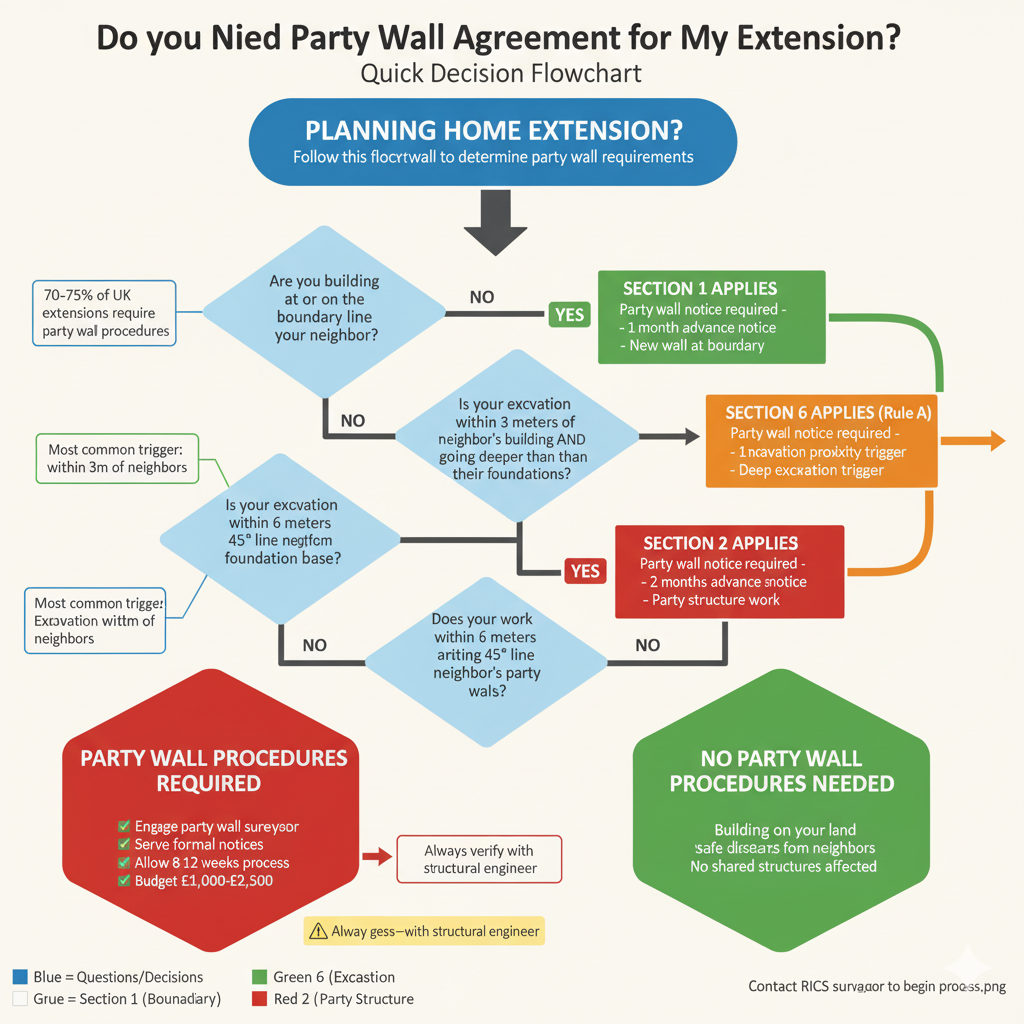
Your extension requires party wall procedures if ANY of these apply:
✓ Building at or on the boundary line between your property and your neighbor’s ✓ Excavating within 3 meters of your neighbor’s building AND going deeper than their foundations ✓ Excavating within 6 meters of your neighbor’s building AND cutting a 45-degree line from their foundation base ✓ Work affects existing party walls (rare for typical extensions, more common in conversions)
Your extension does NOT need party wall procedures if: ✗ Building entirely on your land with no boundary work ✗ Foundations at same or shallower depth than neighbor’s ✗ Excavation more than 6 meters from all neighboring buildings ✗ No work to any shared structures
Reality Check: In typical UK suburban settings with properties 3-5 meters apart, approximately 70-75% of rear and side extensions trigger party wall requirements due to excavation proximity, even when the extension itself doesn’t touch boundaries.
The Three Key Triggers for Party Wall Notices
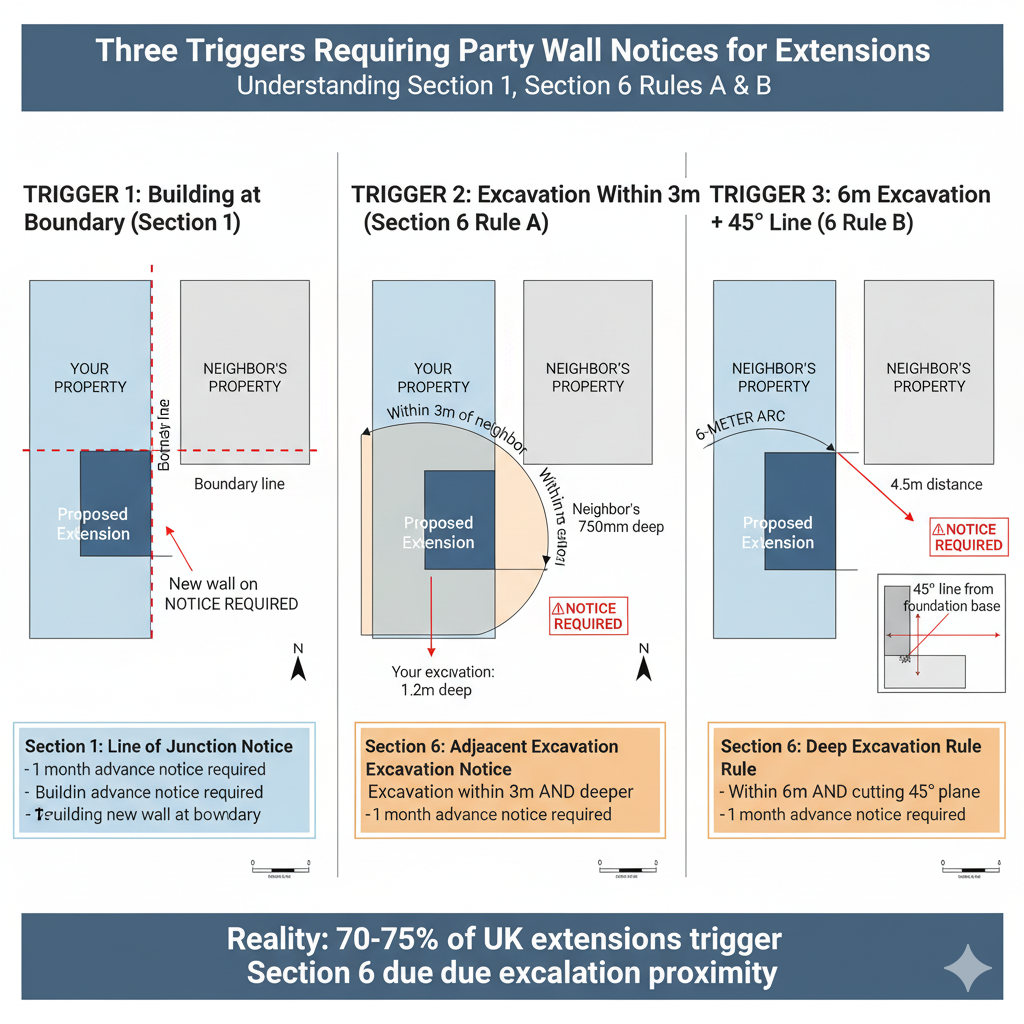
The Party Wall etc. Act 1996 specifies three distinct types of work requiring notices. Understanding which applies to your extension is crucial.
Trigger 1: Building on or at the Boundary (Section 1)
What This Covers: Constructing new walls on the boundary line between properties or building up to the boundary.
Extension Relevance: Less common for typical extensions but applies when:
- Side extensions built directly on the boundary line
- New garden walls at boundaries incorporated into extension design
- Garage conversions where existing boundary walls become part of the structure
Example Scenario: You’re building a single-story side extension, and your architect designs a new wall directly on the boundary line with your neighbor. This triggers Section 1 requirements.
Notice Period: One month before work commences
What You Can Build:
- A wall straddling the boundary (party fence wall)
- A wall entirely on your land at the boundary (with foundation on your side)
Your Neighbor’s Rights: They can require the wall be built as a party fence wall (shared) or entirely on your land, and can contribute to costs if they later benefit from it.
Trigger 2: Excavation Within 3-6 Meters (Section 6)
What This Covers: Digging foundations or excavating near neighboring buildings within specified distances and depths.
This is THE MOST COMMON trigger for extension party wall requirements.
Two Distance/Depth Rules:
Rule A: Within 3 Meters AND Going Deeper If your excavation is within 3 meters of your neighbor’s building AND you’re digging deeper than their foundation base, you must serve notice.
Typical Scenario:
- Your neighbor’s house is 2.5 meters from your boundary
- Their foundations are 750mm deep
- Your extension requires 1.2m deep foundations (standard for Building Regulations)
- Result: Party wall notice required
Rule B: Within 6 Meters AND Cutting 45-Degree Line If excavating within 6 meters and a 45-degree line drawn downward from your neighbor’s foundation base would be intersected by your excavation, notice required.
Typical Scenario:
- Neighbor’s property is 4.5 meters away
- Their foundations are 900mm deep
- Your excavation is 1.8m deep
- Drawing a 45-degree line from their foundation base: it reaches approximately 1.8m depth at 4.5m horizontal distance
- Result: Your excavation cuts this line, notice required
Why This Matters for Extensions: Modern Building Regulations typically require foundations 900mm-1200mm+ deep. Many existing properties (especially Victorian/Edwardian and 1930s houses) have shallower foundations (600-800mm). This depth difference triggers Section 6 requirements even when your extension is entirely on your land, not touching boundaries.
Notice Period: One month before excavation work commences
Trigger 3: Work to Existing Party Walls (Section 2)
What This Covers: Structural work affecting existing shared walls between properties.
Extension Relevance: Less common for new extensions but applies when:
- Extension connects to an existing party wall requiring cutting, insertion, or modification
- Removing part of an existing party wall to create access
- Underpinning existing party walls as part of extension work
- Raising existing party walls (rare for typical extensions)
Example Scenario: You’re extending and need to cut into an existing party wall to insert steel beams connecting old and new structures, or to create doorway access.
Notice Period: Two months before work commences
Typical Extension Reality: Most standard rear and side extensions don’t involve Section 2 work—they’re built as separate structures that may abut but don’t structurally modify existing party walls. Section 6 (excavation) is far more commonly triggered.
Common Extension Scenarios: Do You Need an Agreement?
Let’s examine typical extension projects and their party wall requirements:
Single-Story Rear Extension (Most Common)
Typical Dimensions: 3-4 meters deep, full width of property
Party Wall Assessment:
- Building position: Usually entirely on your land, not at boundaries
- Excavation depth: Typically 1.0-1.2m deep for foundations
- Distance to neighbors: Semi-detached (one neighbor 0-3m away) or terraced (neighbors both sides, typically 0-5m away from rear of their properties)
Verdict: Usually YES—Section 6 excavation notice required
Why: Even though the extension itself doesn’t touch boundaries, excavation for foundations typically occurs within 3 meters of neighboring properties at depths greater than existing foundations.
Typical scenario: Your semi-detached property shares one party wall. You’re building a rear extension entirely on your land. However, you’re excavating 1.2m deep within 2 meters of your neighbor’s rear wall. Their foundations are only 750mm deep. Section 6 notice required.
Two-Story Rear Extension
Party Wall Assessment: Similar to single-story but often with:
- Deeper foundations due to increased load (1.2-1.5m typical)
- Greater likelihood of triggering Section 6 due to increased depth
- Potential for affecting multiple neighbors (rear and sides)
Verdict: Almost always YES—Section 6 notice required, possibly to multiple neighbors
Side Extension (Single or Two-Story)
Party Wall Assessment:
- Semi-detached properties: Often built close to side boundary
- Detached properties: More flexibility, may avoid triggers
- May involve building at boundary if maximizing plot
Verdict: Depends on specific design
- Building at boundary: Section 1 notice required
- Excavation within 3-6m of neighbor: Section 6 notice required
- Building well away from boundaries with shallow foundations: May not require notices
Wrap-Around Extension (L-Shaped)
Party Wall Assessment: Combines rear and side extension considerations. Often affects:
- Neighbor to side (excavation proximity)
- Neighbor to rear (excavation proximity)
- Potentially corner neighbor (if close enough)
Verdict: Usually YES—often requiring notices to 2-3 neighbors
Garage Conversion with Extension
Party Wall Assessment:
- Converting existing garage: Usually no party wall work
- Extending beyond garage footprint: Assessed as new extension
- If garage shares wall with neighbor’s garage: Potential Section 2 implications
Verdict: Variable—depends on whether extending beyond existing footprint and proximity to neighbors
Conservatory or Garden Room
Party Wall Assessment:
- Often on shallow foundations or piled (may avoid depth trigger)
- Distance from boundaries crucial
- Less substantial than traditional extensions
Verdict: Often NO if on piled foundations or within existing footprint boundaries
Modern conservatories on piled foundations (rather than traditional excavated foundations) often avoid Section 6 triggers. However, verify with structural engineer.
What is a Party Wall Agreement (Award)?
Terminology Clarification: People commonly refer to “party wall agreements,” but the legal document is technically called a Party Wall Award. It’s a binding agreement prepared by surveyors specifying how work will proceed.
What the Award Contains:
1. Work Description: Detailed specification of your extension work, including:
- Excavation depths and locations
- Foundation design and methodology
- Relationship to neighboring properties
- Construction sequencing
2. Rights and Obligations:
- Your rights to undertake the work
- Your obligations to minimize disruption and prevent damage
- Neighbor’s rights to protection and compensation if damage occurs
- Access requirements if needed
3. Working Methods:
- How excavation will be executed safely
- Protection measures for neighboring foundations
- Vibration control if using machinery
- Dust suppression requirements
4. Working Hours: Typically specifies:
- Monday-Friday: 8:00am-6:00pm
- Saturday: 8:00am-1:00pm
- No Sunday or Bank Holiday working
- (Can be negotiated based on circumstances)
5. Schedule of Condition: Attached photographic and written survey of neighbor’s property documenting existing condition before work starts. This baseline protects both parties if damage claims arise.
6. Dispute Resolution: Procedures for handling issues during construction and mechanisms for resolving disagreements.
Legal Status: Party Wall Awards are legally binding on both parties. Non-compliance can result in injunctions, legal costs, and liability for damages.
The Complete Process for Extension Party Wall Matters
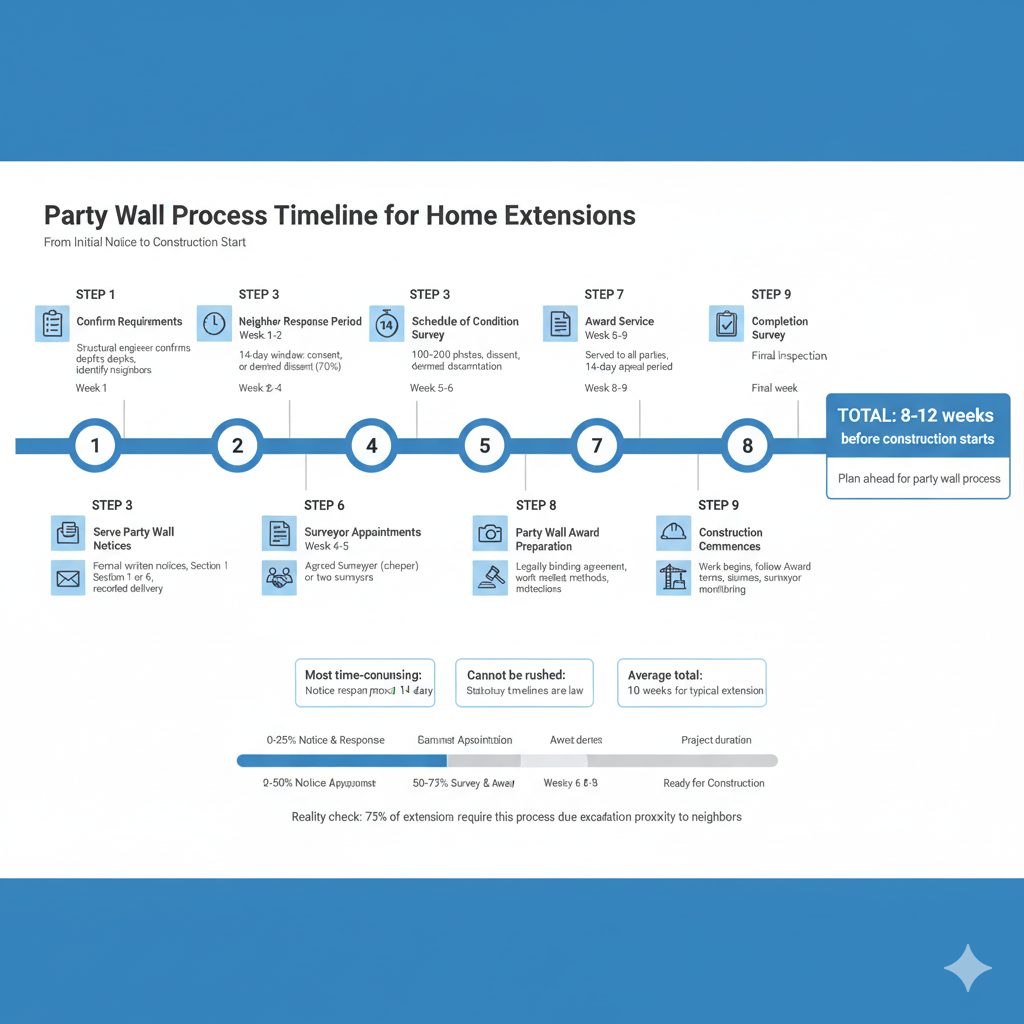
Step 1: Confirm Requirements (Week 1)
- Structural engineer confirms foundation depths and positions
- Identify which neighbors are affected
- Determine which Party Wall Act sections apply
- Engage party wall surveyor for advice
Step 2: Serve Party Wall Notices (Weeks 1-2)
- Prepare formal written notices with drawings
- Serve to all affected neighbors via recorded delivery
- Section 1: One month advance notice
- Section 6: One month advance notice
- Include description of work, start date, your details
Step 3: Neighbor Response Period (Weeks 2-4) Neighbors have 14 days to respond:
- Consent: Formal written agreement (rare, ~10% of cases)
- Dissent: Formal objection (20% of cases)
- No response: “Deemed dissent” after 14 days (70% of cases)
Step 4: Surveyor Appointments (Weeks 4-5) When dissent occurs (actual or deemed):
- Agreed Surveyor: Both parties jointly appoint one surveyor (faster, cheaper)
- Two Surveyors: Each party appoints own surveyor (more expensive, you pay both)
- Surveyors confirm appointment in writing
Step 5: Schedule of Condition Survey (Weeks 5-6) Surveyor inspects neighboring property:
- Photographic documentation (100-200 photos typical)
- Written condition report
- Documents all existing defects
- Creates baseline for post-work comparison
Step 6: Party Wall Award Preparation (Weeks 6-8) Surveyor(s) prepare Award:
- Review structural plans and methodology
- Specify working methods and protections
- Include Schedule of Condition
- Set out rights, obligations, and procedures
Step 7: Award Service and Commencement (Week 8-9)
- Award served to all parties
- 14-day appeal period (appeals very rare)
- After period expires, work can legally commence
- Provide Award copy to builder
Step 8: Construction (Project Duration)
- Follow Award terms precisely
- Surveyor may conduct monitoring visits
- Maintain communication with neighbors
- Document any issues immediately
Step 9: Completion Survey (Final Week)
- Final condition survey of neighbor’s property
- Compare to baseline documentation
- Assess any damage (if occurred)
- Specify repairs if needed
- Close out Award
Typical Timeline: 8-12 weeks from serving notices to construction commencement
Costs: What to Budget for Party Wall Procedures
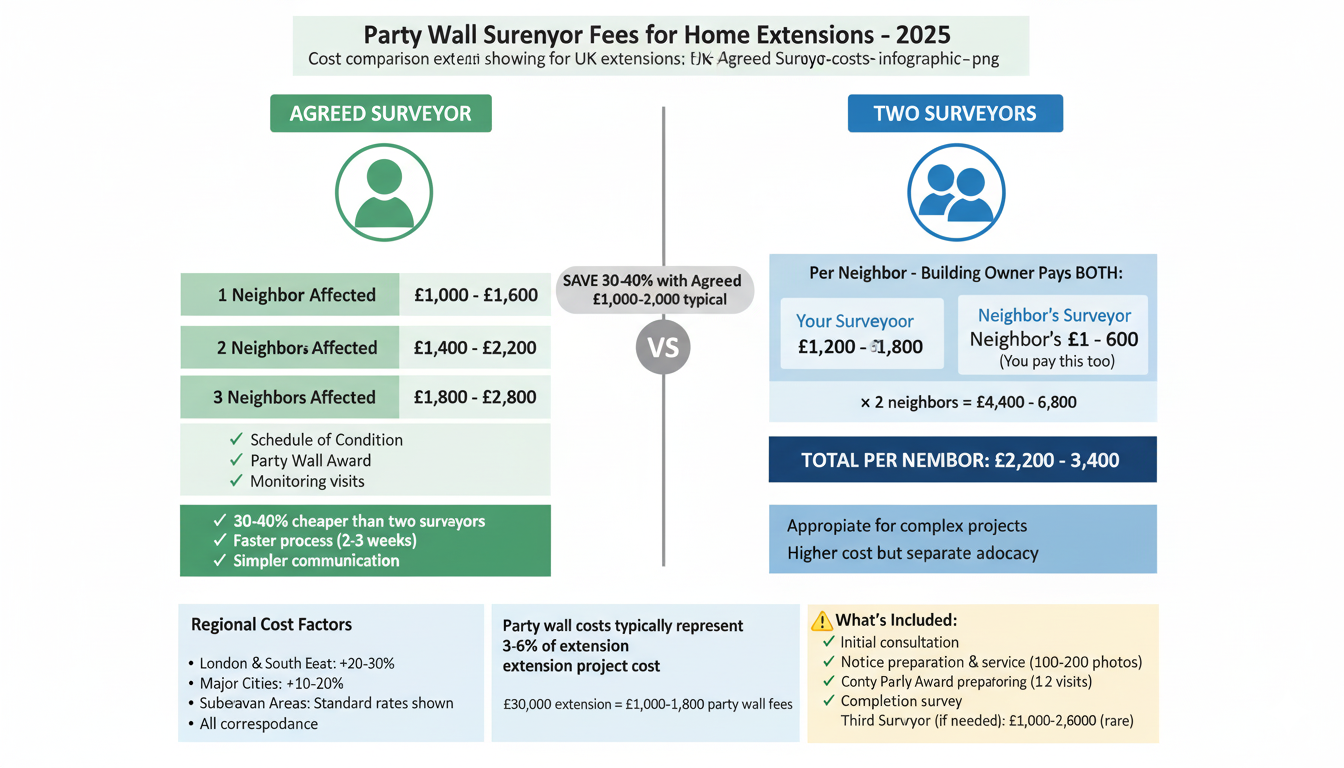
Surveyor Fees (Your Responsibility):
Agreed Surveyor Route (Single Surveyor for All Parties):
- Single neighbor affected: £1,000-£1,600
- Two neighbors affected: £1,400-£2,200
- Three neighbors affected: £1,800-£2,800
Two-Surveyor Route (Separate Surveyors):
- Your surveyor: £1,200-£1,800 per neighbor
- Neighbor’s surveyor (you pay): £1,000-£1,600 per neighbor
- Total per neighbor: £2,200-£3,400
What’s Included:
- Notice preparation and service
- Schedule of Condition surveys
- Party Wall Award preparation
- Construction monitoring (1-2 site visits typically)
- Completion survey
- All correspondence and administration
Regional Variations:
- London and South East: 20-30% above these figures
- Major cities: 10-20% above
- Suburban and rural areas: At or below these ranges
Additional Potential Costs:
Damage Repairs (If Your Work Causes Damage):
- Minor cosmetic: £200-£800
- Significant replastering: £800-£2,500
- Structural repairs: £2,000-£10,000+ (rare with proper procedures)
Third Surveyor (If Two Surveyors Disagree):
- Rare (under 3% of cases)
- Fees: £1,000-£2,000
- Usually shared between disputing parties
Cost as Percentage of Extension:
- Typical single-story rear extension: £25,000-£40,000
- Party wall costs: £1,000-£2,500
- Percentage: 3-6% of total project cost
This is essential legal compliance and insurance against problems costing far more.
What Happens If You Don’t Get an Agreement?
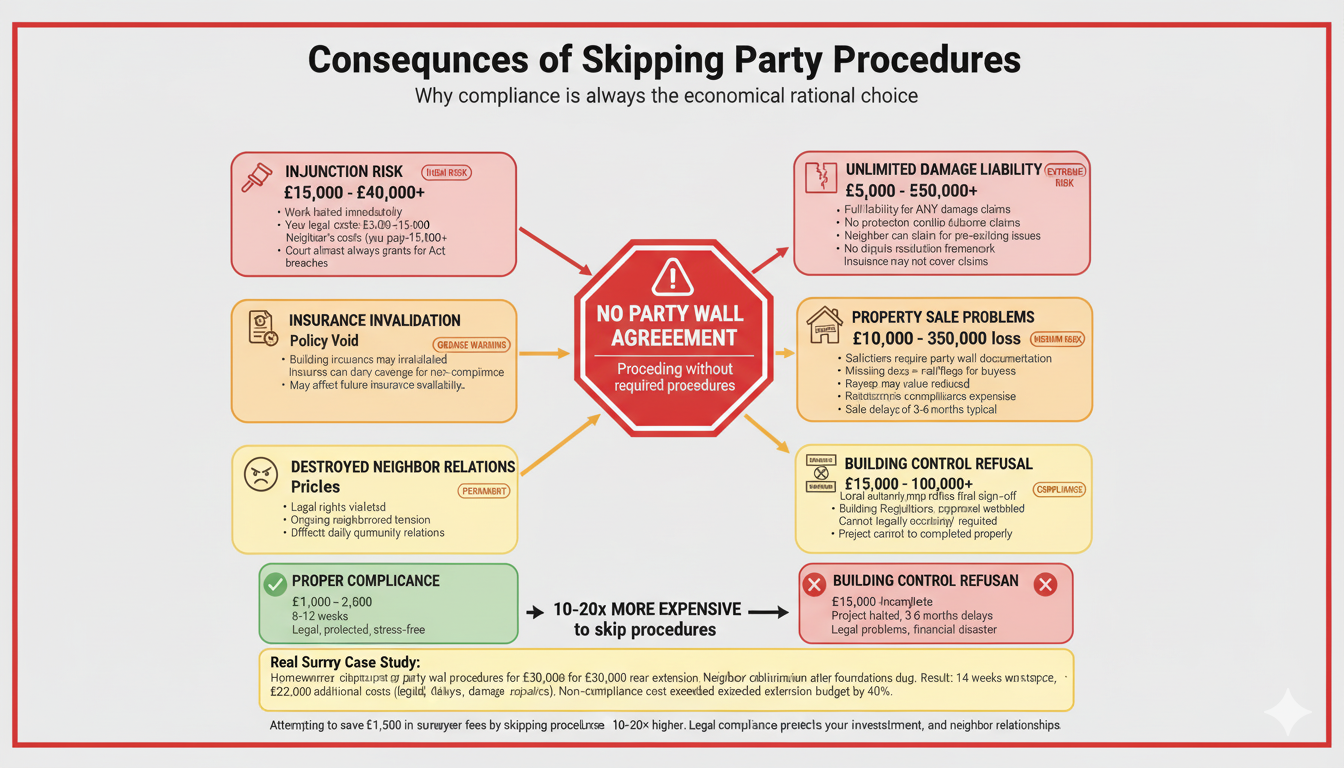
Legal Consequences: Proceeding without required party wall procedures exposes you to:
1. Neighbor Injunctions: Your neighbor can obtain County Court injunction immediately halting your work. Court will almost always grant these for clear Party Wall Act breaches.
Cost Impact:
- Your legal costs: £5,000-£15,000+
- Neighbor’s legal costs (you may be ordered to pay): £5,000-£15,000+
- Builder costs for work stoppage and delay
- Total potential cost: £15,000-£40,000+
2. Unlimited Damage Liability: Without proper party wall procedures:
- You’re fully liable for ANY damage to neighbor’s property
- No protection from claims about pre-existing issues
- No agreed methodology for dispute resolution
- Neighbor can claim for damage that may not be your fault
3. Insurance Complications:
- Building insurance may be invalidated
- Damage claims may not be covered
- Insurers can refuse claims for work done without legal compliance
4. Property Sale Problems: When selling, solicitors ask for party wall documentation:
- Missing documentation raises red flags
- Buyers may withdraw
- Property value reduced
- Retrospective compliance expensive and time-consuming
5. Neighbor Relationship Destruction: Non-compliance shows disrespect for neighbors’ legal rights, often permanently damaging relationships and creating ongoing neighborhood tensions.
6. Building Control Issues: Local authority Building Control may refuse final sign-off without party wall compliance documentation.
Real Case Example: Homeowner in Surrey began rear extension without party wall procedures. Neighbor obtained injunction after foundations were dug. Work halted for 14 weeks while retrospective procedures completed. Additional costs: £22,000 in legal fees, surveyor fees, builder delay costs, and repairs to neighbor’s property for vibration damage. Total party wall non-compliance cost exceeded the extension budget by 40%.
The Bottom Line: Saving £1,500 in surveyor fees by skipping party wall procedures risks costs 10-20x higher. Compliance is always the economically rational choice.
How to Get Started with Your Extension Party Wall Matter
Step 1: Confirm Requirements Early During design phase (before planning application):
- Discuss party wall implications with architect
- Have structural engineer specify foundation depths and positions
- Identify which neighbors will be affected
- Understand which Act sections apply
Step 2: Budget Appropriately Include in extension budget:
- Surveyor fees: £1,000-£3,000 depending on complexity
- 3-4 month pre-construction timeline for party wall process
- Contingency for potential complications
Step 3: Engage Party Wall Surveyor Choose qualified professional:
- experienced surveyor
- Experience with extension party wall matters
- Local knowledge
- Clear fee structure (request fixed-fee quote)
- Good references
Step 4: Communicate with Neighbors Before formal procedures:
- Inform neighbors of your extension plans informally
- Show them drawings
- Explain timeline
- Discuss any concerns
- This personal approach often smooths the entire process
Step 5: Begin Formal Process
- Surveyor prepares and serves notices
- Follow process as outlined earlier
- Maintain communication throughout
- Be patient with statutory timelines
Step 6: Coordinate with Other Approvals Remember party wall is separate from:
- Planning permission
- Building Regulations approval
- Other consents
All must be satisfied independently. Party wall procedures can run parallel to planning/Building Regs but must be complete before construction starts.
Timeline Planning:
- Begin party wall procedures 3-4 months before desired construction start
- Don’t schedule builders until Party Wall Award issued and appeal period expired
- Build 2-week contingency into construction scheduling
Frequently Asked Questions
Q: My extension is entirely on my land—do I still need party wall procedures? A: Possibly yes. If your foundation excavation is within 3-6 meters of neighboring buildings and deeper than their foundations, Section 6 applies even though your extension doesn’t touch boundaries. This affects 70-75% of typical rear extensions.
Q: How long does the party wall process take? A: Minimum 8-10 weeks from serving notices to construction commencement. Allow 10-12 weeks for typical cases, longer if complications arise or multiple neighbors involved.
Q: Can my neighbor refuse and stop my extension? A: No. Neighbors cannot block reasonable building work. They can dissent (triggering surveyor processes), but Party Wall Awards allow your work to proceed with proper protections for both parties.
Q: What if my neighbor doesn’t respond to the notice? A: After 14 days of non-response, “deemed dissent” automatically applies. This is normal (happens in 70% of cases) and isn’t problematic—simply proceed to surveyor appointment stage.
Q: Do I have to pay my neighbor’s surveyor fees? A: Yes, if they appoint their own surveyor (two-surveyor route). The Party Wall Act requires building owners to pay reasonable fees for all surveyors. This ensures neighbors can obtain professional advice without financial barrier.
Q: What if I’ve already started my extension without party wall procedures? A: Stop work immediately. You’re in breach of the Act. Serve retrospective notices and follow full procedures. You face significant risk of injunction and liability. Costs of retrospective compliance plus potential legal fees typically exceed 2-3x what proper advance procedures would have cost.
Q: Does planning permission include party wall matters? A: No. Planning permission and party wall procedures are completely separate. Planning permission addresses land use and appearance. Party Wall Act addresses structural protection for neighbors. Both must be satisfied independently.
Q: Can I avoid party wall procedures by designing foundations differently? A: Sometimes. Discuss with structural engineer:
- Shallower foundations (if structurally adequate)
- Piled foundations (may avoid excavation depth triggers)
- Modified extension footprint
However, structural requirements often limit flexibility. Don’t compromise structural integrity to avoid party wall costs—the savings aren’t worth the risk.
Q: What happens if my work damages my neighbor’s property? A: With proper party wall procedures:
- Schedule of Condition surveys provide baseline
- Award specifies damage resolution process
- Surveyor assesses damage and determines responsibility
- Repairs specified and you pay for damage caused by your work
- Professional, documented process protects both parties
Without procedures: You’re liable for all claims with no documentation to prove what was pre-existing vs. what you caused.
Conclusion: Make Informed Extension Decisions
Most UK home extensions—approximately 70-75%—require party wall procedures due to excavation proximity to neighboring properties. Understanding whether your specific project triggers requirements allows accurate planning, budgeting, and scheduling.
Key Takeaways:
✓ Check three triggers: boundary building, excavation within 3-6m, work to existing party walls ✓ Budget £1,000-£2,500 for surveyor fees (3-6% of extension cost) ✓ Allow 8-12 weeks for party wall process before construction ✓ Engage party wall surveyor during design phase for early confirmation ✓ Never start work without required compliance—risks far exceed savings
Next Steps:
- Review your extension plans with structural engineer
- Identify affected neighbors
- Engage experienced party wall surveyor
- Begin procedures 3-4 months before desired construction start
- Maintain good neighbor communication throughout
Party wall procedures aren’t obstacles—they’re protective frameworks ensuring your extension proceeds legally, safely, and without damaging neighbor relations or creating future liabilities.
Need Expert Advice? Consult a qualified Pyramus and Thisbe Club party wall surveyor for assessment of your specific extension project. Most offer free initial consultations to confirm requirements and provide cost estimates.
Related Resources:
Party Wall Surveyor Havering | Expert Help Survey of Party Wall
Party Wall Surveyor Barking & Dagenham | East London Experts
Section 6 Party Wall Rules: The 3m & 6m Excavation Guide (London)
Single Storey Extension Party Wall Guide London + England and Wales